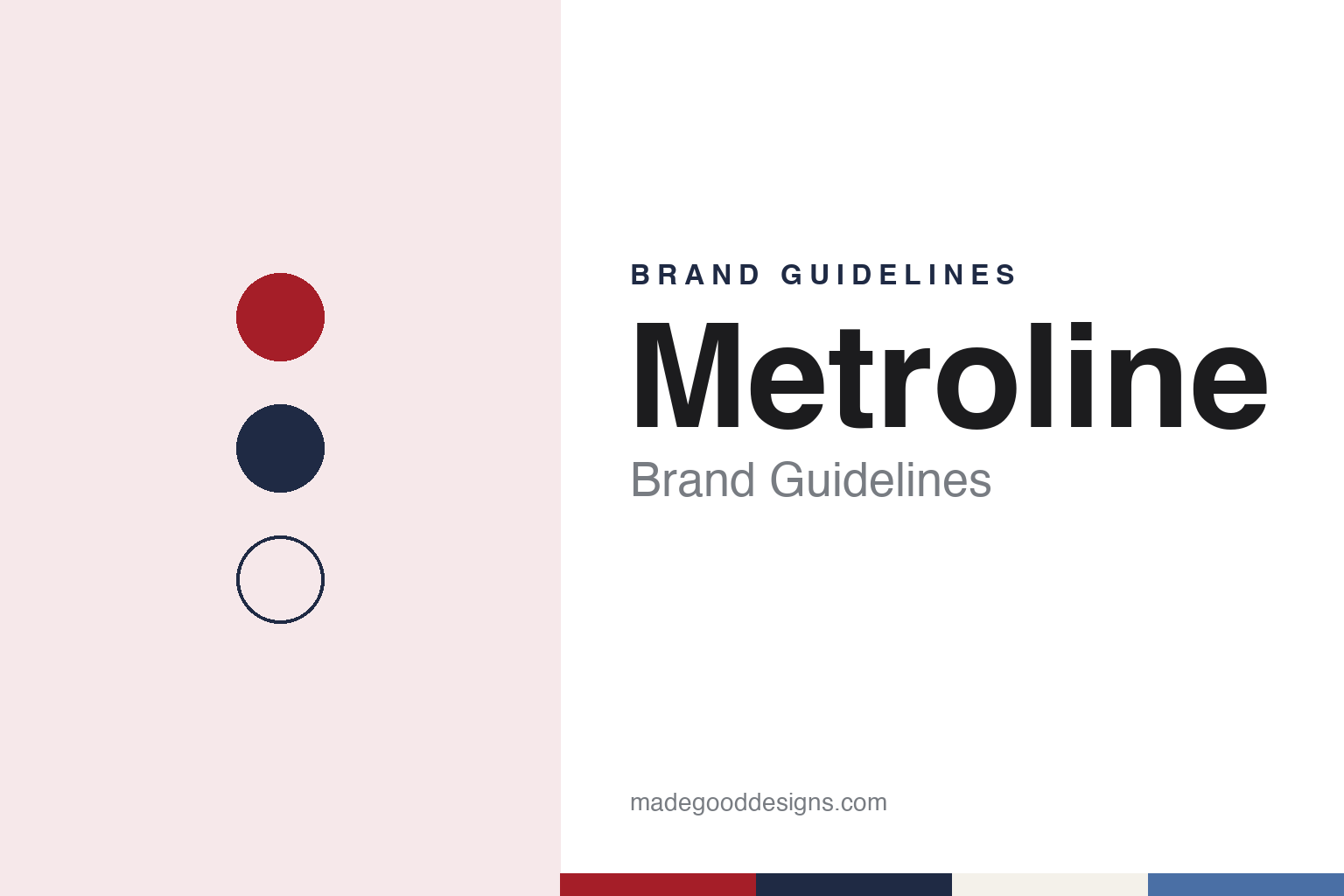
Metroline Brand Guidelines
A 1989 London Buses unit that went private, then to Singapore, then to Manchester.
Aa
Two constants: a Metroline red, deep blue and white palette and a grotesque sans register. Abstract homage — not a Metroline vehicle or mark; no bus, logo or fleet name is reproduced.
London Buses, 1989
A unit of the public bus system that went private.
Metroline began as part of London’s public bus system rather than as a private start-up. In April 1989 London Buses was divided into eleven separate business units, and one of them was named Metroline, English Wikipedia says. Its garages in north-west London were much older than the name. Cricklewood, which Wikipedia says opened in May 1905 as Dollis Hill for the London General Omnibus Company, is one of the city’s oldest bus garages, and the Willesden and Harrow Weald garages date from 1912 and 1930.
When London’s bus companies were privatised, Metroline was sold to a management buyout in October 1994. Within weeks it was growing: in December 1994 it bought Atlas Bus & Coach, which Wikipedia describes as the first expansion by a former London Buses company, and with it regained route 52. In 1998 it took over MTL London, whose Holloway and Potters Bar garages came with the purchase.
In 2000 Metroline was bought by DelGro Corporation, the Singapore parent of SBS Transit. English Wikipedia gives the month as February in its Metroline entry and as March in its ComfortDelGro entry. DelGro merged with Comfort Group on 29 March 2003 to form ComfortDelGro, which has owned Metroline ever since. The group added Thorpes and Armchair Passenger Transport in 2004, and both names gave way to Metroline in January 2007. In June 2013 Metroline bought five garages from First London, adding 494 buses, and it runs that part of the business as Metroline West.
The ownership shows at head office. Cricklewood garage was rebuilt between 2007 and 2009 and became both Metroline’s headquarters and the European headquarters of ComfortDelGro, Wikipedia says. On 26 June 2025 the company marked 25 years under ComfortDelGro with an event at the same garage.
Some of the garages it inherited have long records of their own. Holloway opened in 1907 as a London County Council tram depot with room for 336 trams, Wikipedia says, and later served trolleybuses before buses; Potters Bar opened in 1930 for an Overground subsidiary of the London General Omnibus Company.
Colour
Red buses, a deep blue skirt and contract routes.
In London, Metroline works under contract. Transport for London sets the routes and fares and operators bid to run them; under this gross-cost model the fare revenue goes to TfL, English Wikipedia’s ComfortDelGro entry explains. That arrangement has shaped how Metroline buses look more than any in-house programme. At privatisation the company used red with a dark blue skirt; the skirt turned light blue for a short spell in the mid-2000s before the dark blue returned, and in June 2009 the fleet went all red to meet TfL’s requirements, Wikipedia says. For work outside the TfL network, a blue, white and red commercial livery appeared in 2014.
The fleet is large. As of March 2025 it stood at 1,496 buses, which Wikipedia says made Metroline London’s third-largest bus operator by vehicles, run from 14 garages under two companies, Metroline Travel and Metroline West. Bus & Coach Buyer reported in January 2025 that Metroline runs 17% of London’s bus network. Several garages hold firsts, by Wikipedia’s account: Greenford was the first London garage to run a Superloop express route, when route 607 became SL8 on 15 July 2023, with buses in a red and white livery carrying a route map on each side; Perivale is home to Wright StreetDeck Hydroliner double-deckers, the first of the type to run in England; and Willesden took five BYD battery-electric double-deckers for trial on route 98 in March 2016.
Typography
Liveries, maps and ticketing.
Bus and coach operators present themselves first on the street. The vehicle carries the name, the colours and often a local or route brand, and liveries change gradually as buses are repainted or replaced. A group name can sit in the background while local names do the visible work: English Wikipedia says First’s purple, white and lilac “Olympia” livery reinstated local branding on its buses from 2012, after a decade in which the vehicles simply carried the First name.
Network maps, timetables and route names carry the identity onto stops, stations and screens, and who owns them depends on the contract. In London, operators such as Metroline tender for routes and run them as contractors under Transport for London, with fare revenue going to TfL, English Wikipedia says. Elsewhere an operator may run its own commercial network, its own coach brand or a franchise for a regional authority, such as the Bee Network services that Metroline Manchester began running for Transport for Greater Manchester in January 2025.
Ticketing has moved onto phones, and operators describe their apps in their own terms. FirstGroup says about 80% of First Bus ticket transactions are now digital and that its app and platform account for 35% of ticket revenue. ComfortDelGro brought taxi booking, ride-hailing and its driverless shuttle in Punggol under the Zig name and app, Marketing-Interactive reported in September 2026.
Depots and fleets are part of the picture too: FirstGroup counts around 70 depots for First Bus, and ComfortDelGro gives a bus fleet of more than 8,000 across three countries. The guides in this series set out each operator’s name, its history of mergers, sales and contracts, and the liveries and marks that dated sources document; fleet and depot counts appear only as a source gives them, and every palette and type specimen is an unofficial interpretation.
Aa
A plain grotesque sans for fleet names and timetables. (Specimen set in Archivo, a sans STAND-IN; NOT the Metroline logo.)
Metroline
Out of London and into the Bee Network.
For most of its life Metroline was a London company. That changed in Greater Manchester, where the combined authority has been bringing buses under local control as the Bee Network. In March 2024 the Greater Manchester Combined Authority awarded the final round of franchises, covering Stockport, Tameside, Trafford and the rest of Manchester and Salford, and Metroline, then new to the city, won four of the five large franchises, with the fifth going to Stagecoach, CBW Magazine reported on 2 April 2024. The magazine said the final round covered nine franchises and 248 services.
The new company, Metroline Manchester, started on 5 January 2025. Bus & Coach Buyer reported on 6 January 2025 that it had begun running 232 bus services, had set up a driver training school at its Wythenshawe depot, and was bringing Alexander Dennis Enviro200 MMC, Wright StreetDeck Ultroliner and Volvo/MCV BZL buses to the region, with charging infrastructure planned for up to 134 electric buses. With Manchester added, the magazine said, Metroline manages more than 300 routes and more than 1,700 vehicles, with nearly 6,000 staff in the UK.
For a design guide, Metroline shows how far an operator’s look is set by the authorities it works for: in London its buses are red because TfL requires it, and the company’s own blue, white and red survives on a commercial livery. Compare it with ComfortDelGro, its Singapore parent, and Go-Ahead, another large British bus group. For this guide we use a route red, a skirt deep blue and a garage white with a sans, an unofficial interpretation; no product or logo is reproduced.
Explore & save
Keep Metroline’s identity on hand — save it to a board in the Made Good inspiration library.
Metroline identity set
Pin the Metroline red, deep blue and white palette and the grotesque sans register to your own board.