Miller’s Brand Guidelines
A 1939 Kansas portrait studio that became a lab for professional photographers.
Aa
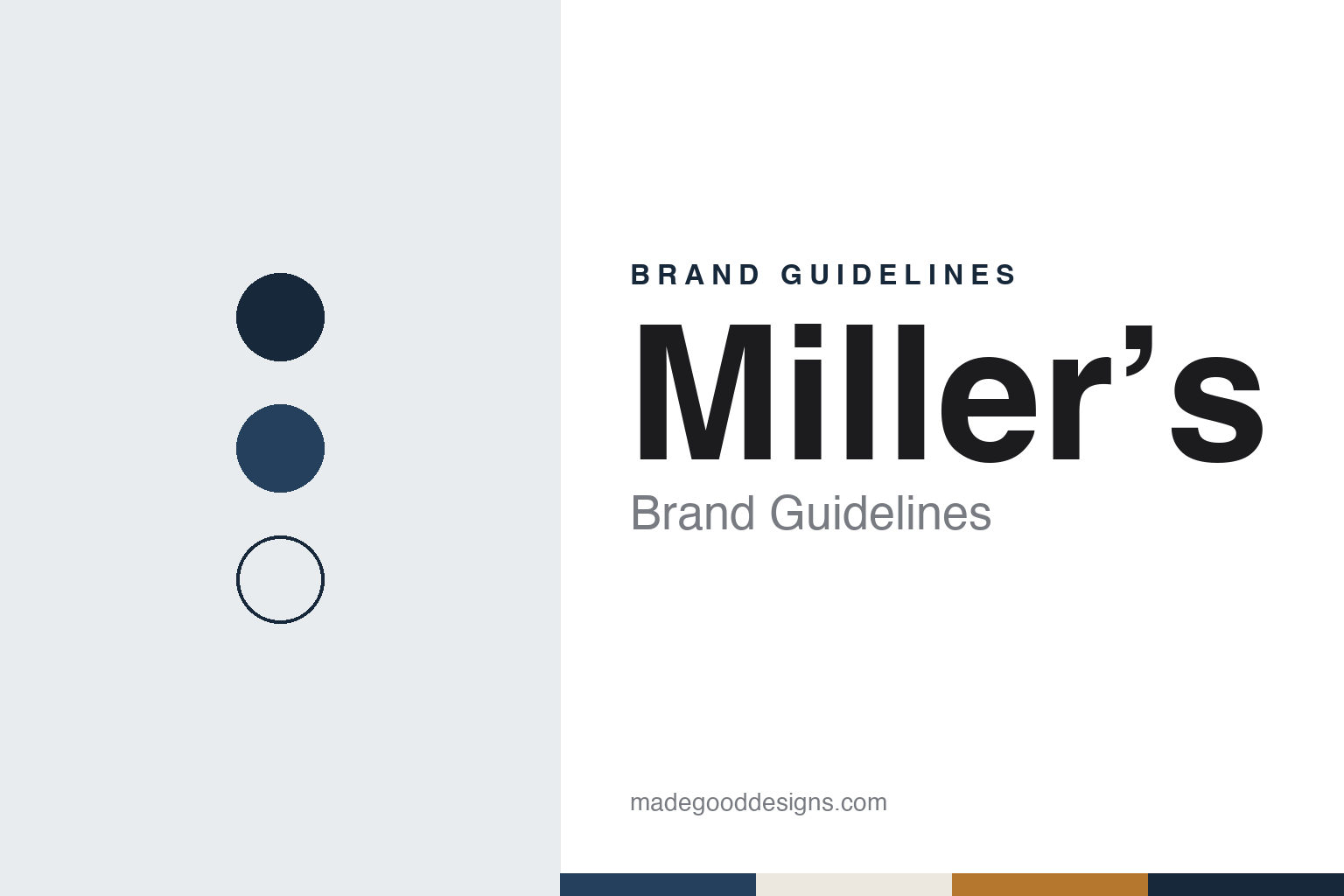
Two constants: an ink blue, linen and bronze palette and a plain American sans register. Abstract homage — not a Miller’s product or mark; no print, album or logo is reproduced.
A studio in Pittsburg
From portraits to printing for other photographers.
Miller’s Professional Imaging traces its start to 1939, when Bill Miller opened a small portrait studio in downtown Pittsburg, Kansas. Pittsburg State University gave that date in a July 2020 news story, and the company tells the same story on the about page of its consumer lab, Mpix: Miller bought equipment to develop film and began printing for other photographers in the area, and the studio grew into the parent company.
The lab business proper dates from 1964. DPS Magazine, the US trade title for digital and production printing, wrote in May 2018 that Miller’s Professional Imaging started that year, when its founder began developing prints for other professional photographers in rooms above his own studio. Mpix gives the same year, calling 1964 the founding of Miller’s as a full-service photo lab built for professional photographers.
From that base the company grew into a large operation by the standards of the trade. DPS Magazine reported in 2018 that Miller’s had two locations, one in Pittsburg and one in Columbia, Missouri, and that the Pittsburg facility had grown to nearly 170,000 square feet, with up to about 460 associates at peak seasons. Pittsburg State University wrote in 2020 that Miller’s provided prints and press products for professional photographers in all 50 states and Canada. The company describes itself as the largest professional lab organisation in the United States, a description the university repeated in the same story; it is the company’s own claim.
The name on the door has stayed the founder’s. The professional business trades simply as Miller’s, with Miller’s Lab used on its web address. Mpix, its consumer brand, says that more than 60 years of work have gone into knowing how a particular paper responds to colour and when a print needs more attention.
Colour
Albums, Dream Prints and a consumer lab.
Miller’s sells to working photographers rather than to the public, and its website is organised the way a studio orders: proofing, presentation boxes and folios, albums and books, wall art, press-printed cards, and separate sections for schools and sports photography, whose order forms carry items such as composites, ID cards and team prints. There is also a film section with a film-processing order form, and an art department that offers retouching, RAW processing and album design.
The album range carries the company’s own name. Miller’s Signature Albums and Signature Books each have pages for covers, papers, add-ons and packaging, and DPS Magazine reported in 2018 that Signature Albums were completed in the lab in one to two business days, with many print and press-card orders out of the door in a single day. The wall-art pages list gallery wraps, metal prints, acrylics and wood prints, the standard vocabulary of the professional lab.
The equipment behind the prints is well documented. In May 2017, DPS Magazine reported, Miller’s installed a Canon DreamLabo 5000, a seven-colour production inkjet printer with automatic double-sided printing, after looking at the machine for several years. With it the lab introduced Dream Prints, which the company described to the magazine as a giclée process giving more image detail than traditional photographic printing, offered in 15 set sizes and on mixed papers within one order. The same report listed a Kodak Nexpress press and a Noritsu 3704HD among the lab’s printers, and named the finishing kit used for book blocks, trimming and covers. Photographers submitted files through ROES, the remote order entry system used widely by professional labs, or through the company’s Designer Plus software.
In 2003 Miller’s launched Mpix, which Pittsburg State University described in 2020 as a fully web-based digital imaging lab for emerging professionals and photo enthusiasts. Mpix says it is still printed in the company’s labs in Pittsburg and Columbia, with every order printed, inspected and assembled in-house rather than outsourced; that is the company’s statement. Mpix keeps its own brand and its own site, while the Miller’s name stays on the professional side.
Typography
How professional labs present themselves.
Professional photo labs and film-processing labs sit between the photographer and the finished object. Most present themselves chiefly through the print: the paper it is made on, the process that made it and the size it comes in. Lab websites typically sort their catalogues by paper surface — glossy, lustre, matt, pearl or metallic — and separate photographic prints exposed on light-sensitive paper from inkjet or giclée prints made for fine-art work.
Around the print sit albums, photo books, cards and wall pieces. Labs name these ranges plainly, usually by material and construction: lay-flat books, hard and soft covers, mounted prints, framed prints, acrylic, metal and wood. Film labs add a second vocabulary of development and scanning, listing film formats, scan resolutions and turnaround times so that a photographer can compare one service with another before sending a roll.
Ordering is part of the brand. Many labs describe their software in practical terms: a web editor for families, a mobile app for quick prints, and downloadable ordering programs or proofing tools for professionals who send large batches. Service promises — remakes, colour correction, shipping deadlines and guarantees — are usually written as short named policies rather than long explanations.
Corporate pages tend to carry the history. Labs that began as a single printer or a small darkroom often tell that story in their About pages, alongside the names of their owners, the towns where their production sits and any group they now belong to. For a design reader, the category is a study in restraint: the identity frames the customer’s pictures and names the materials, and it rarely competes with the images it prints.
Aa
A plain American sans for a working lab. (Specimen set in Libre Franklin, a sans STAND-IN; NOT the Miller’s logo.)
Miller’s
A founder’s name on a trade brand.
Miller’s presents itself less as a consumer brand than as a supplier to studios. The home page describes the company as a lab for professional photographers nationwide, and the site leads with ordering, sample kits and product pages rather than with lifestyle imagery. The tone is practical: turnaround times, paper choices and how to order. DPS Magazine quoted the company’s marketing coordinator in 2018 saying that speed and quality were the two things Miller’s was most known for among photography labs, and that each order is signed off after inspection by every department it passes through. Those are the company’s own words, but they show which values the brand chooses to lead with.
The two-brand structure is the clearest design decision in the company’s history. Rather than open the professional lab to the public in 2003, Miller’s created Mpix as a separate name with its own site and tone, aimed at enthusiasts and new professionals, while the Miller’s name stayed with studio work. The parent name links the two: Mpix’s about page opens with Bill Miller’s 1939 studio and calls Miller’s Professional Imaging its parent company.
Place is part of the story too. Both the professional and consumer brands tell their history through Pittsburg, a small city in south-east Kansas, and through a second lab in Columbia, Missouri. Mpix says every order is made in its labs in the Midwest, and the company’s pages give the two towns by name. The labs, the founder and the dates are the brand’s most concrete material.
For a design guide, Miller’s shows how a professional lab can keep a founder’s surname as a trade brand for decades and give a separate name to a consumer service. Compare WHCC, another American lab that sells to professional photographers, and Bay Photo Lab, a California lab in the same trade. For this guide we use an ink blue, a linen white and a wheat bronze with a sans, an unofficial interpretation; no product or logo is reproduced.
Explore & save
Keep Miller’s’s identity on hand — save it to a board in the Made Good inspiration library.
Miller’s identity set
Keep the Miller’s ink blue, linen and bronze palette and the plain American sans register for your own reference.