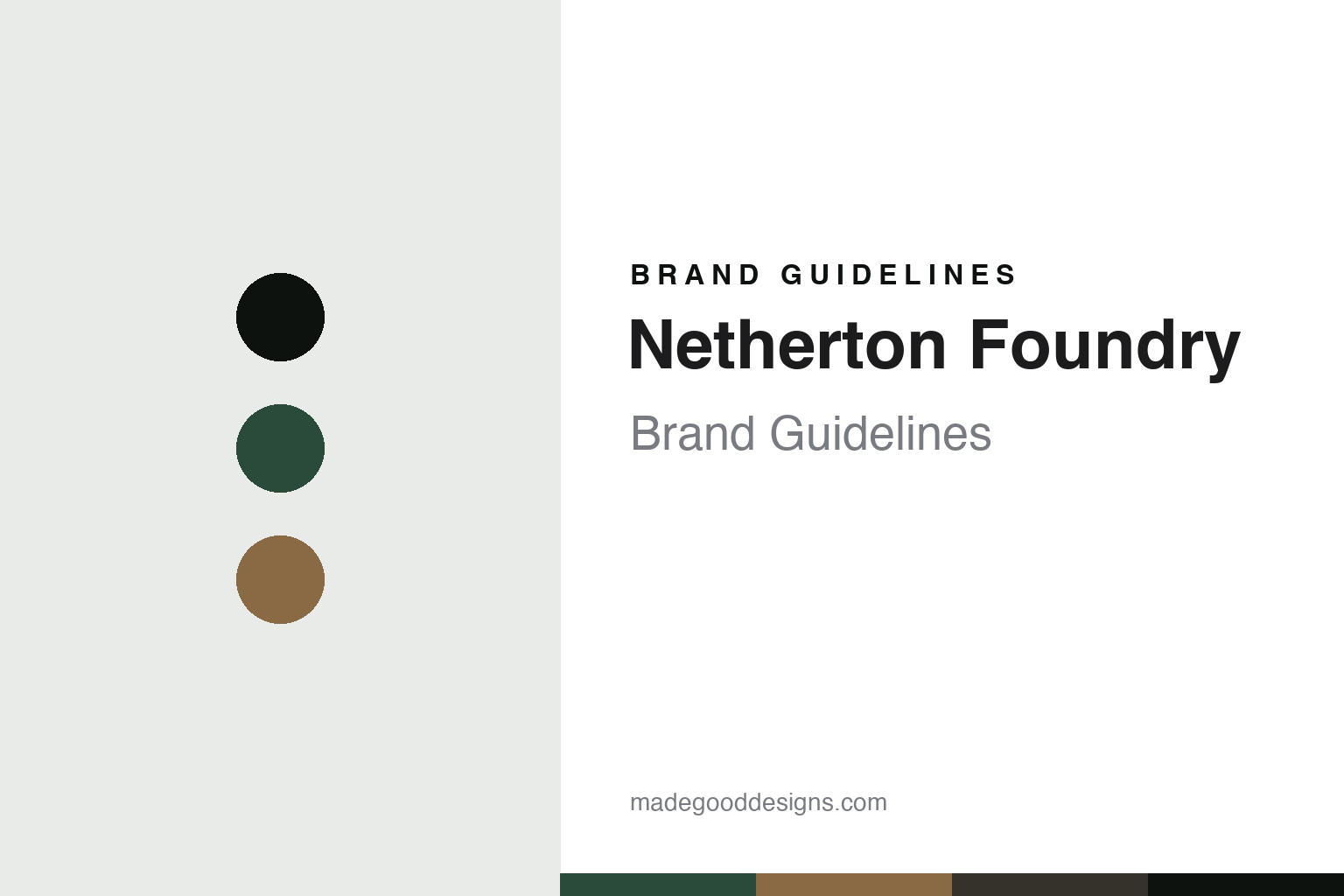
Netherton Foundry Brand Guidelines
The British spun-iron pan.
Aa
Two constants: a Shropshire-green palette and a workshop-sans register. Abstract homage — not a Netherton pan, surface or wordmark.
The British spun-iron pan
Netherton Foundry is a Shropshire maker whose black-iron pans are spun, not cast, and made in Britain.
Netherton Foundry is a lesson in spun iron as the identity. A small family maker in South Shropshire, England, it makes frying pans by spinning a flat disc of black iron into shape on a lathe — a different method from casting or forging — finished with ebonised-oak handles and natural seasoning. Its answer to how a pan is made is the spinner’s one: take a flat metal disc and form it over a spinning lathe into a light, seamless pan. A pan turned, not cast.
Its identity is the metal and the surface, spun by hand. Netherton’s spun-iron pans, its Shropshire workshop and its oak handles are the work it is known for. A method, made a signature. A workshop that spins iron on century-old lathes.
(Honest notes, so the story stays precise. Netherton Foundry Shropshire is a family-owned English maker, working from Newhouse Farm at Cleobury Mortimer in South Shropshire, and it spins its pans there on roughly century-old lathes; it is inspired by Shropshire’s ironmaking heritage around Coalbrookdale. Its hero product is spun iron — a flat disc spun into a pan, which it calls black iron, lighter than cast iron — so we keep it distinct from cast iron, though it does also sell some cast-iron pieces. It is made in Britain: the pans are spun in Shropshire, and details like the rivets are made in the British Midlands, while materials are principally sourced in Shropshire and neighbouring counties — so we say made in Britain rather than claim the raw steel or the oak are British. It seasons its pans with organic flax oil, and uses ebonised-oak handles. One honest limit: it does not publish a founding year, and its “over three decades” refers to the founders’ design career, not the company’s age — so we call it an established independent maker rather than pin a date. Its designs and marks are its IP, described but never reproduced, and there is no official brand hex — these tones are an unofficial interpretation. This is design commentary and does not promote any product.)
Colour
Netherton Foundry lives in a Shropshire-green palette. Click a swatch to copy the hex.
Netherton’s identity is rural, natural and English — a Shropshire green, an ink, an ebonised oak, a black iron, and a chalk. The palette leans Shropshire green and oak: the register of an English countryside workshop and an oak-handled black pan. It signals craft and place over gloss. The honest caveat: with no published brand hex, these values are an original, unofficial interpretation, not first-party colours.
The lesson is a Shropshire-green palette signals a rural, made-in-Britain identity. Netherton’s world is a spun-iron, oak-handled, made-in-Shropshire object. For designers, it is a reminder that a countryside green and a warm oak can carry a brand built on a workshop craft — the green of the Shropshire hills and the brown of an ebonised handle. Because these tones can fail as small text, keep type dark and let the colour live in the accents, palette and band. The takeaways: spin the iron; keep the workshop rural; be honest about sourced materials; and treat any single hex as unofficial.
Typography
The register is a workshop sans — warm, plain, honest.
Netherton’s identity carries a warm, plain, honest spirit — a workshop object, not a factory one. A humanist sans captures the mood: friendly, even and unpretentious, the register of a small English workshop. Set in a Shropshire-green palette, the workshop sans feels warm and plain — exactly the personality Netherton carries. It is honest rather than slick, mirroring a spun-iron pan with an oak handle. (Netherton’s real designs and marks are things we describe but do not reproduce, and the exact typeface is not ours to use.) Because it is not ours to use, the honest description is “a workshop-sans spirit,” shown here in a stand-in. The type behaves like the maker: warm, plain and honest.
Aa
A workshop-sans spirit — warm and plain. (Specimen set in Mulish, a workshop-sans STAND-IN; NOT the Netherton wordmark or any pan design.)
How a pan is made
Netherton Foundry stands for spun, not cast, iron.
Netherton Foundry is a lesson in making a spinning method the identity. A Shropshire-green palette, a workshop sans and a spun black-iron surface make one thing — a pan turned from a flat disc — the whole maker: rural, natural and English. The spinning is the differentiator. The differentiator is method: not casting and not forging, but spinning a flat iron disc over a lathe into a light, seamless pan, on machines that are a century old.
Put to work, the identity is a distinct method as design. A maker building in this spirit would own a specific way of making — here, metal spinning — keep it in a real workshop, and be honest that “made in Britain” means the making, while some materials are sourced. It would treat the lightness of spun iron and a replaceable oak handle as the point. A brand learning from it would see that choosing an unusual method — spinning rather than casting — can itself be the identity, since how a thing is made is as ownable as what it is. It would say plainly the pans are spun in Shropshire. The lesson Netherton teaches is that a method can build a brand: the spinning gives it distinction, and the Shropshire making gives it substance. The method is the personality, and the spun pan is the proof.
For designers and brand-builders, Netherton Foundry holds the spun-iron pole in this round about how a pan is made: own a distinct method, and keep it in a real workshop. The lessons: spin the iron; keep it rural; be honest about sourced materials; and never reproduce a protected design. It is also a reminder to stay precise: Netherton Foundry is a family-owned Shropshire maker spinning black-iron pans in Britain, distinct from cast iron — with no published founding year, so an established-maker framing, and the palette here an unofficial interpretation. Netherton made spinning the maker — proof that the method can be the difference.
Explore & save
Keep Netherton Foundry’s identity on hand — save it to a board in the Made Good inspiration library.
Netherton Foundry identity set
Pin the Shropshire-green palette and the workshop-sans register to your own board.