New York International Auto Show Brand Guidelines
From the original Madison Square Garden in 1900 to the Javits Center.
Aa
Two constants: a navy, taxi yellow and steel palette and a condensed sans register. Abstract homage — not a New York International Auto Show poster or mark; no logo, car or badge is reproduced.
Madison Square Garden, 1900
A November show in the original Garden.
The New York International Auto Show traces its start to November 1900, when the first New York Auto Show opened at the original Madison Square Garden. The show’s own history page and a 2023 interview in CBT News both give that month and that venue. Motoring Research, in a 2019 history of the show, counted 69 exhibitors and about 160 complete vehicles at the first event. Among the vehicles on show, the same article says, were seven electric cars, two petrol-powered cars and a gasoline tricycle.
The New York show grew out of the bicycle exhibitions of the late nineteenth century. Motoring Research notes that the New York City cycle show of 1899 already carried the word automobile in its full title, the Fourth Annual Cycle and Automobile Exhibition, and that New York followed the Paris show of 1898, today’s Mondial de l’Auto. Early editions also used the Grand Central Palace as well as the Garden.
The early shows became a place for American makers to present new cars. According to Motoring Research, the Curved Dash Oldsmobile made its debut at the show in 1901, Cadillac’s first car, the Model A, was shown in 1903, and the Ford Model N was unveiled in 1906. In 1924 Chrysler showed its Chrysler Six; the same article recounts that the company rented space at the Commodore Hotel while three of its cars also stood in the main exhibition hall.
Colour
Coliseum, Javits and a spring date.
The name and the venue changed together in 1956. That year, Motoring Research reports, the word International was added to the title, reflecting the growing presence of European cars, and the show moved to the New York Coliseum. It stayed at the Coliseum until 1987, when it moved to the Jacob K. Javits Convention Center in Manhattan; English Wikipedia gives the same dates.
The international label followed the cars. Motoring Research notes that Mercedes-Benz chose New York rather than Europe to launch the 300SL Gullwing in 1954, at the suggestion of its US distributor Max Hoffman, and that Toyota and Datsun made their debut at the show in 1959. In 1961 the Jaguar E-Type had its North American debut there. By 1984, the same history says, around 700 cars were on display.
Later editions added exhibitions of their own. Motoring Research records that the 1997 show included a display of vehicles adapted for disabled drivers for the first time, and that in 1999 the show closed the century with a Car of the Century exhibition of 28 cars, running from a replica of the 1886 Benz three-wheeler to a 1999 Volkswagen Beetle. In 2002 Toyota used the show to launch its Scion brand with two concept cars, and in 2003 Chrysler showed the 300C concept, inspired by the C-300 of 1955, the same history says.
Today the show runs for about ten days in spring. English Wikipedia describes it as an annual event held in late March or early April, usually opening on or just before Easter weekend and closing on the first Sunday after Easter. It lists the 2024 show as 29 March to 7 April, the 2025 show as 18 to 27 April and the 2026 show as 3 to 12 April, each preceded by two press preview days. Before the public opening, carmakers present new production and concept vehicles to the press, and the Greater New York Automobile Dealers Association and the International Motor Press Association hold industry meetings and events alongside, Wikipedia says.
The run has had gaps. The 2020 show, first set for April, was postponed in March 2020 to late summer and then cancelled on 22 May 2020; the 2021 show, scheduled for August, was also cancelled, according to English Wikipedia. The show returned in April 2022, the edition in which, Wikipedia notes, micromobility exhibits appeared at the show for the first time.
Typography
Shows, lawns and programmes.
Motor shows and concours d’élégance events sell a place and a date as much as the cars on show. Their names usually carry the city, the venue or the estate, and many keep a fixed slot in the calendar: Geneva’s show opened each March, and the Goodwood Festival of Speed runs in late June or early July. Organisers range from dealers’ associations and trade bodies to permanent committees and private estates.
Each event builds its identity from its setting. Indoor shows are defined by halls and stands, where carmakers decide how to present new models; Geneva moved from temporary halls on the Plaine de Plainpalais to Palexpo, beside the airport, in 1982. Outdoor events use lawns, paddocks and routes: at Goodwood a hillclimb up the drive of a country house, with straw bales, tape and a central sculpture on the lawn in front of the house.
Print still matters. Posters, programmes, entry lists and badges are often the most lasting record of a show; Goodwood’s posters were drawn by one motor-racing artist from 1993 to 2015, and the poster for Geneva’s 1905 show survives in its histories. Colour schemes are documented less often; one example is the uniform white and black specified for the first Festival of Speed.
These events also change, pause and end. Shows are renamed, move halls or cities, add days, or lose exhibitors; Geneva’s organisers ended the Swiss show in May 2024 after a single return that February, while its name continued in Doha. This guide sets out each event’s founding, organisers, venues and renamings as dated facts, with no prices, auction results or claims about the cars.
Aa
A condensed sans for a show built around a city and a hall. (Specimen set in Barlow Condensed, a sans STAND-IN; NOT the New York International Auto Show logo.)
New York International Auto Show
A dealers’ association show with an anniversary poster.
The show is organised by the Greater New York Automobile Dealers Association (GNYADA), the trade body for new-car and truck dealers in the New York area. The association presents the show on its own website and says it has served local dealerships since 1910. Its president, Mark Schienberg, spoke for the show in an April 2023 CBT News interview recorded while the Javits floor was being set up for that year’s opening on 7 April, and CarPro quoted him as the show’s president in 2025.
The 2025 edition marked the show’s 125th anniversary. CarPro reported that year’s poster was designed as a tribute to that history, drawing a line from Madison Square Garden in 1900 to the Javits Center, and that a special exhibit of vintage and classic cars traced more than a century of models. In the 2023 interview Schienberg told CBT News that the show then ran five ride-and-drive programmes for electric vehicles, a contrast he drew with the steam, petrol and battery cars of the first show. The show’s own pages address people researching a new car, and its 2026 pages promoted driving experiences, concept cars, a tuner and custom-car area and a family zone.
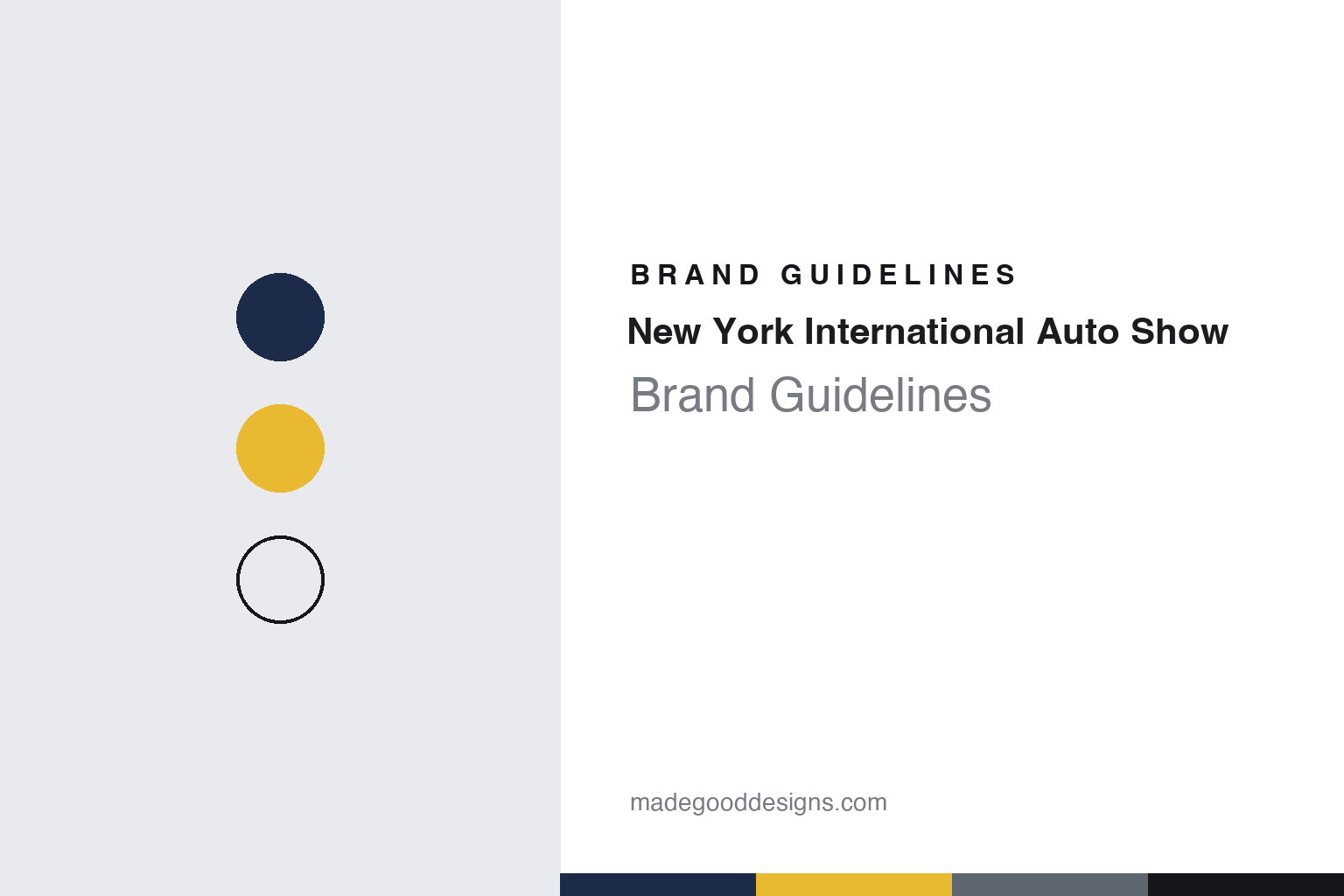
For a design guide, the New York International Auto Show shows how a show identity can lean on a city, a run of venues and an anniversary poster rather than on a single mark. Compare the Detroit Auto Show, another American motor show, and the Geneva International Motor Show. For this guide we use a deep navy, a taxi yellow and steel greys with a condensed sans, an unofficial interpretation; no product or logo is reproduced.
Explore & save
Keep New York International Auto Show’s identity on hand — save it to a board in the Made Good inspiration library.
New York International Auto Show identity set
Pin the navy, taxi yellow and steel palette and the condensed sans register to your own board.
Source & notes
Frequently Asked Questions
What font can I use to match the New York International Auto Show look?
This guide describes New York International Auto Show’s type as “A condensed sans for a show built around a city and a hall”. Its type specimen is set in Barlow Condensed from Google Fonts as a stand-in; Barlow Condensed is not New York International Auto Show’s own lettering.
What colours are in the New York International Auto Show palette?
This guide’s New York International Auto Show palette is Manhattan navy #1D2B4A, Night ink #14161A, Taxi yellow #E8B931, Hall steel #5E6670 and Concrete #EDEBE6. The tones are the guide’s own unofficial interpretation, not official New York International Auto Show hex codes.