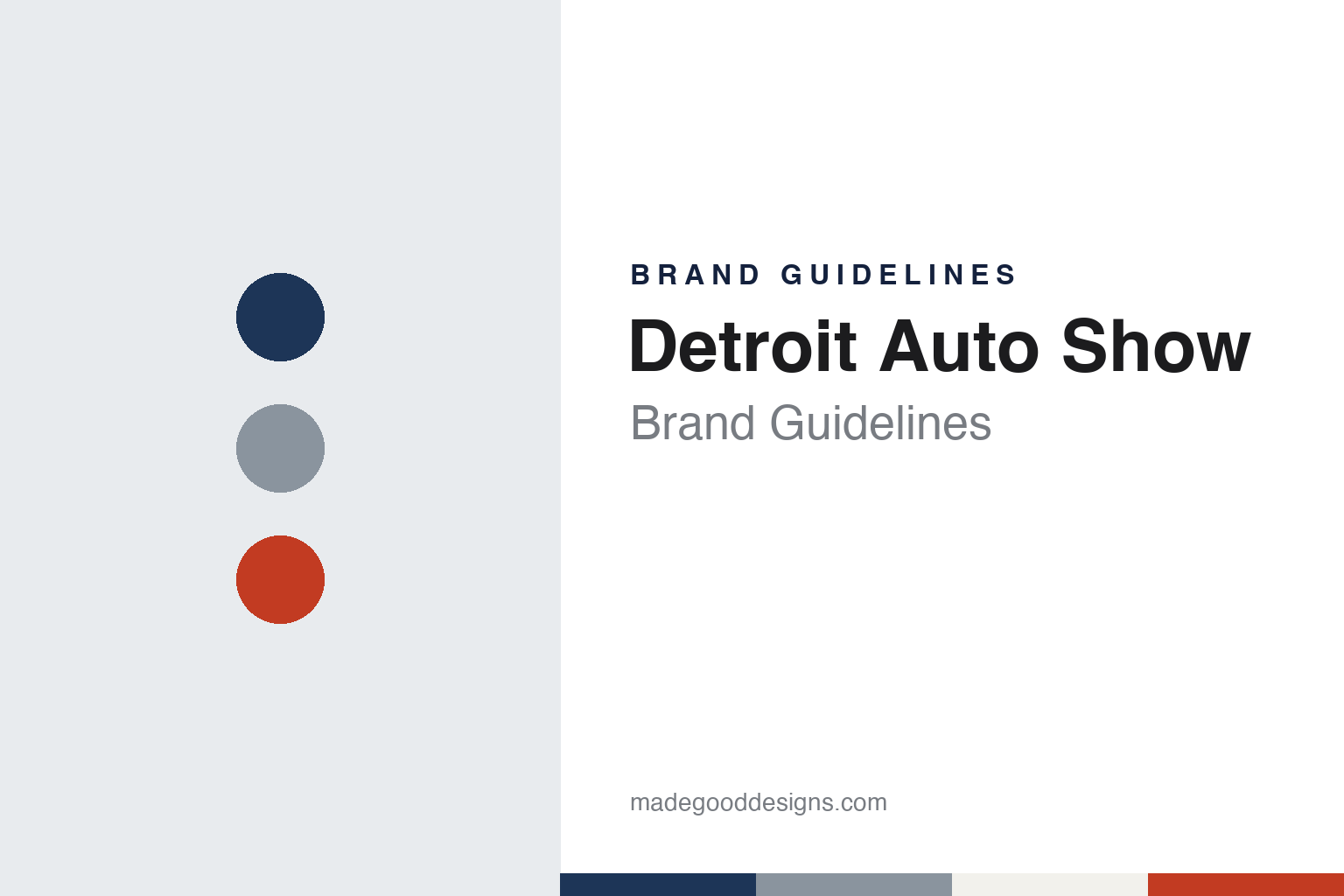
Detroit Auto Show Brand Guidelines
The dealers’ show that kept its city, its hall and its organiser.
Aa
Two constants: a navy, steel and signal red palette and a condensed sans register. Abstract homage — not a Detroit Auto Show mark or poster; no logo, vehicle or badge is reproduced.
From Light Guard Armory to Cobo Hall
Steam cars among the fishing gear.
The Detroit Auto Show traces its roots to 1899. According to the Detroit Historical Society’s Encyclopedia of Detroit, that year two electric and two steam-powered cars were shown in the city as part of a sporting-goods exhibition that also displayed fishing gear and big-game trophies. William Metzger, described by the society as the only automobile dealer in Detroit at the time, was among the organisers of the sponsoring group, the Tri-State Automobile and Sporting Goods Association, and the event was held at the Light Guard Armory.
The show in its present line began in 1907, when the newly formed Detroit Automobile Dealers Association held its own show in December at a beer garden near the Belle Isle Bridge, the society says. The Tri-State association held one more show, in February 1908, and then withdrew. As the dealers’ show grew it moved between venues, among them the Wayne Hotel, Convention Hall, the Detroit Artillery Armory and the Michigan State Fairgrounds. English Wikipedia says the show has been held every year since 1907 except from 1941 to 1953.
In 1965 the show found what the society calls its permanent home at Cobo Hall on the Detroit riverfront. The building has changed its name several times since then: English Wikipedia lists it as Cobo Hall from 1960 to 2010, Cobo Center from 2010 to 2019 and TCF Center from 2019 to 2021, before it became Huntington Place, the name it carries today. It is owned by the Detroit Regional Convention Facility Authority.
In 1987 the dealers’ association proposed making the show international, English Wikipedia says, and its members travelled to Europe and Japan to ask carmakers to bring their vehicle unveilings to Detroit. In 1989 the event was renamed the North American International Auto Show, or NAIAS, the name it kept for more than three decades.
Colour
Moving the calendar.
For most of its history the show took place in winter, usually in January. In 2018 the organisers agreed to move it to June from 2020, which the Detroit Historical Society says was meant to raise attendance and make use of outdoor space for more exhibits and activities. English Wikipedia, citing Autoweek in July 2018, adds plans for an outdoor “auto plaza” around Woodward and Jefferson avenues, next to the indoor exhibition.
The June show never took place. The 2020 edition was cancelled in late March 2020, WDIV ClickOnDetroit reported on 21 September 2020, when the organisers also announced new dates for the 2021 show at the end of September, with seven events under one banner, including Motor Bella, The Gallery and the AutoMobili-D mobility exhibition. NAIAS executive director Rod Alberts said the September dates were chosen partly to avoid a clash with the IAA show in Munich. The full 2021 show was later called off as well; English Wikipedia says the organisers instead held Motor Bella, an outdoor event, at the M1 Concourse in Pontiac in September 2021.
The show returned to downtown Detroit in September 2022 and September 2023, English Wikipedia says. There was no show in 2024 while it moved back to January, and in January 2025 it reopened under a new short name, the Detroit Auto Show. Carscoops, writing on the opening day on 10 January 2025, noted that GM, Ford and Stellantis had a large presence alongside Toyota and Volkswagen, with four indoor tracks on the floor, and that few new models were revealed there. The same report said the organisers had made clear they would no longer focus on the media.
The indoor tracks have become part of the show’s identity. The organiser’s release for the 2026 edition, dated 9 January 2026, describes a show running from 13 to 25 January at Huntington Place with 41 brands on display, the returning Detroit Grand Prix and Powering Michigan ride-along tracks, and the Camp Jeep and Ford Bronco Built Wild courses, where visitors climb artificial “mountains” inside the hall. The two weeks open with The Gallery, which the organiser calls the show’s signature luxury vehicle event.
Typography
Shows, halls and names.
Motor shows and concours d’élégance events sell a place and a date as much as the cars on show. Their names usually carry the city, the venue or the estate, and many keep a fixed slot in the calendar: Geneva’s show opened each March, and the Goodwood Festival of Speed runs in late June or early July. Organisers range from dealers’ associations and trade bodies to permanent committees and private estates.
Each event builds its identity from its setting. Indoor shows are defined by halls and stands, where carmakers decide how to present new models; Geneva moved from temporary halls on the Plaine de Plainpalais to Palexpo, beside the airport, in 1982. Outdoor events use lawns, paddocks and routes: at Goodwood a hillclimb up the drive of a country house, with straw bales, tape and a central sculpture on the lawn in front of the house.
Print still matters. Posters, programmes, entry lists and badges are often the most lasting record of a show; Goodwood’s posters were drawn by one motor-racing artist from 1993 to 2015, and the poster for Geneva’s 1905 show survives in its histories. Colour schemes are documented less often; one example is the uniform white and black specified for the first Festival of Speed.
These events also change, pause and end. Shows are renamed, move halls or cities, add days, or lose exhibitors; Geneva’s organisers ended the Swiss show in May 2024 after a single return that February, while its name continued in Doha. This guide sets out each event’s founding, organisers, venues and renamings as dated facts, with no prices, auction results or claims about the cars.
Aa
A condensed sans for hall signs and show dates. (Specimen set in Barlow Condensed, a sans STAND-IN; NOT the Detroit Auto Show logo.)
Detroit Auto Show
A dealers’ show under a city’s name.
The show is organised by the Detroit Auto Dealers Association, or DADA, the dealers’ body that the Detroit Historical Society traces back to the first dealers’ show of 1907. Each edition has its own chairman; the organiser named Todd Szott as chairman of the 2026 show. The show’s website lists the public days of the next edition as 16 to 24 January 2027, with industry and media access on 14 January, again at Huntington Place.
The identity has followed the names. For more than thirty years the event presented itself by its long title and the four-letter abbreviation NAIAS, with its web address at naias.com; since 2025 it has used the shorter city name and the address detroitautoshow.com. The site’s menus now list a poster contest, a brand centre for the media, Racing Day with the Detroit Grand Prix, and Modded Detroit, alongside the show-floor map and the ticket pages. Building the stands is a long job: the Detroit Historical Society says it takes roughly ten weeks to put up the multi-level display areas and lay the carpet for the show floor.
For a design guide, the Detroit Auto Show shows how an event can change its name twice and keep its city, its hall and its organiser. Compare the New York International Auto Show, another American auto show, and the SEMA Show, the automotive aftermarket trade show in Las Vegas. For this guide we use a river navy, a steel grey, a winter white and a signal red with a condensed sans, an unofficial interpretation; no product or logo is reproduced.
Explore & save
Keep Detroit Auto Show’s identity on hand — save it to a board in the Made Good inspiration library.
Detroit Auto Show identity set
Pin the Detroit Auto Show navy, steel grey and signal red palette and the condensed sans register to your own board.
Source & notes
Frequently Asked Questions
What font can I use to match the Detroit Auto Show look?
This guide describes Detroit Auto Show’s type as “A condensed sans for hall signs and show dates”. Its type specimen is set in Barlow Condensed from Google Fonts as a stand-in; Barlow Condensed is not Detroit Auto Show’s own lettering.
What colours are in the Detroit Auto Show palette?
This guide’s Detroit Auto Show palette is River navy #1D3557, Deep ink #14213D, Steel grey #8A949E, Winter white #F2F1EC and Signal red #C23B22. The tones are the guide’s own unofficial interpretation, not official Detroit Auto Show hex codes.
When was Detroit Auto Show founded?
Detroit Auto Show was founded in 1907 (dealers’ show), in Detroit, Michigan.