Rétromobile Brand Guidelines
The Paris classic-car show born at the Bastille in 1976.
Aa
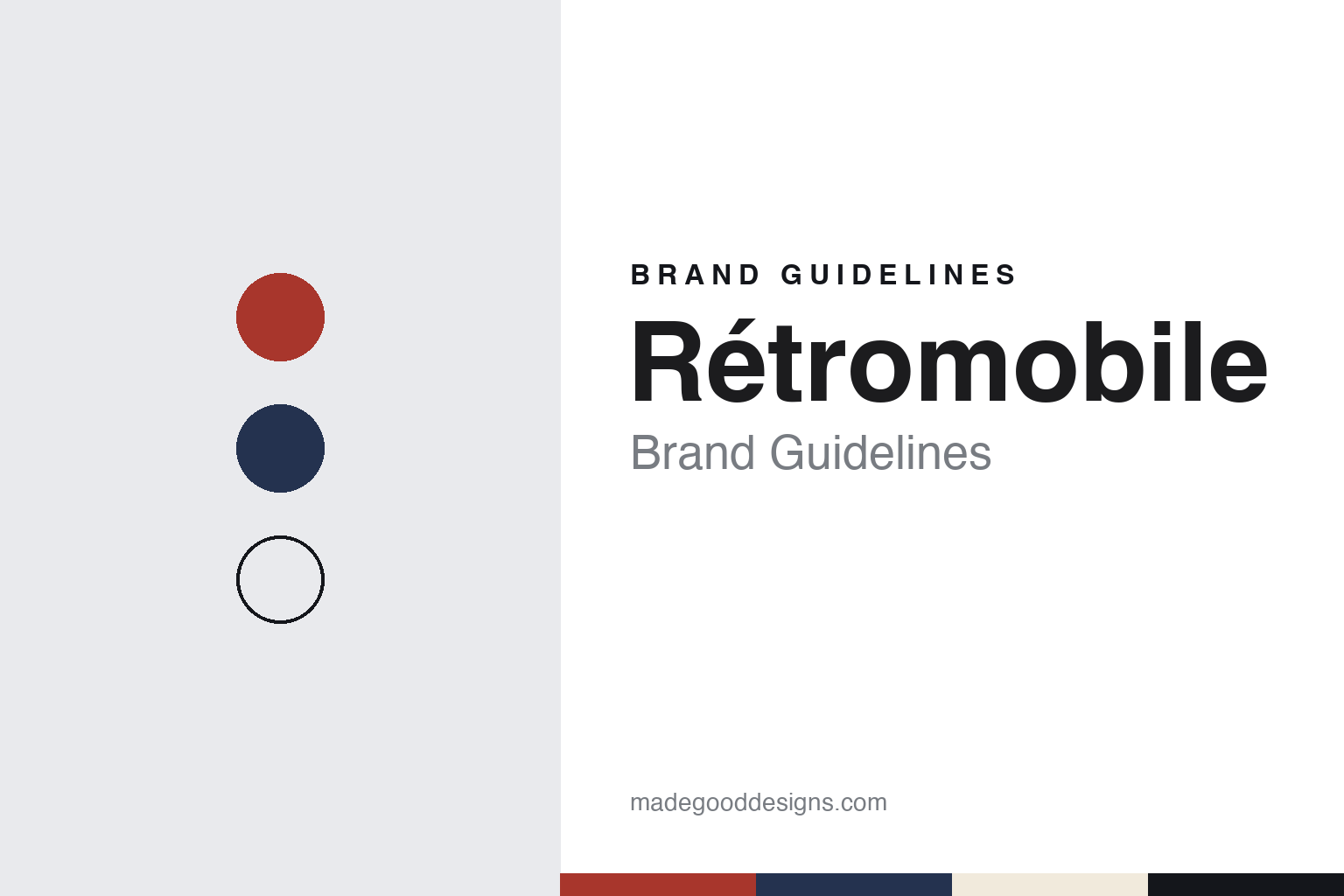
Two constants: a red, navy and ivory palette and a poster sans register. Abstract homage — not a Rétromobile asset; no car, logo or poster is reproduced.
Bastille, 1976
A parts market in a disused station.
Rétromobile is an annual show for collectors’ cars held in Paris each winter. French Wikipedia traces it to 1974, when the publisher Éditions Atlas staged a short exhibition of old cars called “Alpha Auto,” to launch an encyclopedia of the motor car, in the disused Gare de la Bastille. Its organiser, Jean-Pierre Jouët, asked Marc Nicolosi, a former restorer of old cars, to find the vehicles, and the pair then planned a market for spare parts and accessories for old means of transport. The name joined “rétro,” for old, with “mobile,” for transport.
The first Rétromobile opened in the same disused station on 14 February 1976 and ran for nine days, French Wikipedia says, with about a hundred cars, some lent by the collectors’ association ASAVÉ, and around 3,000 visitors. Its poster showed a Rolls-Royce beneath a medallion holding a locomotive, an aeroplane, a bicycle and a boat, because the first show covered every kind of old transport. From the second edition in 1977, when François Melcion joined Nicolosi, the show turned to collectors’ cars, bringing clubs, parts dealers, the specialist press and auction houses together. The first two editions were organised by Jouët’s company OIP; from 1978 to 1980 Nicolosi and Melcion ran the show themselves.
After five editions the show outgrew the Bastille. In 1981 it moved to the Parc des expositions de la Porte de Versailles, now Paris Expo Porte de Versailles, where it filled 4,800 square metres of Hall 8, French Wikipedia says, with Nicolosi as director.
Colour
Promobile, then Comexposium.
Ownership changed twice. In 1994 Nicolosi sold Promobile, the company that organised Rétromobile, to the collector Hervé Ogliastro, working with André Lecoq and Jean-Pierre Beltoise, and stayed on as director, according to French Wikipedia. In February 2003, during the 28th edition, Comexpo, now Comexposium, bought Promobile and with it Rétromobile, and Nicolosi left. Comexposium remains the organiser: L’argus described the group as the show’s organiser in France in February 2025.
The management changed several times after that. Melcion left in 2008 to run the collectors’ car department of the auction house Artcurial and returned as director in 2010, when the show was cut from ten days to five, including a weekend. His last edition was in 2018; Jean-Sébastien Guichaoua took over in September 2018, and Romain Grabowski became director in 2022, French Wikipedia says. In February 2026 the Journal de l’Automobile gave Grabowski’s title as director of Rétromobile and of the Ultimate Supercar Garage, a show for modern supercars staged alongside it for the first time that year.
The show has grown through those changes. French Wikipedia gives 119,000 visitors in 2015 and 132,000 in 2019. For the 45th edition, on 5–9 February 2020, it gives 72,000 square metres across pavilions 1, 2 and 3, with 620 exhibitors, more than 1,000 vehicles and 120 clubs; the 46th edition, first set for early February 2022, was moved to 16–20 March 2022 and held in pavilions 7.2 and 7.3. L’argus reported 146,000 visitors for the 49th edition, held on 5–9 February 2025, with 620 exhibitors and around 2,000 cars and motorcycles on 80,000 square metres. The Journal de l’Automobile reported 181,500 visitors, according to the organisers, for the 50th edition, held from 28 January to 1 February 2026 in halls 4 and 7 of Paris Expo Porte de Versailles.
Typography
Shows, lawns and organisers.
Motor shows and concours d’élégance events sell a place and a date as much as the cars on show. Their names usually carry the city, the venue or the estate, and many keep a fixed slot in the calendar: Geneva’s show opened each March, and the Goodwood Festival of Speed runs in late June or early July. Organisers range from dealers’ associations and trade bodies to permanent committees and private estates.
Each event builds its identity from its setting. Indoor shows are defined by halls and stands, where carmakers decide how to present new models; Geneva moved from temporary halls on the Plaine de Plainpalais to Palexpo, beside the airport, in 1982. Outdoor events use lawns, paddocks and routes: at Goodwood a hillclimb up the drive of a country house, with straw bales, tape and a central sculpture on the lawn in front of the house.
Print still matters. Posters, programmes, entry lists and badges are often the most lasting record of a show; Goodwood’s posters were drawn by one motor-racing artist from 1993 to 2015, and the poster for Geneva’s 1905 show survives in its histories. Colour schemes are documented less often; one example is the uniform white and black specified for the first Festival of Speed.
These events also change, pause and end. Shows are renamed, move halls or cities, add days, or lose exhibitors; Geneva’s organisers ended the Swiss show in May 2024 after a single return that February, while its name continued in Doha. This guide sets out each event’s founding, organisers, venues and renamings as dated facts, with no prices, auction results or claims about the cars.
Aa
A condensed poster sans for a winter show in Paris. (Specimen set in Archivo Narrow, a sans STAND-IN; NOT the Rétromobile logo.)
A theme every year
Anniversaries, clubs and dealers under one roof.
Each Rétromobile is built around themes and anniversaries. French Wikipedia says that every year a marque, a sporting event, a historic place or a field such as French coachbuilding is honoured with its own exhibitions. In 2025 the 70th anniversary of the Citroën DS led the show, with eleven historic models gathered with DS Automobiles and L’Aventure DS, L’argus reported. In 2026 the Journal de l’Automobile listed a Bugatti railcar lent by the Cité du Train, the BMW Art Car World Tour with the seven art cars that raced at Le Mans, a retrospective of rallying’s golden age staged with the Fondation Gino Macaluso and Oreca, and an exhibition about Steve McQueen, and counted 32 carmakers officially present.
Trade sits beside the exhibitions. Clubs, parts dealers, second-hand dealers, the specialist press and auction houses have shared the halls since the second edition, French Wikipedia says, and L’argus noted in 2025 that an area for collectors’ cars offered for sale has been part of the show since 2018. In 2026 the Journal de l’Automobile named Gooding Christie’s as the show’s new auction partner.
The visual side starts with the name: two plain French words joined into one, with an accent on its first letter. The 1976 poster, with its car and its medallion of trains, planes, bicycles and boats, used a single image to stand for a whole show, and the yearly themes give each edition its own subject while the name stays fixed. Inside the halls, carmakers’ heritage stands, club displays and dealers’ cars share one floor, so the identity has to sit as easily on a club banner as on a carmaker’s stand.
For a design guide, Rétromobile shows how a short coined name and a yearly theme can carry a trade show for half a century without a change of title. Compare Comexposium, the events group that has owned the show since 2003, and Mondial de l’Auto, the Paris motor show. For this guide we use a poster red, a deep navy and an ivory with a sans, an unofficial interpretation; no product or logo is reproduced.
Explore & save
Keep Rétromobile’s identity on hand — save it to a board in the Made Good inspiration library.
Rétromobile identity set
Pin the red, navy and ivory palette and the poster sans register to your own board.
Source & notes
Frequently Asked Questions
What font can I use to match the Rétromobile look?
This guide describes Rétromobile’s type as “A condensed poster sans for a winter show in Paris”. Its type specimen is set in Archivo Narrow from Google Fonts as a stand-in; Archivo Narrow is not Rétromobile’s own lettering.
What colours are in the Rétromobile palette?
This guide’s Rétromobile palette is Poster red #A8362C, Hall navy #24324F, Ivory #F1EADC, Chrome grey #878C93 and Ink #14161B. The tones are the guide’s own unofficial interpretation, not official Rétromobile hex codes.
Who founded Rétromobile?
Rétromobile was founded by Marc Nicolosi and Jean-Pierre Jouët.