SEMA Show Brand Guidelines
The aftermarket trade show that began at Dodger Stadium in 1967.
Aa
Two constants: an asphalt, orange and chrome palette and a condensed sans register. Abstract homage — not a SEMA Show asset or mark; no vehicle, logo or badge is reproduced.
Dodger Stadium, 1967
A trade show on a stadium concourse.
The SEMA Show is the trade show of the Specialty Equipment Market Association, the trade body of the US automotive aftermarket. SEMA’s own history, published for its 60th anniversary, says the association grew out of a meeting in May 1963 at the Hollywood offices of the model-car maker Revell, where some twenty makers of speed equipment agreed to form a trade group. It was incorporated that month as the Speed Equipment Manufacturers Association, with Ed Iskenderian of Isky Cams as its first president, and had 36 member companies by the end of the year. English Wikipedia lists its founders as including Roy Richter, Dean Moon and Vic Edelbrock Jr.
The show came four years later. SEMA says the first officially recognised SEMA Show was produced by Petersen Publishing, which bought the rights to the show from the association, with Petersen’s Hot Rod Industry News as the official host. Its official name was the High Performance & Custom Trade Show, and it was held on 10–12 January 1967 on the club-level concourse at Dodger Stadium in Los Angeles, with 98 companies and about 3,000 industry professionals attending. SEMA also names a forerunner: the Speed & Custom Equipment Show, a trade event started at the Disneyland Hotel in 1965 by a magazine publisher, which the association sponsored the following year but did not organise.
The name “SEMA Show” stuck early. In a January 2024 history piece for SEMA News, Drew Hardin quotes the June 1967 issue of Hot Rod Industry News as saying the event was “more commonly referred to as the SEMA Show.” The second show was held on 4–6 January 1968 at the then-new Anaheim Convention Center, near Disneyland, where Hardin reports that 140 exhibitors filled 201 booths and met 3,800 distributors and dealers from the United States, Mexico and Canada.
Colour
From Anaheim to Las Vegas.
The association changed its own name in 1970, to the Specialty Equipment Market Association, keeping the SEMA initials; English Wikipedia says the change was meant to move its image away from the word “speed.” By 1976, Wikipedia says, the Anaheim show had sold all 570 of its booths and was turning manufacturers away, and in 1977 the SEMA Show moved to the Las Vegas Convention Center, where it is still held.
In Las Vegas the show widened. Wikipedia says an import-parts section was added in 1983 with the sister body Automotive International Association, and the event was known for a time as the SEMA/AI Show. SEMA’s timeline says exhibitors were first grouped into sections in 1988, starting with a Street Rod Equipment area; that in 1992 the show joined other aftermarket shows to form Automotive Aftermarket Industry Week, held each year in the first week of November in Las Vegas; and that a tyre exhibition merged with it in 1997 to create the Global Tire Expo.
Features were added over the following decades, according to SEMA’s timeline: a vehicle Proving Ground in 2003, where attendees could see exhibitors’ products in use; the SEMA Launch Pad competition in 2013; the Battle of the Builders competition in 2014; and SEMA Electrified, an emerging-technology feature, in 2019. The convention centre grew around the show, with its South Hall opening in 2002 and its West Hall in 2021. On 5 August 2020 SEMA announced that the 2020 show would not go ahead, the first cancellation in the show’s history, English Wikipedia says.
Typography
Design and documentation.
Motor shows and concours d’élégance events sell a place and a date as much as the cars on show. Their names usually carry the city, the venue or the estate, and many keep a fixed slot in the calendar: Geneva’s show opened each March, and the Goodwood Festival of Speed runs in late June or early July. Organisers range from dealers’ associations and trade bodies to permanent committees and private estates.
Each event builds its identity from its setting. Indoor shows are defined by halls and stands, where carmakers decide how to present new models; Geneva moved from temporary halls on the Plaine de Plainpalais to Palexpo, beside the airport, in 1982. Outdoor events use lawns, paddocks and routes: at Goodwood a hillclimb up the drive of a country house, with straw bales, tape and a central sculpture on the lawn in front of the house.
Print still matters. Posters, programmes, entry lists and badges are often the most lasting record of a show; Goodwood’s posters were drawn by one motor-racing artist from 1993 to 2015, and the poster for Geneva’s 1905 show survives in its histories. Colour schemes are documented less often; one example is the uniform white and black specified for the first Festival of Speed.
These events also change, pause and end. Shows are renamed, move halls or cities, add days, or lose exhibitors; Geneva’s organisers ended the Swiss show in May 2024 after a single return that February, while its name continued in Doha. This guide sets out each event’s founding, organisers, venues and renamings as dated facts, with no prices, auction results or claims about the cars.
Aa
A condensed sans for a trade-show badge. (Specimen set in Oswald, a condensed sans STAND-IN; NOT the SEMA Show logo.)
SEMA Show
Trade-only, with a public Friday.
The SEMA Show has long been a business event. Its website describes it as a trade-only event, and English Wikipedia says registration as media, manufacturer, buyer or exhibitor is required. That has loosened: The Drive reported in November 2024 on a new policy of opening the show to the general public on the Friday of show week, so that it was “not just a B2B conference anymore.” The same report described the Las Vegas Convention Center as a campus of four buildings, put attendance at the 2024 show at 160,000 with more than 2,400 vendors, and quoted SEMA’s chief executive, Mike Spagnola.
The show sits inside a wider industry week. The 2026 SEMA Show was held on 3–6 November 2026 at the Las Vegas Convention Center, its website says, and the next is listed for 2–5 November 2027 at the same venue. The organisation behind it is the association, not an events company: SEMA’s timeline also lists year-round work for its members, from a product-data service launched in 2012 to the SEMA Garage in Diamond Bar, California, opened in 2014, and the purchase of the Performance Racing Industry trade show in 2012.
The identity rests on the association’s initials. The show’s first official name, the High Performance & Custom Trade Show, gave way within months to the shorthand the trade already used, and the initials then outlived the change of the association’s own name in 1970, from Speed Equipment Manufacturers Association to Specialty Equipment Market Association, so that SEMA Show has stood for both.
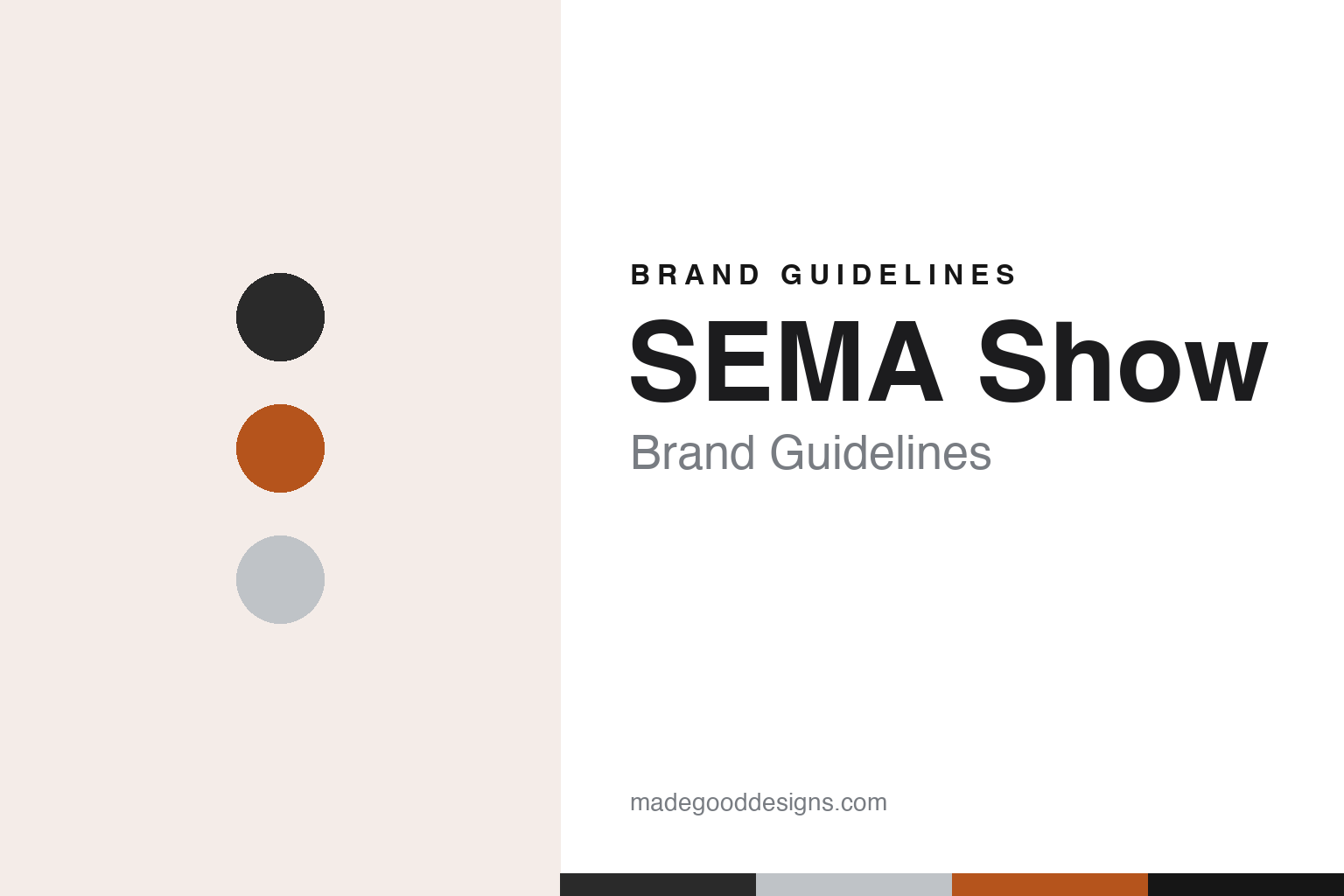
For a design guide, the SEMA Show shows how a trade event can carry its organiser’s initials as its name, from a stadium concourse in 1967 to a four-building convention campus in Las Vegas. Compare Japan Mobility Show, a motor show run by a carmakers’ association, and New York International Auto Show. For this guide we use an asphalt grey, a burnt orange and a chrome silver with a condensed sans, an unofficial interpretation; no product or logo is reproduced.
Explore & save
Keep SEMA Show’s identity on hand — save it to a board in the Made Good inspiration library.
SEMA Show identity set
Pin the SEMA Show asphalt, orange and chrome palette and the condensed sans register to your own board.
Source & notes
Frequently Asked Questions
What font can I use to match the SEMA Show look?
This guide describes SEMA Show’s type as “A condensed sans for a trade-show badge”. Its type specimen is set in Oswald from Google Fonts as a stand-in; Oswald is not SEMA Show’s own lettering.
What colours are in the SEMA Show palette?
This guide’s SEMA Show palette is Asphalt grey #2A2A2A, Ink #161616, Chrome silver #BFC3C7, Burnt orange #B5541C and Paper #F7F5F1. The tones are the guide’s own unofficial interpretation, not official SEMA Show hex codes.