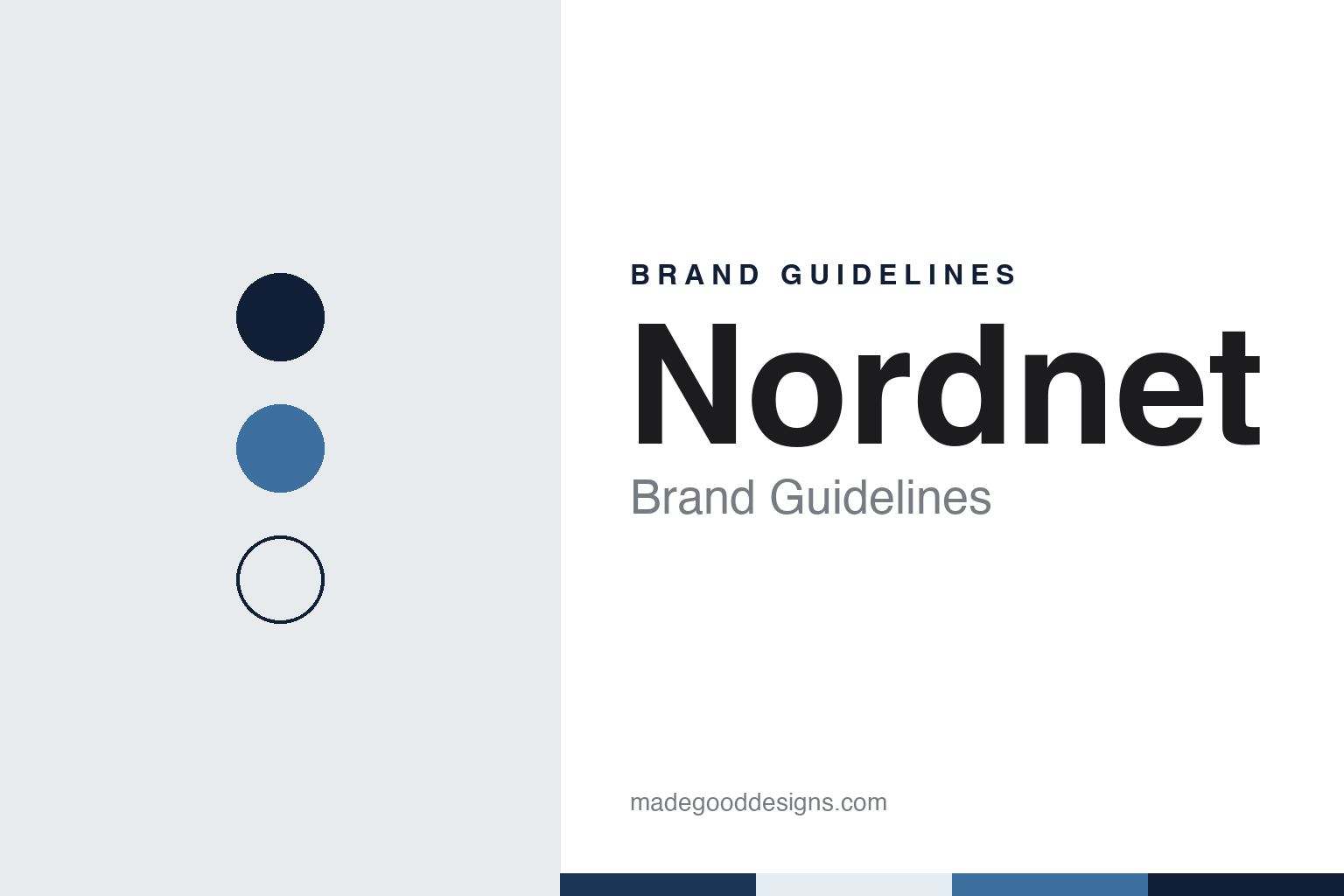
Nordnet Brand Guidelines
The Stockholm online broker that grew into a Nordic savings bank.
Aa
Two constants: a Nordnet navy, fjord blue and ice white palette and a Geometric sans register. Abstract homage — not a Nordnet product or mark; no app screen, logo or wordmark is reproduced.
Nordnet
A web broker born inside a Stockholm securities house.
Nordnet began in Stockholm in 1996. Swedish Wikipedia says it was set up that year as a secondary business name of E. Öhman J:or Fondkommission AB, the Öhman group’s securities firm, and that it was one of the first players in Swedish internet share trading; the company itself calls Nordnet “one of the first online brokers in the Nordics.” Its brand page describes the starting idea as taking trading “out of bricks and mortar branches” and offering it online, so that ordinary people could grow their savings on their own terms.
Expansion came quickly. Swedish Wikipedia dates a move into Luxembourg, through a company called Eurotrade, to 1999, and the start of operations in Norway in February 2001 and in Denmark in May 2001. In October 2001 Nordnet merged with Teletrade, a Swedish online broker founded in 1997; the encyclopedia says the combination created one of the largest online brokers in the Nordic region. The parent company, Nordnet AB (publ), had been listed on the Stockholm exchange since April 2000, and the company says it received its banking licence in 2002.
The middle of the decade brought new products and markets. In 2004 Nordnet bought the Norwegian internet broker Stocknet, which also brought a business in Germany. It opened in Finland in 2005 and, according to Swedish Wikipedia, gained a prominent position there in 2009 by buying eQ, which the encyclopedia calls the country’s largest internet broker. Pension services for private customers followed in 2005, occupational pensions in 2006 and the first banking services in Sweden in 2007. In 2010 Nordnet sold its German and Luxembourg businesses and bought the consumer lender Konsumentkredit; the company says it had made a strategic decision to be a bank for Nordic savers.
Colour
An app, a social network and a fund house.
Nordnet tells much of its product story through its app. The company says that in 2010 it launched the first Nordic mobile app for trading shares and funds; Swedish Wikipedia records the same year as the launch of the first Nordic mobile app for banking services. In June 2013 Nordnet bought a majority of the social investment network Shareville, where customers share their holdings in real time and can look at other savers’ portfolios; it now runs as Nordnet Social, which the company says has more than half a million members.
Design recognition has followed the app. Nordnet says its mobile app won a Red Dot award in 2021 in the “Brands & Communication” category for finance apps, and in August 2025 it announced a second Red Dot, in the “Mobile Apps” category and “Finance” subcategory. In that release the company said around 1.5 million of its 2.2 million customers used the app, that most logins came through it, and that it released a new version about twice a week on average. The Swedish personal-finance magazine Privata Affärer named Nordnet its bank of the year in December 2017, Swedish Wikipedia says, and gave it a savings-innovation award the following year for a share-lending programme; the company adds a further bank-of-the-year title from the same magazine in 2022.
The range has widened beyond trading. The company lists pension accounts in each Nordic market, including the Norwegian EPK account launched in 2021 and a Danish pension product in 2024, as well as residential mortgages for private banking customers. Its own fund company, Nordnet Fonder, received permission from the Swedish financial supervisor, Finansinspektionen, in April 2022, Swedish Wikipedia says. In 2024, the company says, it closed the sale of its unsecured lending portfolio to focus on savings and investment.
Nordnet sets out its brand language on its corporate site. Its stated purpose is to “democratize savings and investments,” its values are passion, simplicity and transparency, and its brand position is the “most inspiring savings experience.” Its communication concept is called “Level up”: in the company’s words, the idea of aiming higher “regardless of starting position or prior knowledge.” In 2024, the company says, it launched a new brand concept built around the joy of saving, backed by large marketing campaigns across the Nordic countries.
Typography
How brokers present themselves.
Online brokers and trading platforms sell access to markets through a screen, so the screen does much of the branding. Their websites lead with app views and price charts, and many show the same platform on a phone, a tablet and a desktop. Saxo, for example, presents two platforms by name, SaxoInvestor for simple investing and SaxoTrader for its full range, rather than a single product.
The visual language is often restrained. Interfaces come in dark and light modes, numbers are set in clear sans-serif type, and green and blue accents mark rising prices, buttons and links. Wordmarks tend to be short and confident: a single word, two letters or a name with a number, written to sit comfortably in an app icon as well as on a sponsorship board or the name of an arena.
Regulation is part of the page design. Footers carry licence lines that name the regulated companies behind a brand and their supervisors, such as the Financial Conduct Authority in the UK or the Danish Financial Supervisory Authority, and pages for leveraged products carry risk warnings set near the top. IG’s UK website, for instance, names four separate companies behind the one brand in its footer.
Beyond trading, these brands publish a great deal. Product pages explain shares, ETFs, options and, in some markets, savings or pension accounts; education hubs and market commentary aim at newer investors; and listed or bank-owned groups add annual and investor reports and press releases. This guide looks at how each company’s name, ownership and history sit behind that common pattern.
Aa
A clean geometric sans for a digital savings platform. (Specimen set in DM Sans, a sans STAND-IN; NOT the Nordnet logo.)
Nordnet
Taken private, relisted, and heading south.
Nordnet’s ownership changed twice in four years. On 25 October 2016 the Öhman group and the private-equity firm Nordic Capital made a public offer for all shares in Nordnet, and the share was delisted from Nasdaq Stockholm on 17 February 2017, Swedish Wikipedia says. Under the new owners the company introduced direct deposits through Swish, a new app, a share-lending programme and digital advice, and before the start of 2019 it announced the purchase of the Norwegian bank Netfonds. On 25 November 2020 Nordnet returned to the stock market on the main list of Nasdaq Stockholm under the ticker SAVE; the encyclopedia describes the offering as heavily oversubscribed, and the company says the listing was on the large-cap segment.
The company has also faced regulatory action. In 2022 Finansinspektionen issued Nordnet a remark and a sanction fee after finding that controls and routines for its intraday short-selling service were deficient, creating a risk that customers sold shares short without cover, and that naked short selling had taken place on a large scale, Dagens PS reported in July 2022. The newspaper reported that Nordnet’s appeal had been filed too late and was rejected by the regulator, and that the company considered that decision wrong.
Today the group is Nordnet AB (publ), based in Stockholm, with local offices in Oslo, Helsinki and Copenhagen according to Swedish Wikipedia. It describes itself as a pan-Nordic digital platform for savings and investments in Sweden, Norway, Denmark and Finland. In January 2025 it announced plans to open in Germany, and on 2 November 2026 it said the German service would start on 16 November 2026 in phases: first for people who had joined a waiting list for early access, with a full market launch planned for January 2027 that would add pension savings accounts. At the time of writing, that full German launch has not yet taken place.
For a design guide, Nordnet shows how a broker can build an identity around one app, a short Nordic name and a plain set of stated values. Compare Avanza, another Stockholm online savings platform, and DEGIRO, another European online broker. For this guide we use a deep navy, a fjord blue and an ice white with a sans, an unofficial interpretation; no product or logo is reproduced.
Explore & save
Keep Nordnet’s identity on hand — save it to a board in the Made Good inspiration library.
Nordnet identity set
Pin the Nordnet navy, fjord blue and ice white palette and the Geometric sans register to your own board.