NumWorks Brand Guidelines
The French challenger to the calculator giants.
Aa
Two constants: a NumWorks-teal palette and a challenger-sans register. Abstract homage — not a NumWorks product or mark; no calculator, display or logo is reproduced.
The French challenger to the calculator giants
NumWorks is the independent French graphing calculator, founded in 2016 — that runs Python and a source-available OS to challenge TI and Casio in the classroom.
NumWorks follows Canon as the round’s challenger node — a young, independent French maker taking on the entrenched graphing-calculator giants with a modern, minimalist device. Its answer to a round about who owns and where-makes the calculator is a newcomer with an opinion: the French challenger to the calculator giants.
Its identity is the French challenger to the calculator giants. The 2016 founding, the Python graphing calculator and the source-available OS are the story here. The French challenger. The French challenger to the calculator giants.
(Honest notes, so the origin, the ownership, the product and a source claim are framed accurately, with two points hedged. NumWorks sells its graphing calculator as its hero; we report its language as the brand’s own. On origin: NumWorks is a French technology company, with its Paris base treated as reported, founded on the fourth of March 2016 by Romain Goyet, a former Apple software engineer, with its first model, the N0100, launched in August 2017. On ownership: it is privately held and independent, with no parent company. On the product: it is a modern graphing calculator aimed at high-school students, minimalist in design, using Python rather than a proprietary language, and approved for the SAT, AP, ACT and IB exams with test modes. On a source claim we correct: its operating system, Epsilon, has its source on GitHub, but the licence reads all rights reserved, so it is source-available rather than a true open-source licence, though its hardware design has been shared under a Creative Commons licence. On the making: it is French-designed and manufactured in Asia, which we report. Its designs and the NumWorks name are IP we describe but do not reproduce; there is no official brand hex; these tones are an unofficial interpretation.)
Colour
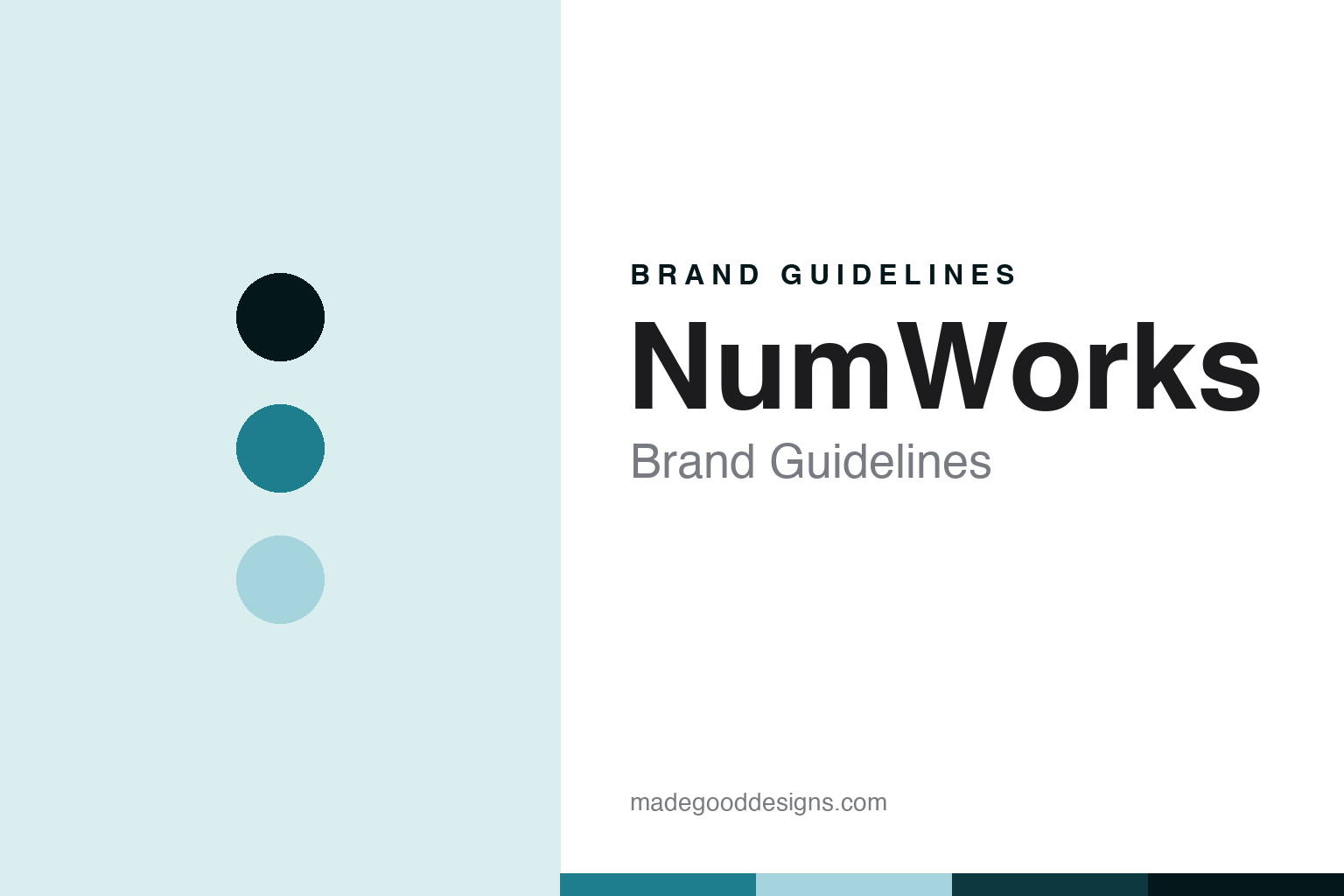
NumWorks lives in a NumWorks teal. Click a swatch to copy the hex.
NumWorks’ identity is French, independent and challenger — a NumWorks teal, an ink, a pale aqua, a deep teal, and a paper. The palette leans NumWorks teal and deep teal: a clean, modern register that stands in for a challenger calculator rather than a loud logo colour. It signals the French challenger to the calculator giants — French, independent and challenger. The honest caveat: with no official brand hex, these values are a modern, unofficial interpretation, not first-party colours.
The lesson is a NumWorks teal signals a French, challenger identity. NumWorks’ world is the Python graphing calculator and the exam mode. For designers, it is a reminder that a clean teal and a pale aqua can carry a French, challenger brand — a modern tone held as an accent, not a product shot. Because a mid hue can fail as small text, keep type dark and let the colour live in the accents, palette and band. The takeaways: date the founding to 2016 and name Romain Goyet; keep it French and independent; feature the Python graphing calculator; and call the OS source-available, not open-source.
Typography
The register is a challenger sans — French, independent, challenger.
NumWorks’ identity carries a French, challenger spirit — a newcomer against the giants. A challenger sans captures the mood: clean, modern and confident, the register of a young disruptor. Set in a NumWorks-teal palette, the challenger sans feels current and dependable — exactly the personality NumWorks carries. It behaves like a made, moulded thing rather than a loud logo, mirroring a display-line and a button-ring. (NumWorks’ real products and the name are things we describe but do not reproduce, and the exact typeface is not ours to use.) Because it is not ours to use, the honest description is “a challenger-sans brand,” shown here in a stand-in. The type behaves like the brand: French, independent and challenger.
Aa
A challenger-sans brand — clean and confident. (Specimen set in Outfit, a challenger-sans STAND-IN; NOT the NumWorks logo or products.)
The calculator node
NumWorks stands for the French challenger to the calculator giants.
NumWorks sits sixth in the round as its challenger node. A NumWorks-teal palette, a challenger sans and a 2016 founding make one thing — the French challenger to the calculator giants — the whole identity: French, independent and challenger. The 2016 founding is the pitch, the Python graphing calculator is the substance, and the source-available OS is the twist. The point is a young French maker challenging the incumbents, in a round about who owns and where-makes the calculator.
Put to work, the identity is the brand told straight, the founder named and the source claim corrected. A brand in this spirit would date the founding to 2016 and name Romain Goyet, keep it French and independent, feature the Python graphing calculator, and call the OS source-available, not open-source. A reader in this spirit would keep the facts right: NumWorks makes a graphing calculator; it dates to 2016; it is French and independent; and its OS is source-available. NumWorks sits after Canon and before Desmos. The honest editorial moves are to date the founding, to name the founder, to feature the product, and to correct the source claim.
For designers and brand-builders, NumWorks carries the calculator node: a challenger can take on the giants on design and openness — accurately described. The lessons: a newcomer can challenge entrenched incumbents, here NumWorks against TI and Casio; a founding is dated to the fourth of March 2016, by Romain Goyet, a former Apple engineer, with the N0100 launched in 2017; an ownership is kept, privately held and independent; a product is featured, a minimalist graphing calculator using Python, approved for the SAT, AP, ACT and IB; and a source claim is corrected, that the Epsilon operating system is source-available on GitHub under an all-rights-reserved licence rather than a true open-source one, with the hardware design shared under Creative Commons. It is also a reminder to describe openness accurately: NumWorks is the French, independent challenger with a source-available OS — with the palette here an unofficial interpretation, and the Paris base and Asian manufacture hedged. The hook is that challenge: NumWorks is the French challenger to the calculator giants, the independent French graphing calculator, founded in 2016, that runs Python and a source-available OS to challenge TI and Casio in the classroom. Read that way, NumWorks is less a single calculator than the French challenger to the calculator giants: French, independent, challenger. The lesson for a brand is that a challenger can take on the giants on design and openness when it is accurately described, and correcting the source claim keeps it honest. NumWorks made the-French-challenger-to-the-calculator-giants the identity — proof that a challenger can carry a node.
Explore & save
Keep NumWorks’s identity on hand — save it to a board in the Made Good inspiration library.
NumWorks identity set
Pin the NumWorks-teal palette and the challenger-sans register to your own board.