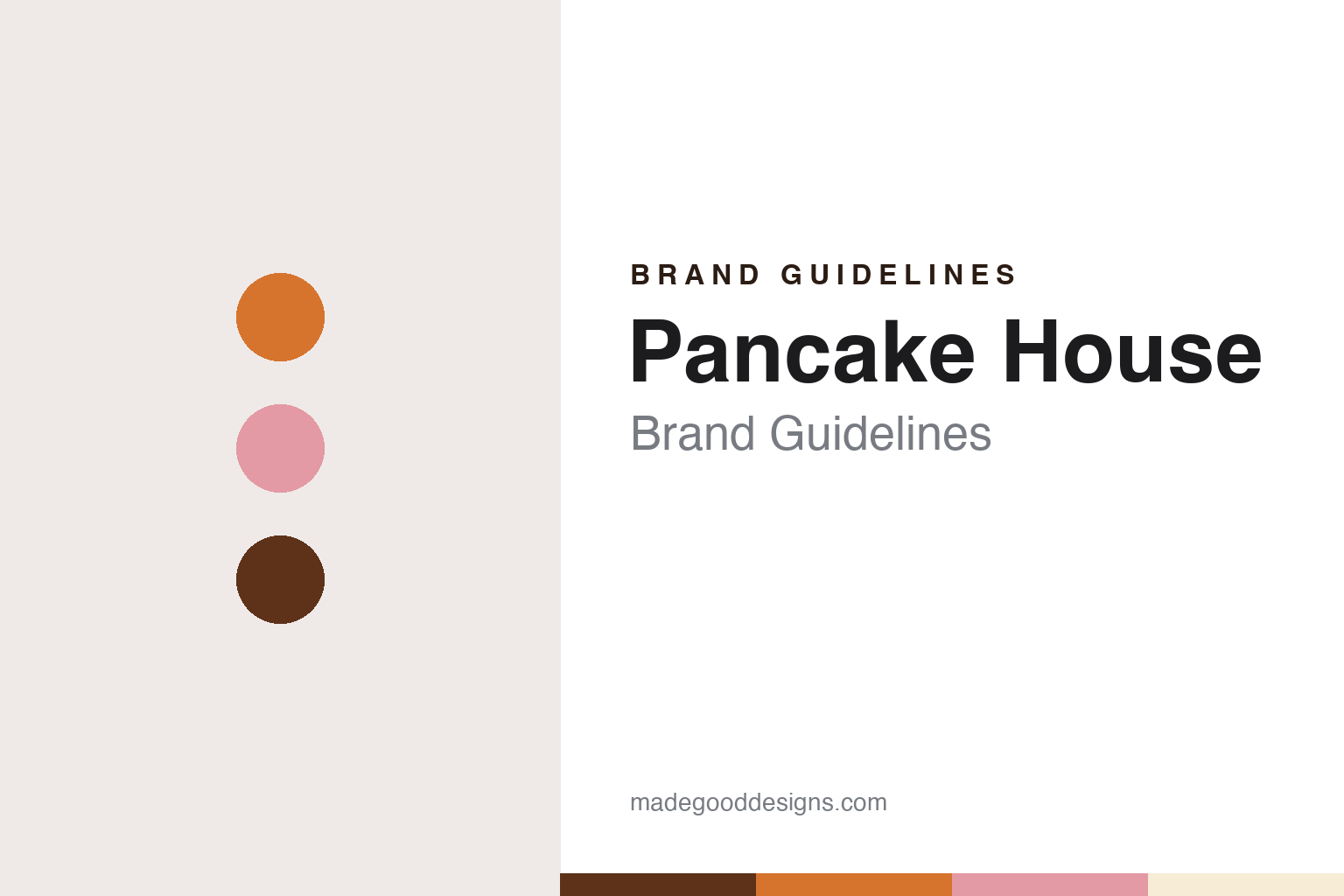
Pancake House Brand Guidelines
Magallanes pancakes, orange and pink booths, and Max’s Group.
Aa
Two constants: an orange, pink and syrup-brown palette and a soft serif register. Abstract homage — not a Pancake House product or mark; no logo, menu or dish is reproduced.
Magallanes
Pancakes and waffles in 1970s Makati.
Pancake House began in Magallanes, in Makati, Metro Manila. Its owner, Max’s Group, says the chain has served diners “since 1974,” and The Philippine Star gave the same year in February 2014: “Founded in 1974, the Pancake House group.” Other sources put the start earlier. A 2012 case study published by Wamda says the company was founded in 1970, and the Daily Tribune wrote in October 2025 that the first store opened at the Magallanes Theater in Makati in 1970.
Tatler Asia, in a 2021 piece on Filipino-owned restaurant chains, names the founders as the entrepreneurs Milagros Basa, Leticia Zamora and Carmen Zaragosa, and says they set out to introduce pancakes and waffles to Filipino diners. The company’s own website does not name them; it says only that Pancake House has been around since the 1970s.
The early look is the part the brand still talks about. The Pancake House website says early customers remember the early branches in Magallanes or the Ayala Arcade, with diners “seated in bright orange and pink booths, with old movie posters on the walls.” Tatler Asia quotes the same line.
Colour
Pan Chicken, waffles and a 2025 refit.
The menu widened over time. The Philippine Star noted in 2005 that Pancake House had “traditionally been associated with specialty pancakes and waffles” and had expanded into international dishes such as spaghetti, tacos and chicken. In October 2025 the Daily Tribune listed the dishes still served as Pan Chicken, Golden Brown Waffles, pancakes, spaghetti and the chain’s taco, while the brand’s own site opens with its classic pancakes served with whipped butter.
The Magallanes branch has been refitted rather than replaced. In 2025 Pancake House reopened its store at the Paseo de Magallanes, in the Makati district where the brand began; the Daily Tribune reported that the refreshed branch added a coffee nook made with the local roaster Yardstick Coffee and a separate takeout window. The same article described the brand as homegrown and as having been part of Filipino dining for more than five decades.
The franchise network carries the brand far beyond Makati. The Pancake House website says it has more than 100 franchises in the Philippines and overseas, Tatler Asia put the figure at more than 100 franchises in the Philippines in 2021, and The Philippine Star counted 114 Pancake House branches at the end of March 2014, out of 310 stores in the listed company’s network at that date.
Typography
Filipino chains and their owners.
The Philippines’ restaurant, bakeshop and snack chains tend to present themselves through a small set of recurring elements: a shop name and sign that customers can spot in a mall or on a busy road, menus organised around named dishes and named cakes, and packaging that travels home with the order. Some brands take their names from a place or a founder; Red Ribbon, by its own account, takes its name from the ribbon once tied around its cake boxes.
Many of these chains now sit inside a few restaurant groups. Jollibee Foods Corporation, which adopted “Jollibee Group” as its corporate brand in July 2025 according to BusinessWorld, owns brands including Jollibee, Chowking, Greenwich, Red Ribbon and Mang Inasal. Max’s Group, which traces itself to the Max’s Restaurant fried-chicken café of 1945, runs another portfolio of casual-dining brands, according to its own website.
Franchising is the usual route to growth, at home and abroad. Group and brand websites publish franchising pages for the Philippines and, in several cases, for international partners, and some chains have opened abroad. Red Ribbon is one example: it opened in California in 1984, according to English Wikipedia, and had 39 stores in the United States by October 2022, The Philippine Star reported.
This guide sets out what can be checked about each brand: who founded it, when and where, who owns it now, and how its own pages and the Philippine press describe its menu, stores and franchise network. Counts of stores are given with the date of the source, and claims that rest only on a company’s own word are marked as such.
Aa
A soft, rounded serif with a 1970s diner warmth. (Specimen set in Fraunces, a serif STAND-IN; NOT the Pancake House logo.)
Pancake House
The listed company that became Max’s Group.
The chain changed hands in 2000. Tatler Asia says the Lorenzo family acquired the company that year, turned it into Pancake House Inc. and listed it on the Philippine Stock Exchange; The Philippine Star reported in January 2026 that Pancake House listed in December 2000. Wamda’s 2012 case study says the chain was in a rut when Martin Lorenzo took it over in 2000 and that he rebuilt it as Pancake House, Inc.
Under that ownership Pancake House became a group of brands. It bought the Filipino grill chain Dencio’s in 2004 and agreed to buy the Japanese fast-food chain Teriyaki Boy in 2005, The Philippine Star reported; Fast Casual reported that the investment firm Abraaj, which had invested in 2005 and again in 2009, supported the purchases of Le Coeur de France and Yellow Cab Pizza. According to Fast Casual, the network grew from 89 to about 300 stores over that period, and the partnership also produced a joint venture with Malaysia’s Chicken Rice Shop group. Wamda counted six brands and 180 outlets in 2012. Yellow Cab joined in August 2011, and in 2013 Pancake House Inc. signed a ten-year master franchise agreement to take Yellow Cab into the United Arab Emirates, the Dubai trade title Images RetailME reported.
In February 2014 the Max’s Group, the company behind Max’s Restaurant, completed its purchase of a stake of nearly 90 percent in Pancake House Inc., The Philippine Star reported, and Pancake House remained a listed company. At that point, the paper said, the Pancake House group had 105 outlets of its flagship brand and more than 300 stores across its other chains, while the Max’s Group, established in 1945, ran more than 150 stores and held the Philippine franchise for Krispy Kreme. In July 2014 the board of Pancake House Inc. approved buying the 20 companies of the Max’s Group of Companies through a share issue, The Philippine Star reported, and Marketing-Interactive reported on 25 July 2014 that Pancake House Inc. would be renamed Max’s Group, Inc., with the ticker MAXS. By January 2015 The Philippine Star was describing Max’s Group, Inc. as the combined entity of Pancake House Inc. and the Max’s Group of Companies. The listed company now called Max’s Group therefore began as Pancake House; in January 2026 The Philippine Star called Pancake House the “precursor company” of Max’s, and listed the brand among the group’s chains, which numbered 573 stores at the end of 2025.
For a design guide, Pancake House shows how a remembered interior — orange and pink booths, old movie posters — can become a brand’s lasting reference. Compare Max’s Restaurant, now its sister chain, and Yellow Cab Pizza, which Pancake House bought in 2011. For this guide we use a booth orange, a booth pink and a syrup brown with a serif, an unofficial interpretation; no product or logo is reproduced.
Explore & save
Keep Pancake House’s identity on hand — save it to a board in the Made Good inspiration library.
Pancake House identity set
Pin the orange, pink and syrup-brown palette and the soft serif register to your own board.
Source & notes
Frequently Asked Questions
What font can I use to match the Pancake House look?
This guide describes Pancake House’s type as “A soft, rounded serif with a 1970s diner warmth”. Its type specimen is set in Fraunces from Google Fonts as a stand-in; Fraunces is not Pancake House’s own lettering.
What colours are in the Pancake House palette?
This guide’s Pancake House palette is Booth orange #D6742E, Booth pink #E39AA4, Syrup brown #5E3219, Butter cream #F7ECD6 and Griddle ink #2B1C14. The tones are the guide’s own unofficial interpretation, not official Pancake House hex codes.
When was Pancake House founded?
Pancake House was founded in 1974 (company date; some sources give 1970), in Magallanes, Makati.
Who founded Pancake House?
Pancake House was founded by Milagros Basa, Leticia Zamora and Carmen Zaragosa in 1974 (company date; some sources give 1970).