Philip Webb is better known to architects than to graphic designers, yet his work answers a question every designer faces: how much decoration does an object really need? He designed a house for William Morris, a set of table glass with almost no ornament, painted cabinets that served as frames for other artists, and late country houses that look as if they grew out of local building habits.
This guide covers what to look at in his objects, a short sourced career outline, his working methods and ideas you can borrow. For the wider movement, see our guide to the Arts and Crafts movement.
Who was Philip Webb?
Britannica records Philip Speakman Webb as born in Oxford on 12 January 1831 and died at Worth, Sussex, on 17 April 1915; the Metropolitan Museum of Art gives the same years, with Oxford and West Sussex as the places. Britannica describes him as an architect and designer known for unconventional country houses and places him in the English domestic revival. He trained in the Oxford office of the Gothic Revival architect George Edmund Street, a point made both by Britannica and by the Victorian Web.
In 1859 William Morris, newly married, commissioned Webb to design a house at Bexleyheath, then in Kent. Red House was completed in 1860, according to the National Trust, which now cares for it. The V&A describes how the pleasure Morris, Webb and their friends took in fitting out the house led in 1861 to Morris, Marshall, Faulkner & Co., a decorating firm for which Webb worked as a lead designer.
Webb’s later practice was mostly domestic. In 1877 he joined Morris in setting up the Society for the Protection of Ancient Buildings (SPAB), whose own history pages describe his long service on its committee. W. R. Lethaby, his friend and biographer, published Philip Webb and His Work as a book in 1935, after a series of articles in The Builder in 1925. Drawing Matter dates his retirement from practice to 1900; several other accounts put it in January 1901, when he moved to a cottage at Worth.
Key works, with dates
- Red House, Bexleyheath, 1859–60. Historic England’s Grade I listing describes a moderately sized, two-storey, L-shaped house in a simplified Gothic manner. The V&A holds Webb’s contract drawings of the plans and elevations.
- Table glass for Red House, 1860. The V&A dates Webb’s drawings to January 1860 and records that James Powell & Sons made the glass. The Met’s goblet below belongs to this design.
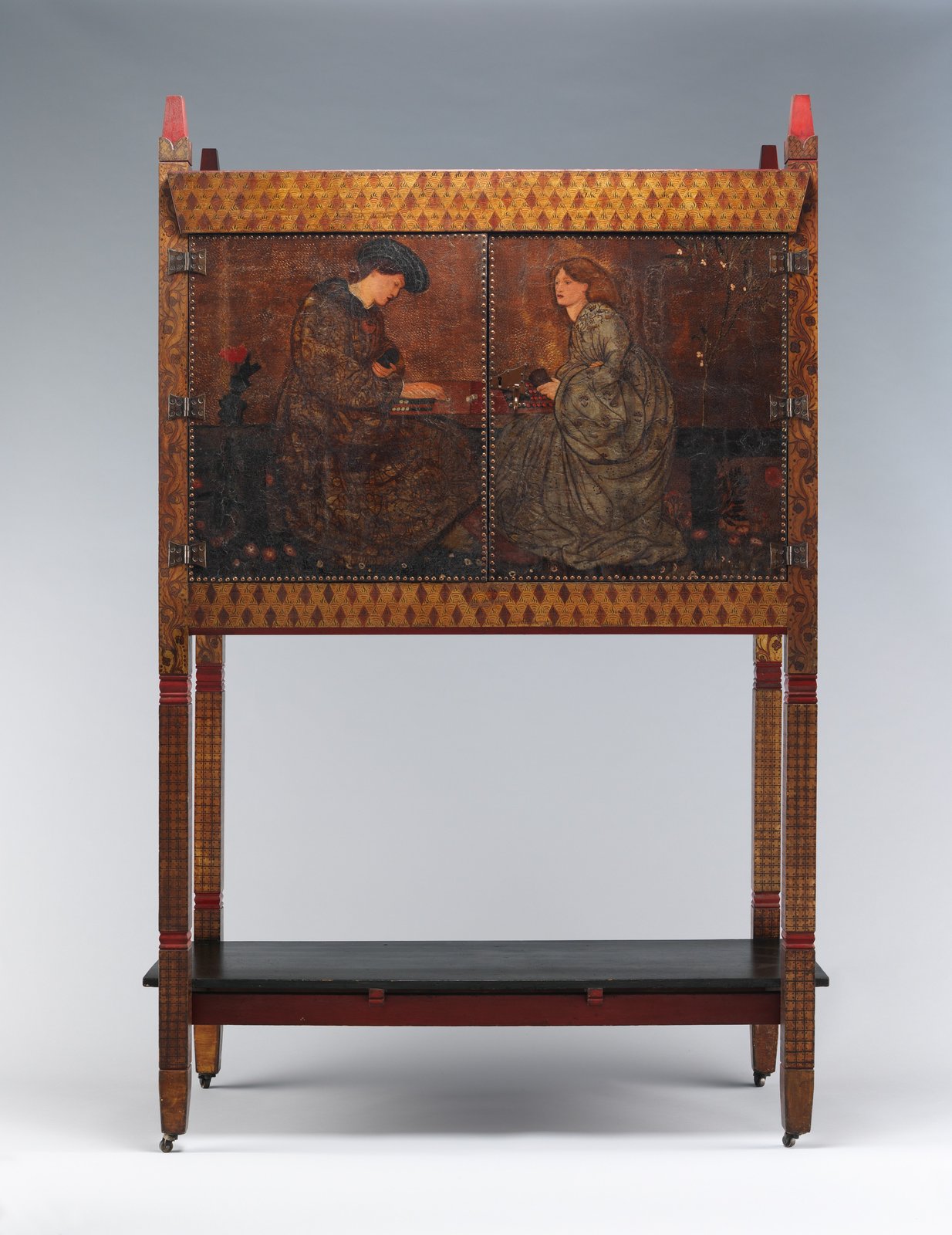
- The Backgammon Players cabinet, 1861. Designed by Webb, painted by Edward Burne-Jones and made by Morris, Marshall, Faulkner & Co., according to the Met, which bought it in 1926.
- Trellis wallpaper, 1864. The Met’s record for this block-printed paper credits William Morris with the design and Webb with the birds.
- Side table, mid-1860s. The V&A holds an oak table Webb designed for Burne-Jones, probably made by the Morris firm and possibly the one Burne-Jones ordered in 1865.
- Clouds, East Knoyle, Wiltshire. A country house for Percy Wyndham that Historic England dates to 1881–91.
- Standen, West Sussex, 1891–94. Built for James and Margaret Beale and fitted out with Morris & Co. furnishings, according to the National Trust, which now owns it.
What to look at in Philip Webb’s objects
Start with the cabinet. It stands about 185 centimetres high on four tall legs, with the storage box lifted to eye level like an easel. Two doors carry Burne-Jones’s painting on leather of a man and a woman at a backgammon board. Webb’s part is the frame: a deep cornice, a lower rail and legs decorated with small repeated diamonds and dots, plus red-tipped finials at the corners.
- A frame that serves the picture. The painted doors fill almost the whole front, and the surrounding woodwork stays flat and patterned, so the eye goes straight to the figures.
- Small repeats on long members. Rows of diamonds run along the cornice and down the legs, turning plain timber into a band of texture without carving.
- Visible hardware. Studded edges, strap hinges and a plain lower shelf are left in view. The Met lists brass and copper among the materials.
Measured from the Met’s scan of this cabinet, the painted doors sit in dark browns, #3e2b26 and #664334, with a warmer highlight near #805941. The gilded cornice pattern reads at about #b16533 and #ce8b3f, and the legs at #5d3423. These are values from the museum’s photograph, not original pigments.

Table glass: almost nothing added
The goblet is only 12 centimetres high, according to the Met, and made of clear flint glass. The record lists Webb as designer, James Powell and Sons at the Whitefriars glassworks as maker, and Morris, Marshall, Faulkner & Co. as retailer. Its whole decoration is a band of thin glass threads wound round the bowl, a short knopped stem and a round foot.
What makes it worth studying is restraint. The bowl swells slightly below the threads and narrows to the stem, so the profile alone gives it character. The trail of glass is decoration made from the same material, applied hot, and it doubles as a grip. According to the V&A, the Red House glass was originally intended for Morris’s own table, and by 1862 a simplified version without painting was sold commercially through the firm. The V&A also notes that very little of the range survives, despite its importance in the firm’s accounts.
Compare the dense, flat repeats in our guide to William Morris patterns, where Webb’s birds share space with Morris’s roses.
Technique: building as a craft
Webb worked across scales with the same habits. At Red House, Historic England’s description links the simplified Gothic manner to the domestic work of Street and William Butterfield. The plan is an L of two storeys rather than a single block. At Standen, more than thirty years later, the National Trust describes a deliberately vernacular house, with Margaret Beale planning and recording the interiors and Morris & Co. supplying wallpapers and textiles.
His furniture follows similar rules. The cabinet uses painted pine, leather, brass and copper; the V&A’s side table is oak. Construction stays simple and rectangular, and decoration comes from paint, pattern or another artist’s picture rather than from carved ornament.
The SPAB work added a conservation ethic. The society’s 1877 manifesto argued for “Protection in the place of Restoration”, meaning daily care and honest repair instead of rebuilding old fabric in a period style. The SPAB says Webb, Morris and George Wardle, manager of the Morris firm, were charged with drafting it.
Webb also shows how a small group can build a shared identity. The Met describes the painted cabinets as part of Morris’s attempt to erase the line between fine and applied art. A catalogue entry from the Edward Burne-Jones catalogue raisonné project suggests that this cabinet was probably among those the firm showed at the 1862 International Exhibition in London. For the brand side of that story, see our guide to Morris & Co. brand guidelines.
How designers can borrow Philip Webb’s ideas
- Design the frame, not just the content. Like the cabinet, a good layout gives an image or headline a quiet, patterned surround that points the eye inward.
- Make the accent functional. The trailed threads on the goblet are a grip as well as an ornament. Look for a detail in your design that does two jobs.
- Use small repeats on long edges. Rows of diamonds or dots along borders and rules add texture to a page without competing with the main image.
- Build a warm palette from real objects. Start from the measured browns and gilt tones above and test them in the MGD colour palette generator.
- Repair, don’t restyle. When updating an old identity, keep the elements that still work and make new parts visibly new, in the spirit of the SPAB manifesto.
- Look sideways at other architects. Our profile of C. F. A. Voysey shows another route through Arts and Crafts houses, furniture and pattern.
For more public domain furniture, glass and pattern to study, browse the MGD museum inspiration collection.
Frequently asked questions
What is Philip Webb known for?
For designing Red House for William Morris in 1859–60, for glass, furniture and pattern details made for Morris, Marshall, Faulkner & Co., for country houses such as Clouds and Standen, and for co-founding the Society for the Protection of Ancient Buildings with Morris in 1877.
Did Philip Webb paint The Backgammon Players cabinet?
No. The Met credits Webb with the design of the cabinet and Edward Burne-Jones with the painting on its doors. Morris, Marshall, Faulkner & Co. made it in 1861.
Who made Philip Webb’s table glass?
James Powell & Sons of the Whitefriars glassworks in London made it to Webb’s designs, according to both the V&A and the Met. The Met’s goblet of 1860 was retailed by the Morris firm.
Where can I see Philip Webb’s work?
Red House in Bexleyheath and Standen in West Sussex are cared for by the National Trust. The Met holds the cabinet and a goblet, and the V&A holds table glass, furniture and Webb’s Red House drawings. Not every piece is on view.