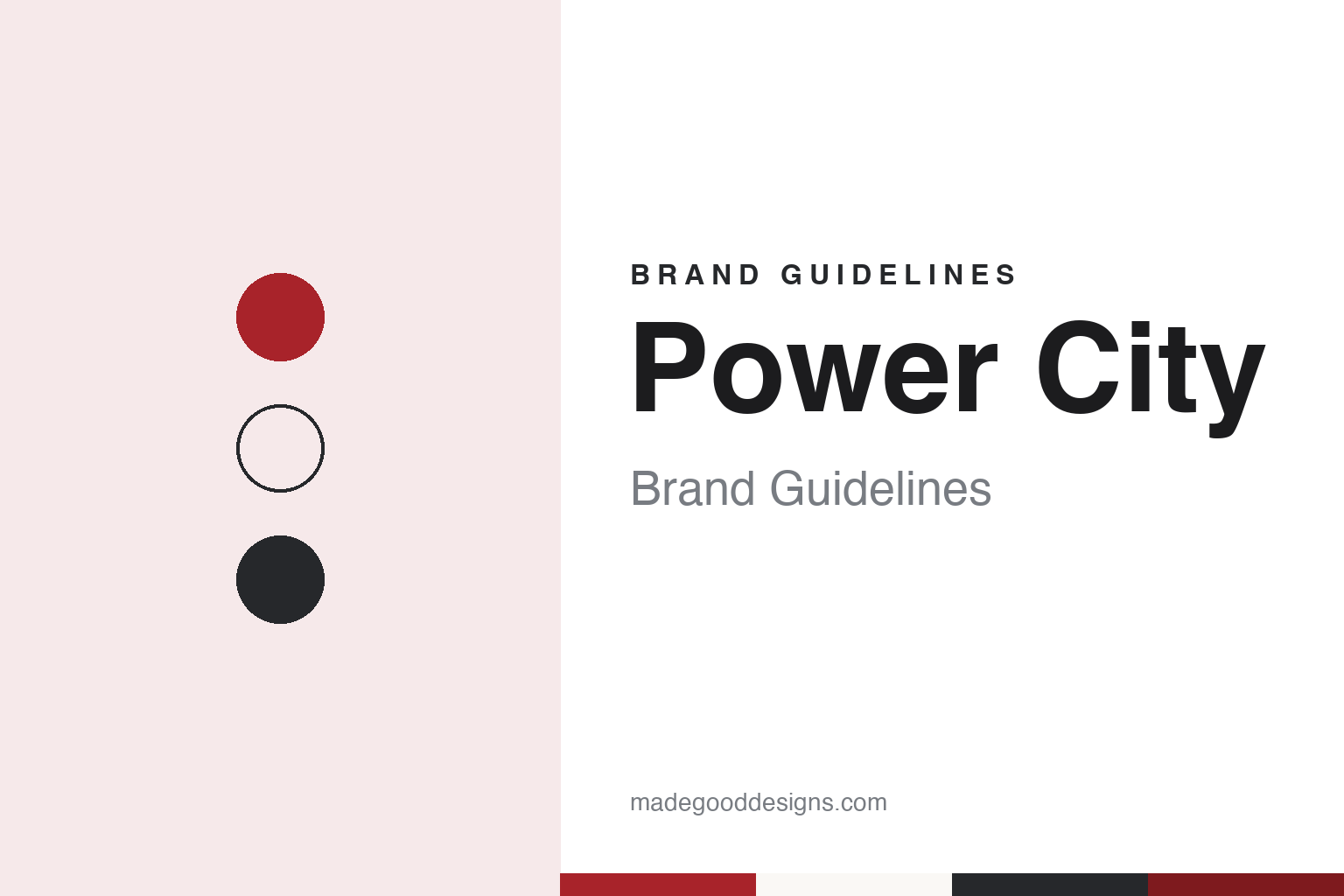
Power City Brand Guidelines
The family electrical chain from Bray with a red-and-white uniform.
Aa
Two constants: a red, white and charcoal palette and a heavy grotesque register. Abstract homage — not a Power City product or mark; no logo, fascia or advertisement is reproduced.
A family business from Bray
An electrical retailer owned by the McKenna family.
Power City is an Irish retailer of electrical appliances and consumer electronics owned by the McKenna family of Bray, County Wicklow. The trading company is Power City Ltd, and the company’s own website uses both “Power City” and “Powercity” on its pages; this guide uses the two-word form throughout. The Irish Times has described the business as a family-owned “consumer and electrical goods retailer” (March 2017) and as an “electrical appliance and tech retailer” (March 2024 and June 2026).
English Wikipedia places the head office in Bray, where the company’s website also lists a store at Pinewood Close. In March 2017 The Irish Times reported that the chain was controlled by the family of Wicklow-based businessman Liam McKenna; in June 2026 the same paper named Liam T McKenna, Dermot B McKenna and Sinéad McKenna as the company’s directors and described members of the McKenna family as its owners.
The chain grew out of Dublin. The Irish Times reported on 30 July 2005 that Power City, then owned by members of the Co Wicklow-based McKenna family, employed 194 staff at stores in Tallaght, Sallynoggin, Blanchardstown, Coolock, Finglas and Fonthill, the last near the Liffey Valley Centre in west Dublin. All six were in the Dublin area.
By March 2017 the paper counted 10 branches: the same six plus Bray, Drogheda, Naas and Carrickmines, with 238 staff. The new shops took the chain into County Wicklow, County Louth and County Kildare, while Carrickmines added a site in south County Dublin.
Colour
Eleven stores, mostly on retail parks.
The company’s store list, read in November 2026, names 11 stores: Tallaght, Sallynoggin, Blanchardstown at Coolmine Retail Park, Finglas, Coolock in the UCI complex on the Malahide Road, Fonthill Retail Park in Clondalkin, Bray, the M1 Drogheda Retail Park, Naas, The Park at Carrickmines and Airside in Swords. The Irish Times reported in June 2026 that the 11 stores are in the eastern part of Ireland and that staff numbers fell from 231 to 214 in the year to September 2025. English Wikipedia also records a former branch in the Airways Industrial Estate in Santry.
Staff numbers in the same newspaper’s reports give a sense of the chain’s scale over two decades: 194 people in 2005, 238 in the year to September 2016, 240 in the year to September 2023 and 214 in the year to September 2025. Over that period the store count rose from six to 11, with Swords the most recent addition named in the company’s own list.
Several of those addresses are retail parks rather than high streets, and the website groups the range into departments such as television, laundry appliances, built-in appliances, small kitchen appliances, heating, cooling, gaming and home office. Services listed on the site include click and collect, delivery, disconnect and installation, recycling, returns and a statutory warranty page, and its careers page recruits for senior sales, junior sales, cashier and support, and warehouse and logistics roles.
Power City has also had its own label. English Wikipedia says the chain once sold badge-engineered home-entertainment products under the brand “ZX”, including video cassette recorders, televisions and satellite dishes. Manufacturer names featured on the website in November 2026 include Bosch, Beko and LG.
Typography
How Irish retailers present themselves.
Irish retailers present themselves first through the shopfront. A name above the door, a logo on the carrier bag and a consistent colour scheme travel from one branch to the next, whether the shop is a city-centre department store, an out-of-town supermarket or a convenience shop on a village street. Many chains publish their own account of these elements on their corporate pages, alongside the story of their founders and owners.
The formats vary widely. Department stores, supermarkets and symbol-group convenience shops sit beside DIY and garden sheds, electrical stores, bookshops and newsagents, and sports chains. Some sell food, fashion and homeware under one roof; others concentrate on a single category and repeat the same layout, fittings and signage in every branch they open.
Ownership shapes the identity too. Some chains are family-owned and privately held; some are symbol groups, in which a wholesaler supplies a shared name, format and own-brand range to shops run by independent retailers; and some belong to larger retail groups at home or abroad. Each structure leaves its own mark on how a brand is applied: a single owner sets every sign directly, while a symbol group relies on shared standards that many separate owners follow.
Own brands and services carry the identity beyond the shop floor. Retailers name their own labels, food ranges, loyalty schemes, gift cards and delivery services, and those names appear on packaging, receipts, apps and websites. This guide draws on the companies’ own published material and on dated independent reporting, and its colours and type are an unofficial interpretation rather than any official brand standard.
Aa
A heavy grotesque for a loud, direct retail register. (Specimen set in Archivo, a sans STAND-IN; NOT the Power City logo.)
Power City
Television adverts and a striped shirt.
Advertising made the name familiar. In July 2005 The Irish Times pointed to Power City’s “in-your-face television adverts.” English Wikipedia says the chain’s advertising was satirised in the comedy Bull Island, which drew on the staff uniform of the time, red-and-white striped shirts with red V-neck jumpers, on the adverts’ emphatic phrasing and on their psychological pricing.
Ownership has stayed in the family through every period the press covers. The Irish Times described Power City as family-owned in 2005, 2017, 2024 and 2026, and its March 2024 report called the business McKenna family owned.
For designers, the public image that the sources record rests on a few plain elements: a short two-word name, a red-and-white staff uniform and heavy broadcast advertising. A system for the brand has to read on a retail-park fascia seen from across a car park, on a dense online appliance grid and in a fast television sign-off, and the uniform’s red and white stripe gives a ready graphic motif without borrowing any official artwork.
This guide therefore builds its palette around a strong shop red, a deeper red for small text and rules, a warm stripe white for backgrounds and a charcoal for body copy, with a steel grey reserved for secondary labels such as store names and opening hours. The display face is a heavy grotesque set tight and large, close in spirit to bold retail signage, while body text stays in a plain sans so that product names, model codes and service terms remain easy to scan on a busy page. Store names work well set as a simple list, from Tallaght to Swords, in the same weight throughout, rather than as a map or a decorative graphic.
For a design guide, Power City shows how a regional, family-owned chain built its name around a uniform, a colour pair and repeated television advertising. Compare DID Electrical, another Irish electrical retailer, and Arnotts, the Dublin department store. For this guide we use a strong red, a warm white and a charcoal with a heavy sans, an unofficial interpretation; no product or logo is reproduced.
Explore & save
Keep Power City’s identity on hand — save it to a board in the Made Good inspiration library.
Power City identity set
Pin the Power City red, white and charcoal palette and the heavy grotesque register to your own board.
Source & notes
Frequently Asked Questions
What font can I use to match the Power City look?
This guide describes Power City’s type as “A heavy grotesque for a loud, direct retail register”. Its type specimen is set in Archivo from Google Fonts as a stand-in; Archivo is not Power City’s own lettering.
What colours are in the Power City palette?
This guide’s Power City palette is Shop red #A8232A, Deep red #7E1A1E, Stripe white #FAF8F5, Charcoal #26282B and Steel grey #8A8F96. The tones are the guide’s own unofficial interpretation, not official Power City hex codes.
Who owns Power City?
Power City is owned by the McKenna family. This guide gives Bray, Co Wicklow as where Power City is based.
Where is Power City based?
Power City is based in Bray, Co Wicklow. This guide lists McKenna family as its owner.