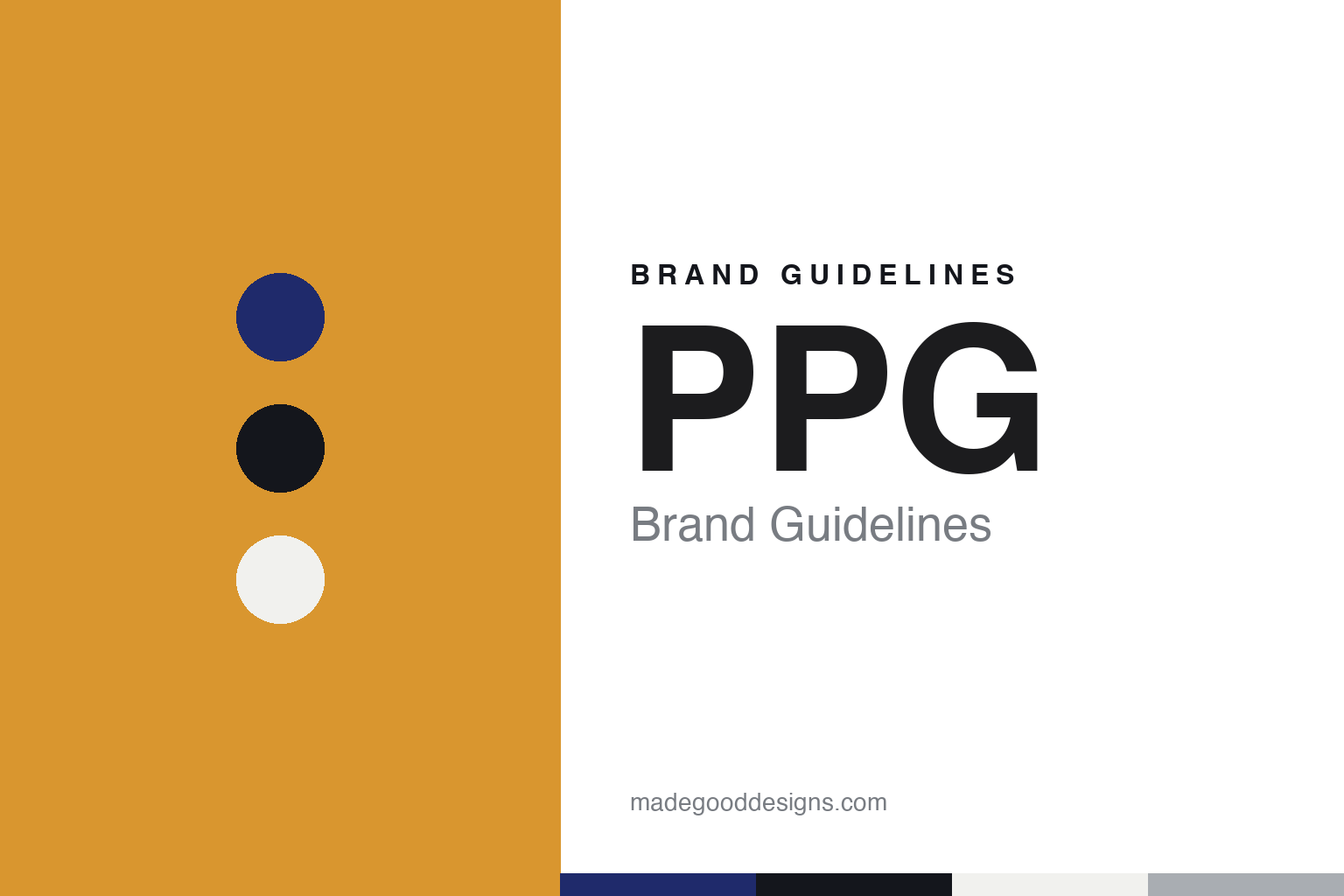
PPG Brand Guidelines
The Hamburg wavetable pioneer and its blue Wave.
Aa
Two constants: a PPG ultramarine, ink and white palette and a Technical sans register. Abstract homage — not a PPG product or mark; no instrument, logo or nameplate is reproduced.
Palm Products
A fifth-floor workshop in Hamburg.
PPG was one man’s company. Wolfgang Palm, a keyboard player in Hamburg bands, began building synthesizer circuits himself after hearing a synthesizer solo by Emerson, Lake & Palmer on the radio around 1970, he recalled in “The PPG Story,” the history he published on his own website. Having finished his studies in 1974, he decided to put all his time into developing and making synthesizers. The firm became Palm Products GmbH, abbreviated PPG — the name English and German Wikipedia give, while Sound On Sound and other sources write Palm Productions. Most accounts date it to 1975; Palm himself wrote that a tenth-anniversary party held in 1984 marked the date of his business registration.
Its beginnings were modest. Palm described PPG as himself, one salaried employee and some part-timers, in an old mechanics’ workshop on the fifth floor of a building with no lift, where finished systems were lowered to the street with a winch. He made a small monophonic synthesizer, the 1002, and modular systems modelled on Moog’s; built modules and multi-wheel keyboards for Christoph Franke and Peter Baumann of Tangerine Dream; and in the 1020 used digitally controlled oscillators to cure the tuning drift of analogue designs. He also wrote that “it isn’t true that TD had a share in PPG,” correcting a story that circulated about the band. His 1003 Sonic Carrier, which could store its settings, sold only 16 units, he said, and he called it the first fully “memory-programmable” synthesizer in the world — his claim.
In 1977 Palm took his instruments to the Frankfurt Musikmesse without a booth, showing them to dealers in his hotel room. That trip led to orders, and to a call from a shop assistant in Offenburg, Wolfgang Düren, who persuaded Palm to let him set up a proper PPG distribution.
Colour
Wavetables, the Wave and the Waveterm.
PPG’s fame rests on wavetable synthesis. Palm’s idea, he wrote, was an oscillator that changes its waveform as it plays: each wave 128 samples long, 64 waves to a table, some built from the spectra of trumpets and violins that he measured from a textbook with a ruler. Sound On Sound’s Gordon Reid dated the first Wavecomputers, the 340/380 system and the 360, to 1978; other sources give 1979 or 1980. They sounded thin and sold slowly, so in 1981 Palm added analogue filters and a sequencer to make the Wave 2, priced at about 16,500 marks in Germany, German Wikipedia says. The Wave 2.2 of 1982, with two oscillators per voice, “brought the marque to the world’s attention,” Reid wrote in 2011, and the Wave 2.3 of 1984 added eight-part multitimbrality and MIDI as standard.
Around the keyboards Palm built a system: the Waveterm computer for sampling and drawing wavetables, the PRK keyboard shown at Frankfurt in 1983, expansion voice units and, in 1986, the HDU hard-disk recorder. English Wikipedia says the Wave system was meant to compete with the far more expensive Fairlight CMI. At the peak, Palm wrote, PPG was making “in the region of 50 Waves per month”; it marked the 500th with a gold-coloured case. English and German Wikipedia put the total at about 1,000 Waves.
Its players included David Bowie, Thomas Dolby, Tangerine Dream, Depeche Mode, Talk Talk and Tears for Fears, according to English Wikipedia; Palm himself singled out Frankie Goes to Hollywood’s “Two Tribes,” Propaganda and Robert Palmer. Reliability was the weak point, he admitted: the 2.2’s boards ran hot, and dealers had to swap them rather than repair them.
Typography
Design and documentation.
Digital sampling and synthesis reached recording studios in the late 1970s and 1980s. Fairlight, founded in Sydney in 1975 by Peter Vogel and Kim Ryrie, introduced its CMI in 1979; New England Digital, founded in Vermont in 1976 by Sydney Alonso and Cameron Jones, built the Synclavier; and Wolfgang Palm’s PPG, in Hamburg, introduced wavetable synthesis in 1979, English Wikipedia says.
American makers brought prices down. E-mu, whose name Dave Rossum coined in 1971 and which he and Scott Wedge formed as a partnership in 1972, moved from modular synthesizers to samplers; Ensoniq, of Malvern, Pennsylvania, launched its Mirage sampler in 1985 at $1,695; Kurzweil, founded in 1982, launched its K250 in 1984; and Alesis, formed in Hollywood by Keith Barr in 1984, Mix reported, launched the ADAT recorder in 1991.
Few stayed independent. PPG closed in 1987, and New England Digital in the early 1990s. Creative Technology of Singapore bought E-mu in 1993 and Ensoniq in 1998, and merged them. The Korean piano maker Young Chang bought Kurzweil in 1990; Hyundai Development Company bought Young Chang in 2006, and the group, renamed HDC Young Chang in 2018, is based in Incheon; Kurzweil’s own website names no parent company today.
Some names returned. Blackmagic Design, the Australian video company, bought Fairlight in 2016 and sells Fairlight consoles. Cameron Jones bought back the Synclavier trademark, and his Synclavier Digital released the Regen synthesizer in 2022. Jack O’Donnell bought Alesis in 2001; it belongs to his inMusic group of Cumberland, Rhode Island.
This guide sets out what can be checked about each brand — who founded it, who owns it, and what it says about where its products are made — and marks clearly what rests only on the company’s own word.
Aa
A technical sans — the logic of a wavetable. (Specimen set in Chakra Petch, a sans STAND-IN; NOT the PPG logo.)
PPG
A clean ending and a long afterlife.
The end came in 1987. Wave sales fell as the Yamaha DX7 and cheaper samplers took over, while PPG spent heavily on the Realizer, an all-in-one digital studio first shown to dealers at the 1986 Frankfurt fair. Reid wrote that only a couple of prototypes were built. Palm wrote that after the 1987 fair the company decided on liquidation, adding that PPG “was not bankrupt … but was very cleanly dissolved.” Palm then went to work at Steinberg, he said, and in 2002 Steinberg released PLEX, a software synthesizer developed with him, German Wikipedia says.
The ideas outlived the company. In 1988 Düren founded Waldorf, whose first instrument, the Microwave of 1989, used a chip Palm designed; Waldorf later sold PPG Wave software, the Wave 2.V and the Wave 3.V. In the 2010s Palm sold his own PPG-branded plug-ins and iOS apps, among them WaveMapper, Infinite, Phonem and WaveGenerator. In March 2020 he announced on his website that he was stopping business and that Brainworx Audio GmbH, the company behind Plugin Alliance, would “take over and continue my products and ideas.” Brainworx and Plugin Alliance became part of Native Instruments in 2023, and in May 2026 inMusic acquired them along with Native Instruments, MusicRadar reported. We found no PPG title in Plugin Alliance’s online catalogue in October 2026. By 2025 Behringer was selling the Wave, a hardware copy of the Wave 2.2 and 2.3, Synth Anatomy reported.
The look is a colour. English Wikipedia, citing enthusiasts’ sites, says the Wave’s control panels were finished in ultramarine RAL 5002 blue, and that blue panel is how most people picture a PPG.
For a design guide, PPG shows how one colour and one idea can carry a brand long after the company has gone. Compare Fairlight, the sampling system the Wave set out to rival, and Sequential, whose Prophet VS of 1986 also stepped through stored waveforms. For this guide we use an ultramarine, ink, white and silver with a sans, an unofficial interpretation; no product or logo is reproduced.
Explore & save
Keep PPG’s identity on hand — save it to a board in the Made Good inspiration library.
PPG identity set
Pin the PPG ultramarine, ink and white palette and the Technical sans register to your own board.