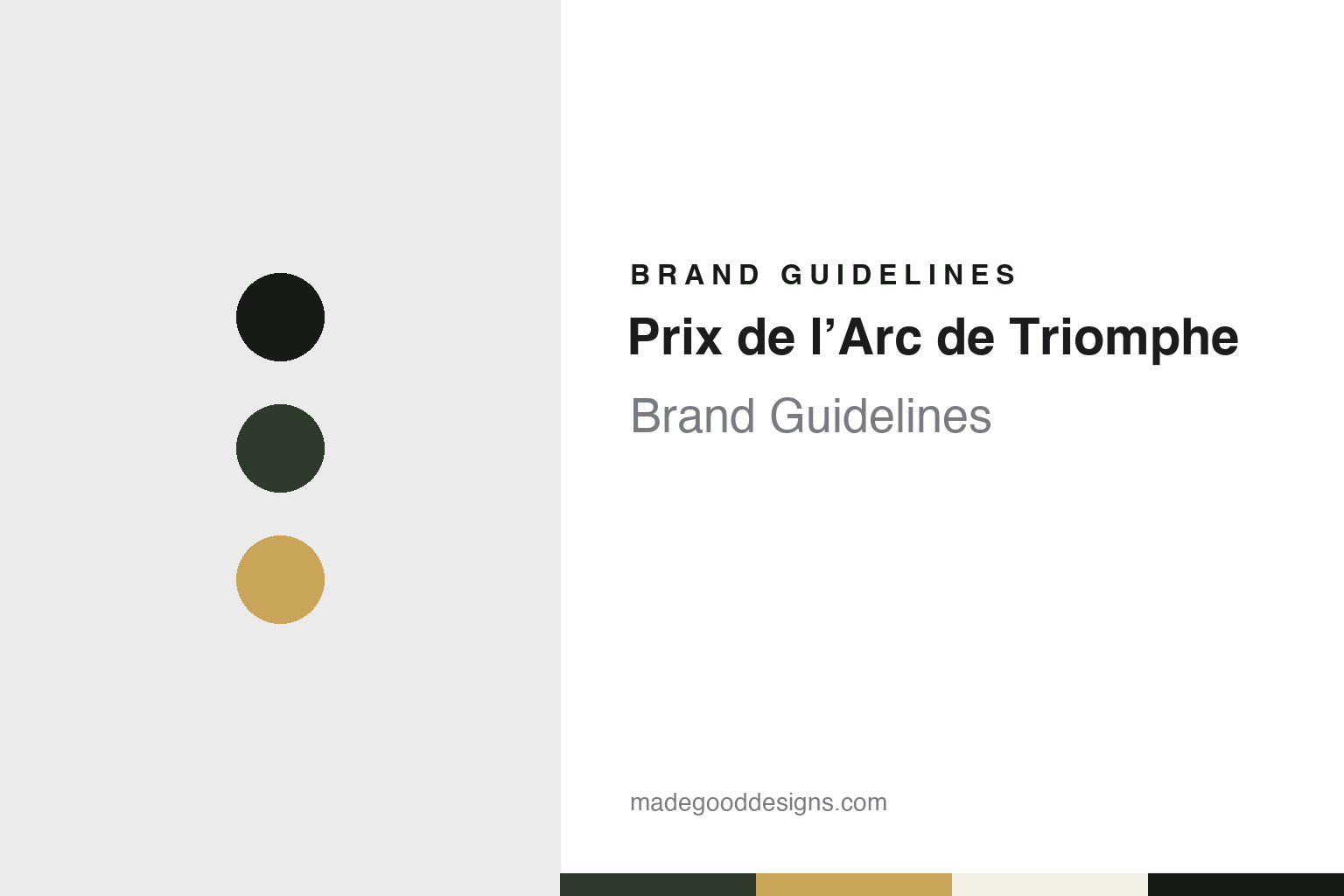
Prix de l’Arc de Triomphe Brand Guidelines
Longchamp’s October race, first run in 1920.
Aa
Two constants: a Bois green and autumn gilt palette and a Parisian serif register. Abstract homage — not a Prix de l’Arc de Triomphe or France Galop mark; no trophy, logo or poster is reproduced.
Longchamp, 1920
A post-war race named after a monument.
The Prix de l’Arc de Triomphe is a Group 1 flat race for thoroughbreds aged three and older, run over 2,400 metres at Longchamp in the Bois de Boulogne, on the western edge of Paris. English Wikipedia says it is usually held on the first Sunday in October. French Wikipedia adds that it is open to entire males and fillies and mares, with geldings excluded.
The race grew out of an older plan to open French racing to foreign horses. Both Wikipedias say that in 1863 the Société d’Encouragement, then the body that ran French flat racing, created the Grand Prix de Paris for three-year-olds of any country, and some thirty years later added the Prix du Conseil Municipal for older horses. A third international race was proposed at a committee meeting on 24 January 1920. Unlike the Conseil Municipal, where weights depended on earlier results, the new race would set weights only by age and sex. Coming after the First World War, it was named after the Arc de Triomphe, the monument that had been the scene of the Allied victory parade in 1919; English Wikipedia says “Prix de la Victoire” had also been suggested.
The first Arc was run on Sunday 3 October 1920 and won by the three-year-old colt Comrade. The racecourse was already more than sixty years old. French Wikipedia says the City of Paris conceded the Longchamp plain to the Société d’Encouragement in 1856, and that the course, designed by the architect Antoine-Nicolas Bailly, opened on 27 April 1857. Its first wooden stands were replaced in stone in 1904, and new stands were built between 1962 and 1964.
The race was not run in 1939 and 1940, and in 1943 and 1944 it was held at the Le Tremblay racecourse over 2,300 metres, according to both English and French Wikipedia. It returned to Longchamp afterwards, and the distance has stayed at 2,400 metres.
Colour
France Galop, Chantilly and a gilded grandstand.
The organiser today is France Galop. French Wikipedia says it was created on 5 May 1997 by decree, from the merger of the Société d’Encouragement et des Steeple-Chases de France, the Société de Sport de France and the Société Sportive d’Encouragement. It runs five racecourses, Longchamp, Auteuil, Chantilly, Saint-Cloud and Deauville, and lists the Arc among the major races it stages alongside the Prix de Diane and the Prix du Jockey Club. Longchamp sits on land owned by the City of Paris, which has long entrusted its operation to France Galop.
The Arc’s current look comes from the most recent rebuild. French Wikipedia says Longchamp closed in autumn 2015 and reopened on 8 April 2018, with an inauguration on 29 April, after works led by Dominique Perrault, the architect of the Bibliothèque nationale de France; the course has since been called ParisLongchamp. During the closure the race moved to Chantilly, which staged the 2016 and 2017 editions, both Wikipedias say.
Architectural Record described the new building in August 2018. Its editor Josephine Minutillo wrote that the timing of the race, when the leaves of the Bois de Boulogne turn gold, influenced the look of the grandstand: the glazed balustrades, mesh doors and mushroom-like sunshades are all a soft gilded colour, which Perrault told the magazine was about the relationship to the landscape. The practice’s artistic director, Gaëlle Lauriot-Prévost, said the team wanted the building to look like a galloping thoroughbred, ending in a cantilever as its head.
The magazine gave the grandstand about 10,000 seats on four levels, inclined towards the track, and said it replaced a pair of 1960s structures while a landmarked 1921 grandstand was kept beside it. A long raised walkway, which the architects call la planche, runs in front of a green lawn that takes temporary seating for big days; Architectural Record said the Arc weekend can draw up to 70,000 visitors.
Typography
Design and documentation.
Horse races, race meetings and racecourses present themselves through a small set of lasting things: a race name, a place and a date in the calendar. Many of the oldest names come from people or places. English Wikipedia says the Derby at Epsom took its name from the 12th Earl of Derby in 1780, and that the name was later borrowed by races in Ireland, France, Germany, Italy, the United States and Japan. Other names record a sponsor, a patron or a change of venue, and renamings and moves are part of each event’s history.
The racecourse is the main stage. Grandstands are often named, rebuilt and renamed over the decades: at Cheltenham the Princess Royal Stand opened in 2015, and at Epsom the main stand was renamed the Queen Elizabeth II Stand in 2022, according to English Wikipedia. The ground matters too, from Cheltenham’s amphitheatre under the Cotswold escarpment to the open downs at Epsom, where part of the crowd has always watched for free.
Objects carry the rest of the identity, and a trophy can become an emblem of a race: The Jockey Club says the original 1924 Cheltenham Gold Cup returned to the course in 2018 and is now presented as a perpetual trophy. Racecards, posters and paintings add a printed and painted record, as William Powell Frith’s The Derby Day of 1858 shows.
Behind each event stands an organiser or owner. In Britain, The Jockey Club owns and operates both Cheltenham and Epsom Downs. This guide describes each race or racecourse through dated facts: when it was first run, who organises it, where it has been held and how its name and buildings have changed.
Aa
A Parisian serif for a race named after a monument. (Specimen set in Cormorant Garamond, a serif STAND-IN; NOT the Prix de l’Arc de Triomphe logo.)
Prix de l’Arc de Triomphe
A race weekend with a sponsor’s name in front.
Since 2008 the race has carried a Qatari sponsor’s name. French Wikipedia says the Qatar Racing and Equestrian Club signed an agreement with France Galop in Doha in 2008, and the same encyclopaedia’s France Galop article lists the race as the Qatar Prix de l’Arc de Triomphe. English Wikipedia lists earlier sponsors after state lottery support ended in 1982, including Trusthouse Forte, CIGA Hotels and Groupe Lucien Barrière. As with any title sponsor, the race name and the sponsor’s own identity are separate subjects.
The Arc is the centre of a two-day meeting rather than a single race. English Wikipedia says the weekend includes seven Group 1 races and four at Group 2, and French Wikipedia names several of them, among them the Prix Marcel Boussac, the Prix Jean-Luc Lagardère, the Prix de l’Abbaye de Longchamp and the Prix de l’Opéra, along with races for purebred Arabian horses. French Wikipedia records eight horses that have won the Arc twice and gives the jockey Frankie Dettori the most wins, with six between 1995 and 2018.
Visually, the Arc borrows from its setting more than from any single emblem. The name points to a Paris monument, the course sits inside a public park with the towers of La Défense on the horizon, as Architectural Record noted, and the 2018 grandstand takes its colour from the trees in October.
For a design guide, the Prix de l’Arc de Triomphe shows how a race can take its identity from a city, a season and a building. Compare Royal Ascot, another European meeting built around a historic course, and Japan Cup, another international race in this series of guides. For this guide we use a deep park green, an autumn gilt and a zinc grey with a serif, an unofficial interpretation; no product or logo is reproduced.
Explore & save
Keep Prix de l’Arc de Triomphe’s identity on hand — save it to a board in the Made Good inspiration library.
Prix de l’Arc de Triomphe identity set
Pin the Prix de l’Arc de Triomphe green and gilt palette and the Parisian serif register to your own board.
Source & notes
Frequently Asked Questions
What font can I use to match the Prix de l’Arc de Triomphe look?
This guide describes Prix de l’Arc de Triomphe’s type as “A Parisian serif for a race named after a monument”. Its type specimen is set in Cormorant Garamond from Google Fonts as a stand-in; Cormorant Garamond is not Prix de l’Arc de Triomphe’s own lettering.
What colours are in the Prix de l’Arc de Triomphe palette?
This guide’s Prix de l’Arc de Triomphe palette is Bois green #2E3A2C, Paris ink #161B15, Autumn gilt #C9A55A, Zinc grey #7D8389 and Limestone #F4EFE4. The tones are the guide’s own unofficial interpretation, not official Prix de l’Arc de Triomphe hex codes.


