Dubai World Cup Brand Guidelines
A 1996 dirt race that moved to Meydan.
Aa
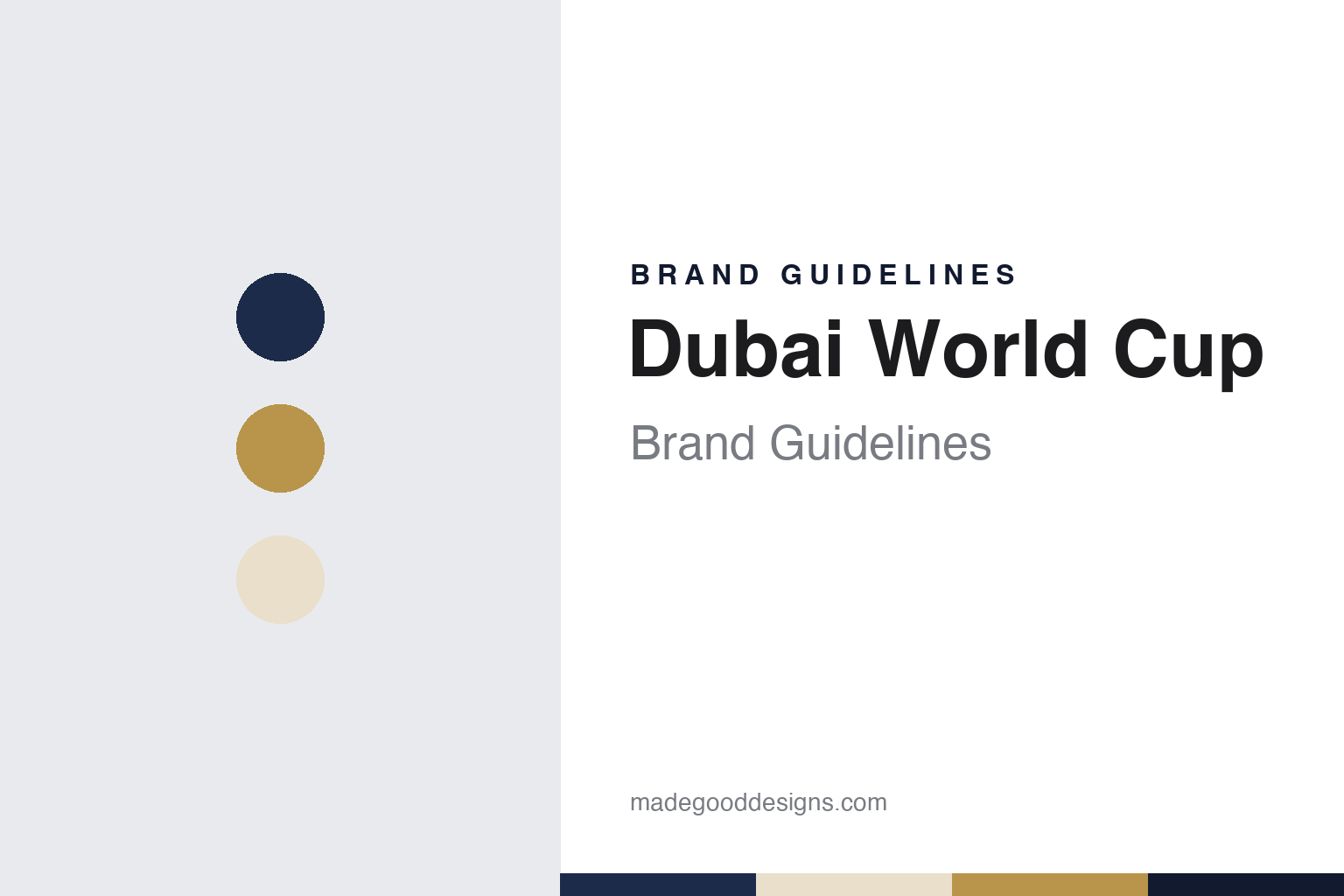
Two constants: a night blue, sand and gold palette and an evening serif register. Abstract homage — not a Dubai World Cup or Dubai Racing Club asset; no logo, trophy or mark is reproduced.
Nad Al Sheba
From a camel track to a world cup.
The Dubai World Cup is a horse race run each year in Dubai, in the United Arab Emirates. English Wikipedia says it was created in 1996 by Sheikh Mohammed bin Rashid Al Maktoum, the owner of the Godolphin racing operation and the Darley stud. It is run as a Group 1 flat race on dirt over 2,000 metres, about ten furlongs, and it is the final race of Dubai World Cup Night, a card of races held at the end of the season; Wikipedia gives the usual date as the last Saturday in March.
The race grew out of a younger racing calendar. Dubai Racing Club says Thoroughbred racing in Dubai began in October 1981, when three races were run at the city’s camel track, over a sprint, a mile and a mile and a half. The club itself was set up in early 1992, and it dates the official opening of Nad Al Sheba Racecourse to March of that year; English Wikipedia gives an earlier opening year, 1986, for the same course, so the two accounts differ. In March 1993 the club staged the first Dubai International Jockeys’ Challenge, with riders invited from the United States, Europe, Australia, Japan and the Emirates, and the club says that event paved the way for the World Cup.
The first running, in 1996, went to the American horse Cigar, according to both the club and Wikipedia. The race stayed at Nad Al Sheba for its first editions; the club dates the last World Cup there to 2009, its fourteenth running. Wikipedia says the old course was then demolished, and a new racecourse took its place on the same site.
Colour
A grandstand half a mile long.
That racecourse is Meydan. English Wikipedia, citing Gulf News, dates its opening to 27 March 2010 and names Dubai Racing Club as its owner. Its grandstand runs for about half a mile and holds more than 60,000 spectators, Wikipedia says, a figure the club also gives; the building includes a hotel, restaurants, corporate suites and a racing museum. The club names The Meydan hotel, with 285 rooms, beside the track, and calls Meydan the permanent home of the World Cup.
The move brought a change of surface. The Guardian’s Greg Wood reported from the first World Cup at Meydan on 27 March 2010, a finish decided by a nose in favour of a horse trained in France by Pascal Bary and ridden by the Brazilian jockey Tiago Pereira; he described Meydan as part of Sheikh Mohammed’s plan for a focus of international racing. Wikipedia says that 2010 race was run on Tapeta, a synthetic surface, and that the World Cup returned to dirt in 2015.
Dubai Racing Club describes its role as organising and hosting racing at Meydan each season from November to March, working with the Emirates Racing Authority, the body that governs the sport in the country. Its group also takes in the Dubai Equestrian Club, the Emirates Equestrian Centre and Zabeel Feed, the club says.
The field is international. The race is open to Northern Hemisphere horses aged four and over and Southern Hemisphere horses aged three and over, according to Wikipedia. The club’s own history notes a first Brazilian-bred winner in 2010, a first win for Japan in 2011, when Japanese horses finished first and second, and, in 2024, the first winner trained locally outside the Godolphin operation. Wikipedia counts nine wins for Godolphin as an owner, more than any other.
There has been one break. The 2020 meeting, which was due to be the 25th edition and was set for 28 March at Meydan, was called off on 22 March, BBC Sport reported. The club dates the 25th running of the race to 2021.
Typography
How race meetings present themselves.
Horse races, race meetings and racecourses present themselves through a small set of lasting things: a race name, a place and a date in the calendar. Many of the oldest names come from people or places. English Wikipedia says the Derby at Epsom took its name from the 12th Earl of Derby in 1780, and that the name was later borrowed by races in Ireland, France, Germany, Italy, the United States and Japan. Other names record a sponsor, a patron or a change of venue, and renamings and moves are part of each event’s history.
The racecourse is the main stage. Grandstands are often named, rebuilt and renamed over the decades: at Cheltenham the Princess Royal Stand opened in 2015, and at Epsom the main stand was renamed the Queen Elizabeth II Stand in 2022, according to English Wikipedia. The ground matters too, from Cheltenham’s amphitheatre under the Cotswold escarpment to the open downs at Epsom, where part of the crowd has always watched for free.
Objects carry the rest of the identity, and a trophy can become an emblem of a race: The Jockey Club says the original 1924 Cheltenham Gold Cup returned to the course in 2018 and is now presented as a perpetual trophy. Racecards, posters and paintings add a printed and painted record, as William Powell Frith’s The Derby Day of 1858 shows.
Behind each event stands an organiser or owner. In Britain, The Jockey Club owns and operates both Cheltenham and Epsom Downs. This guide describes each race or racecourse through dated facts: when it was first run, who organises it, where it has been held and how its name and buildings have changed.
Aa
An evening serif for a race run under floodlights. (Specimen set in Playfair Display, a serif STAND-IN; NOT the Dubai World Cup logo.)
Dubai World Cup
A race named for its city.
The race carries two names at once: the city and the meeting. It sits inside a larger programme that the club runs through the winter, from November to March, ending on World Cup Night, when the World Cup is run as the last race of the evening. Music is part of the night: Wikipedia lists performers on World Cup night from 2012 onward, among them Kylie Minogue in 2015 and Janet Jackson in 2016.
Dubai Racing Club’s website lists partners including the airline Emirates and the Swiss watchmaker Longines; both are separate subjects with their own guides. The club’s site also states that its branding and trademarks belong to Dubai Racing Club and may not be reproduced without permission, which is why this guide uses abstract shapes and our own tones rather than any race mark.
The record stays long. Wikipedia lists the speed record at Nad Al Sheba from 2000 and separate records for the synthetic and dirt eras at Meydan, where the race has been run on both Tapeta and dirt. In 2026 the race marked its 30th anniversary, the club says, and the World Cup that year was won by Magnitude.
For a design guide, Dubai World Cup shows how a race can build its identity around a single night, a single venue and a calendar that ends on one closing race. Compare the Breeders’ Cup, another meeting built around a closing championship card, and Emirates, one of the club’s listed partners. For this guide we use a night blue, desert sand and a trophy gold with a serif, an unofficial interpretation; no product or logo is reproduced.
Explore & save
Keep Dubai World Cup’s identity on hand — save it to a board in the Made Good inspiration library.
Dubai World Cup identity set
Pin the Dubai World Cup night blue, sand and gold palette and the evening serif register to your own board.
Source & notes
Frequently Asked Questions
What font can I use to match the Dubai World Cup look?
This guide describes Dubai World Cup’s type as “An evening serif for a race run under floodlights”. Its type specimen is set in Playfair Display from Google Fonts as a stand-in; Playfair Display is not Dubai World Cup’s own lettering.
What colours are in the Dubai World Cup palette?
This guide’s Dubai World Cup palette is Night blue #1D2B4A, Deep ink #111A2E, Desert sand #E9DFCB, Trophy gold #B8954A and Paper #F8F6F1. The tones are the guide’s own unofficial interpretation, not official Dubai World Cup hex codes.