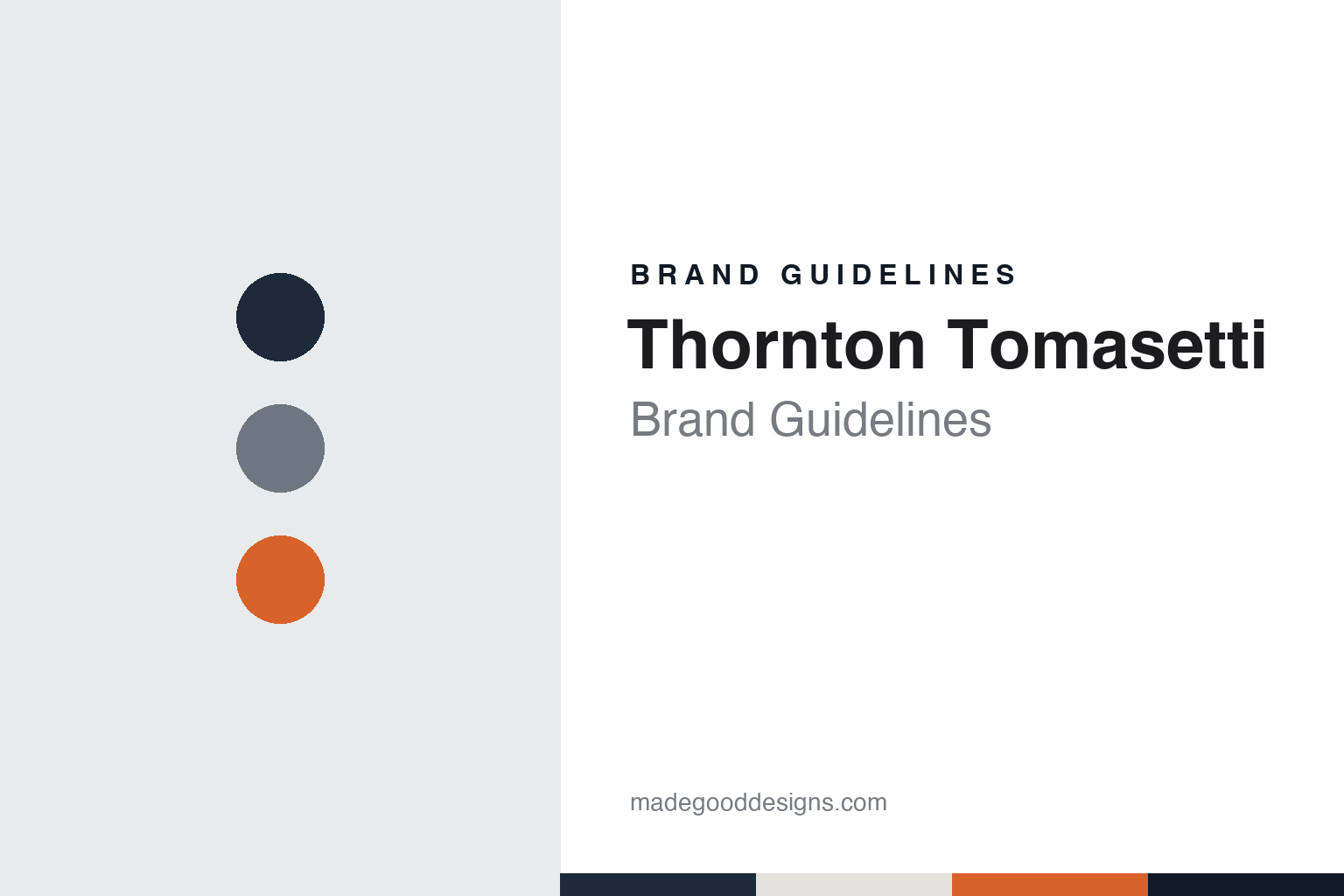
Thornton Tomasetti Brand Guidelines
The New York engineers who grew out of Lev Zetlin Associates.
Aa
Two constants: an ink navy, steel grey and signal orange palette and an engineering sans register. Abstract homage — not a Thornton Tomasetti drawing or mark; no building, logo or document is reproduced.
Lev Zetlin Associates
A New York practice, and the two engineers who bought it.
Thornton Tomasetti is an engineering consultancy headquartered in New York. English Wikipedia puts its staff at more than 2,000 and lists the names it has carried or absorbed over the decades: Lev Zetlin & Associates, LZA Technology, the Thornton-Tomasetti Group, Thornton Tomasetti Engineers and Weidlinger Associates. The present name does not belong to a founder. It joins the surnames of two engineers who joined someone else’s practice and later bought it.
That practice was Lev Zetlin Associates, set up in 1956 by the engineer Lev Zetlin after he completed a doctorate at Cornell University, English Wikipedia says. Zetlin’s office became known for cable roofs. His “double-layer bicycle wheel” system pairs upper and lower cables at different tensions, jacked apart and joined by rigid vertical struts; it was developed originally for the Utica Memorial Auditorium in upstate New York, completed in 1960, and went on to shape a number of later tensile roofs, according to the same article.
Charles Thornton joined in 1960, having earned master’s and doctoral degrees at New York University with a thesis on cable nets, and worked on the analysis, design and construction of projects in many countries, English Wikipedia says. Richard Tomasetti joined in 1968, after working in the aerospace industry, and set up the practice’s research and development group, Environspace. In 1977 the two bought Lev Zetlin Associates, then a subsidiary of Gable Industries, and began to carry out some work under the name Thornton Tomasetti. After a period as the TTG Group, the name officially became Thornton Tomasetti in 1999, English Wikipedia says; Thornton served as co-chairman until 2004.
Colour
Towers, timber studies and a research studio.
The firm’s work runs across structure, envelope and analysis. Its website lists practices that include structural engineering, façade engineering, construction engineering, transportation and applied science, and describes Thornton Tomasetti as “an independent organization of engineers, scientists, architects and other professionals.” English Wikipedia adds forensic engineering, structural renovation, civil engineering and bridge design and rehabilitation, and names its clients as architects, contractors, insurers, law firms, developers and building owners, among others.
Tall buildings make up a large part of the record. For Taipei 101, completed in 2004, Thornton Tomasetti worked with the engineer of record, Evergreen Consulting, on a steel-based dual structural system and on the double stair-step corners of the tower’s outline, English Wikipedia says.
Trade coverage places the firm on New York and Chicago projects. In July 2015 ArchDaily listed a Council on Tall Buildings and Urban Habitat event on VIA 57 West, the 467-foot Manhattan building by Bjarke Ingels Group, at which BIG, an engineer from Thornton Tomasetti and the builder Hunter Roberts were to discuss its architecture, engineering and construction. In October 2016 ArchDaily reported on River Beech Tower, a concept for a timber residential high-rise beside the Chicago River, put together by the architects Perkins+Will with Thornton Tomasetti as engineers and the University of Cambridge; the magazine described it as a conceptual academic and professional undertaking rather than a commissioned building.
Software and research sit beside the drawings. English Wikipedia says the firm set up its CORE studio in 2011 as an internal research and development group for application development, computational modelling and artificial intelligence in structural design and construction, and that the later merger created a sister group, CORE Lab, and a technology platform called TTWiiN.
Typography
How engineering consultancies present themselves.
Structural and façade engineering consultancies rarely sell a product, so their identity rests on a name and a record. Many carry the surnames of founders or partners, sometimes joined by a plus sign or an ampersand, sometimes run together in lower case, and many shorten to initials in everyday use. The wordmark is usually typographic rather than pictorial: a plain sans or a restrained serif, set on a quiet background, with one accent colour at most.
The work itself does most of the talking. Websites, brochures and monographs lead with project photography of bridges, stadium roofs, glass façades, towers and temporary pavilions, often shot at dusk or from below to show cables, members and joints. Alongside the photographs come drawings, sections, physical and digital models and construction sequences, and the projects are credited together with the architects and builders who worked on them, since an engineer’s name rarely appears on a building alone.
Writing about these firms tends to follow the same pattern. Founders and partners are described in their professional roles, with dates for when they joined or took over; ownership is set out plainly, whether a partnership, a firm owned by its employees or a practice absorbed into a larger group; and renamings and mergers are dated. History pages trace a practice back through earlier names, and office pages list the cities where teams are based, often with the year each office opened.
This guide follows that approach. It sets out what dated sources say about each firm: who founded it, how its name and ownership changed, where it works and which projects independent publications credit to it. It describes what was engineered rather than what it achieves, and it treats the palette and typefaces shown here as an unofficial interpretation, not the firms’ own identity.
Aa
An engineering sans for a name made of two surnames. (Specimen set in Archivo, a sans STAND-IN; NOT the Thornton Tomasetti logo.)
Thornton Tomasetti
Two surnames, one practice, many offices.
The firm has grown by merger as well as by hiring. English Wikipedia dates its merger with Weidlinger Associates to 2015. Weidlinger traced its roots to a consulting practice opened in Washington, D.C. in 1949 and designed and rehabilitated buildings, bridges and infrastructure. The combined business kept the Thornton Tomasetti name and its base in New York.
Leadership has passed through several hands. In September 2019 The Construction Specifier reported that Peter DiMaggio, a managing director in New York, and Michael Squarzini, a managing principal, were to become co-CEOs the following January, with the then chief executive and chairman moving to the role of executive chairman; the same report said the managing principal of the Washington, D.C. office would become president and would co-lead the firm’s business units with a managing director based in San Francisco. Both are listed as co-CEOs on the firm’s leadership page in 2026. The company says its leaders are employee-shareholders, that no single shareholder holds more than a few per cent of the shares, and that it runs a matrix structure in which technical staff belong to both a practice and a region. Project teams, it says, are put together to match each client’s requirements and may draw on several regions and practices at once.
The office map is wide. The firm’s website lists offices across the United States, from Boston and Chicago to Houston, Los Angeles and Seattle, and others in Canada, the United Kingdom, Italy, the United Arab Emirates, India, Vietnam and Australia. In the United Kingdom they include London and Belfast; in Italy, Milan and Venice; in Canada, Toronto, Ottawa and Halifax; in India, Mumbai, Pune and Chennai; and in Australia, Sydney, Melbourne and Perth.
For a design guide, Thornton Tomasetti shows how an engineering practice can carry the names of two engineers who bought it, while its record is told through towers, cable roofs and research groups. Compare Walter P Moore, another American engineering firm with a long history, and Skidmore, Owings & Merrill, a practice likewise named after its partners. For this guide we use ink navy, steel grey and a signal orange with a sans, an unofficial interpretation; no product or logo is reproduced.
Explore & save
Keep Thornton Tomasetti’s identity on hand — save it to a board in the Made Good inspiration library.
Thornton Tomasetti identity set
Pin the Thornton Tomasetti ink navy, steel grey and signal orange palette and the engineering sans register to your own board.
Source & notes
Frequently Asked Questions
What font can I use to match the Thornton Tomasetti look?
This guide describes Thornton Tomasetti’s type as “An engineering sans for a name made of two surnames”. Its type specimen is set in Archivo from Google Fonts as a stand-in; Archivo is not Thornton Tomasetti’s own lettering.
What colours are in the Thornton Tomasetti palette?
This guide’s Thornton Tomasetti palette is Ink navy #1C2A3A, Steel grey #6E7781, Signal orange #D9622B, Concrete #E4E2DD and Paper #F7F6F3. The tones are the guide’s own unofficial interpretation, not official Thornton Tomasetti hex codes.
When was Thornton Tomasetti founded?
Thornton Tomasetti was founded in 1956 (as Lev Zetlin Associates), in New York, USA.