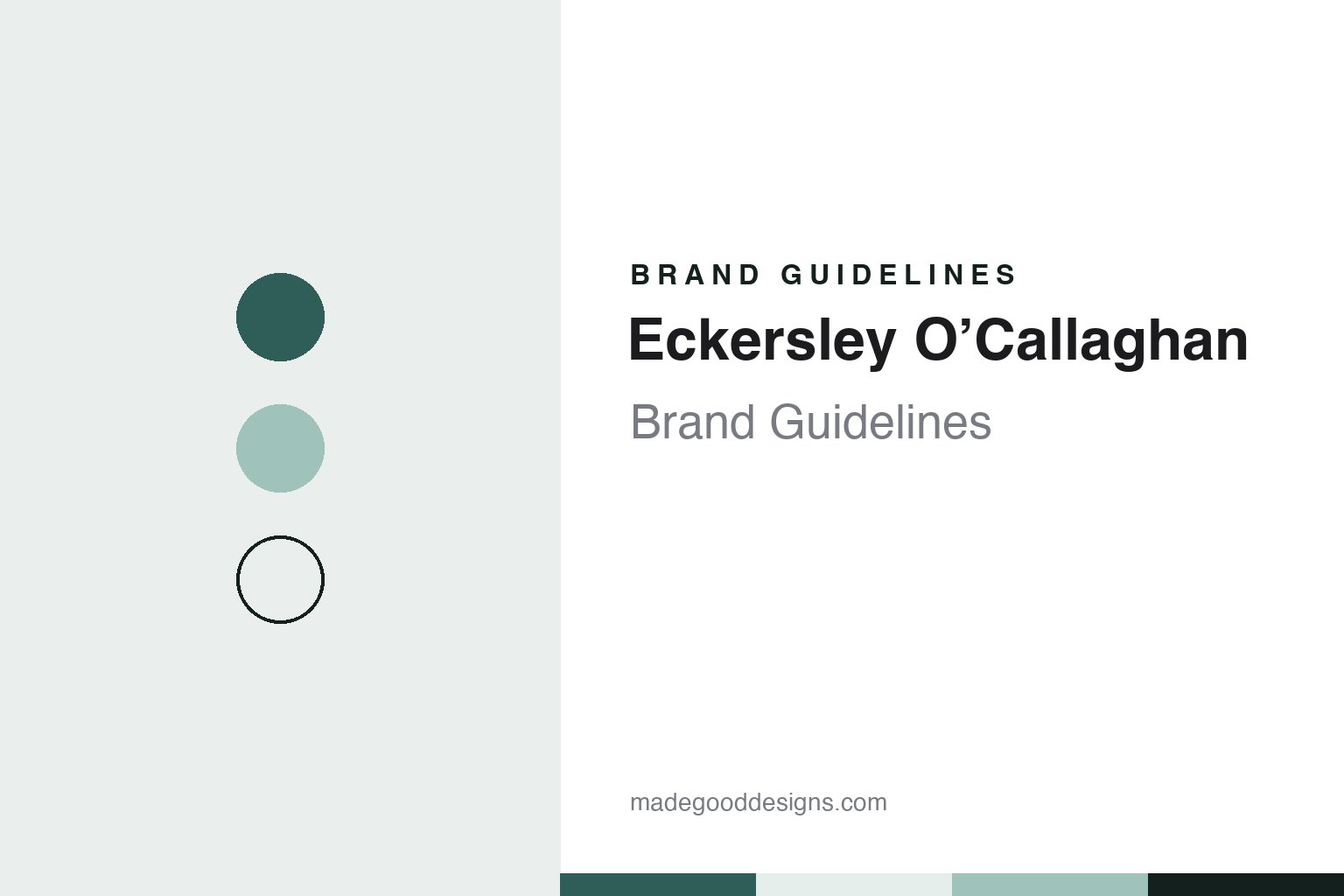
Eckersley O’Callaghan Brand Guidelines
The London engineers who made glass carry the structure.
Aa
Two constants: a glass-green and clear-white palette and a clear geometric sans register. Abstract homage — not an Eckersley O’Callaghan drawing or mark; no project, logo or photograph is reproduced.
Two Engineers
A London practice built on glass.
Eckersley O’Callaghan is a structural and façade engineering practice founded in London in 2004 by two engineers, Brian Eckersley and James O’Callaghan. The company says the pair wanted a structural design practice that would join engineering and architecture closely, and both are still named as founding directors on its project pages. The practice shortens its own name to EOC, and its website sits under that abbreviation.
Glass shaped the early years. In an article published in May 2025 to mark twenty years of the practice, the company says its earliest days were spent on glass work for Apple’s stores, and that this early collaboration with Apple gave it an international platform but also forced it to grow quickly and work across borders from the start. The outside view is similar. In September 2012 Wired, in a long feature on the glassmaker Corning, described Eckersley O’Callaghan as the design firm responsible for some of Apple’s stores, and reported that at that year’s London Design Festival the firm had shown a serpentine sculpture made entirely of Corning’s Gorilla Glass. The rest of that feature dealt with how Corning had revived an old strengthened-glass recipe and scaled it up for phone screens.
The practice grew steadily from there. A 2018 profile of James O’Callaghan published by the Royal Academy of Engineering described him as an engineer known internationally for the design and use of structural glass, and put the company at about 90 people after fourteen years. By its own count in 2025 it had passed 160 people of more than thirty nationalities.
The company dates a second turning point to 2011, when it says it expanded into façade engineering alongside its structural work. Its services now cover structures in timber, steel and concrete, heritage work, and what it calls advanced materials such as glass and carbon fibre.
Colour
Glass drums, old façades and timber towers.
One of the practice’s most documented projects is the entrance pavilion of the Steve Jobs Theater at Apple Park in Cupertino, California, designed by Foster + Partners for Apple. Wikipedia dates its opening to 12 September 2017, when Apple held its autumn product event there. The company’s project page describes a cylinder of curved glass panels about 7 metres high and 41 metres across, each panel built from four layers of glass, carrying a carbon-fibre roof of 44 radial panels that was assembled on site and lifted into place in one operation; the company gives the roof’s weight as about 80 tonnes and says the glass carries it without any additional framing. Cables, pipes and data lines for the roof run inside the narrow joints between the glass panels. With Foster + Partners the practice also engineered a glass lift for the building, which turns 171 degrees on helical guides between its entry and its exit.
The façade side of the practice works on old buildings as well as new ones. The company says it has restored the 1970s façade by Jean Prouvé on the UNESCO headquarters in Paris, treating it as a heritage project, and lists envelope work for universities and colleges in London and Oxford.
Timber has become the third strand. The company names a series of timber projects in its twentieth-anniversary article, ending with Atlassian Central, a hybrid-timber tower beside Central station in Sydney. Wikipedia lists Eckersley O’Callaghan as the structural engineer, with SHoP Architects and BVN as architects; the tower combines mass timber, concrete and steel inside a glass and steel exoskeleton, and construction began in August 2022 under a joint venture of Built and Obayashi.
The project pages themselves are long technical write-ups: panel thicknesses, ply counts, spans and connection details set out in plain engineering language next to the photographs, with the client, the architect and the photographer credited at the end.
Typography
Design and documentation.
Structural and façade engineering consultancies rarely sell a product, so their identity rests on a name and a record. Many carry the surnames of founders or partners, sometimes joined by a plus sign or an ampersand, sometimes run together in lower case, and many shorten to initials in everyday use. The wordmark is usually typographic rather than pictorial: a plain sans or a restrained serif, set on a quiet background, with one accent colour at most.
The work itself does most of the talking. Websites, brochures and monographs lead with project photography of bridges, stadium roofs, glass façades, towers and temporary pavilions, often shot at dusk or from below to show cables, members and joints. Alongside the photographs come drawings, sections, physical and digital models and construction sequences, and the projects are credited together with the architects and builders who worked on them, since an engineer’s name rarely appears on a building alone.
Writing about these firms tends to follow the same pattern. Founders and partners are described in their professional roles, with dates for when they joined or took over; ownership is set out plainly, whether a partnership, a firm owned by its employees or a practice absorbed into a larger group; and renamings and mergers are dated. History pages trace a practice back through earlier names, and office pages list the cities where teams are based, often with the year each office opened.
This guide follows that approach. It sets out what dated sources say about each firm: who founded it, how its name and ownership changed, where it works and which projects independent publications credit to it. It describes what was engineered rather than what it achieves, and it treats the palette and typefaces shown here as an unofficial interpretation, not the firms’ own identity.
Aa
A clear geometric sans for an engineering practice. (Specimen set in Manrope, a sans STAND-IN; NOT the Eckersley O’Callaghan logo.)
Eckersley O’Callaghan
Offices on four continents.
Eckersley O’Callaghan is run from London, with both founders still listed as founding directors. Its website lists offices in London, Manchester, New York, San Francisco, Los Angeles, Paris, Milan, Hong Kong, Shanghai, Delhi and Sydney, and the company says those offices were never planned from the top but grew out of relationships with clients and the people who joined it, each led by local engineers within one network.
The way it presents itself is quiet and technical. The name is set out in full, the two surnames joined, and shortened to EOC where space is tight. Its project pages lead with large photographs of finished buildings, followed by numbers: diameters, heights, tonnages and the make-up of laminated panels. Project credits name the client and the architect, then the directors who led the work, so the founders appear on the projects they ran rather than in a separate story about the firm. A video interview with both founders marked the practice’s twentieth year in 2025.
Its home page mixes project stories with staff profiles, conference talks and an office trip, and its project pages close with lists of related projects in other cities, from London and Manchester to Hong Kong and New York.
For a design guide, Eckersley O’Callaghan shows how an engineering practice can build a recognisable identity from one material and from clear technical writing about it. Compare Foster + Partners, the architects of the Steve Jobs Theater, and AKT II, another London structural practice of the same generation. For this guide we use a glass green, a pale clear white and a near-black with a sans, an unofficial interpretation; no product or logo is reproduced.
Explore & save
Keep Eckersley O’Callaghan’s identity on hand — save it to a board in the Made Good inspiration library.
Eckersley O’Callaghan identity set
Pin the Eckersley O’Callaghan glass-green palette and the clear geometric sans register to your own board.
Source & notes
Frequently Asked Questions
What font can I use to match the Eckersley O’Callaghan look?
This guide describes Eckersley O’Callaghan’s type as “A clear geometric sans for an engineering practice”. Its type specimen is set in Manrope from Google Fonts as a stand-in; Manrope is not Eckersley O’Callaghan’s own lettering.
What colours are in the Eckersley O’Callaghan palette?
This guide’s Eckersley O’Callaghan palette is Laminate green #2F5D57, Ink #14201E, Clear glass #E6EEEC, Interlayer #9FC2BA and Paper #F6F8F7. The tones are the guide’s own unofficial interpretation, not official Eckersley O’Callaghan hex codes.
When was Eckersley O’Callaghan founded?
Eckersley O’Callaghan was founded in 2004, in London, UK. Eckersley O’Callaghan is known for Structural glass, façades, timber structures.
Who founded Eckersley O’Callaghan?
Eckersley O’Callaghan was founded by Brian Eckersley and James O’Callaghan in 2004.


