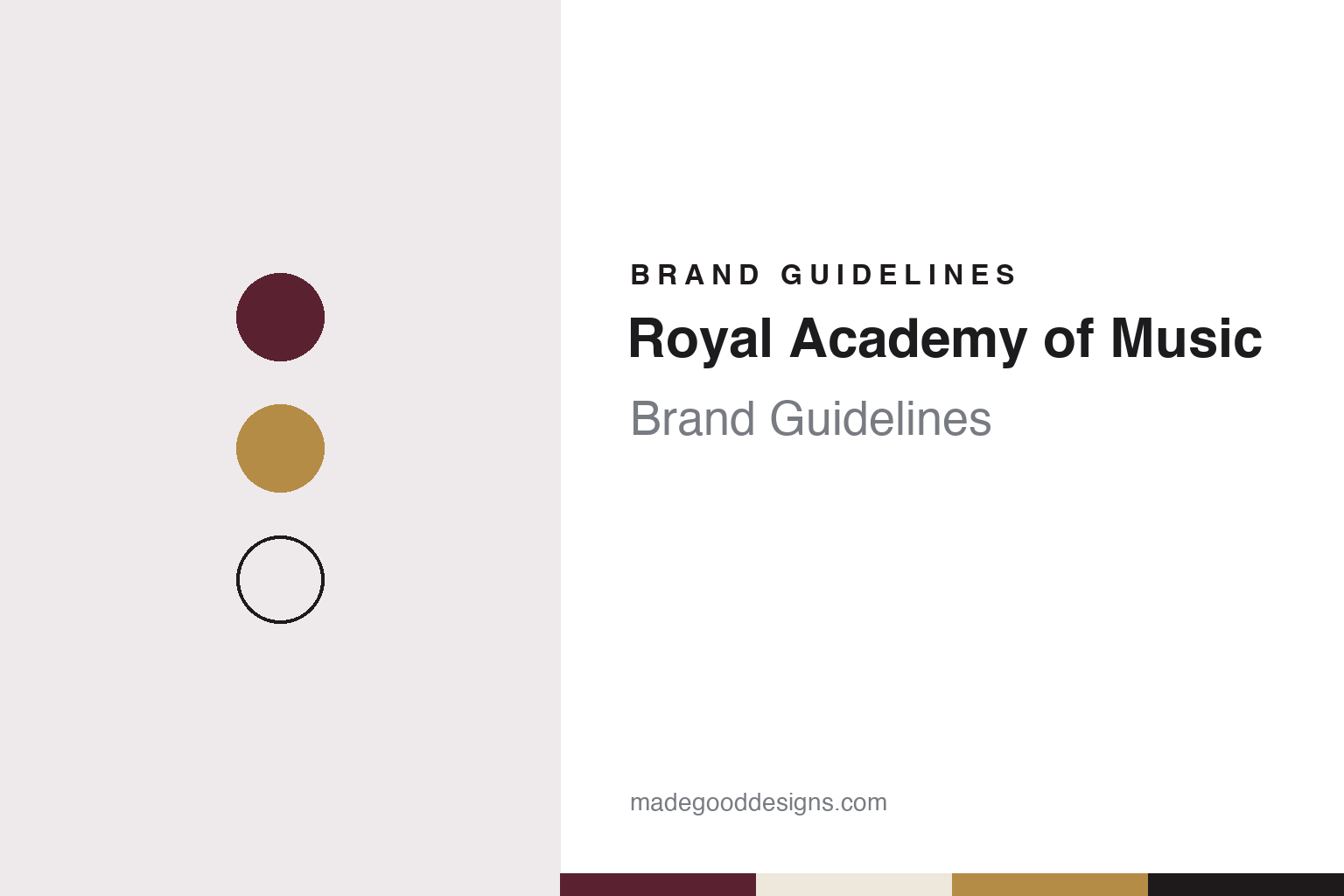
Royal Academy of Music Brand Guidelines
The 1822 London conservatoire on Marylebone Road.
Aa
Two constants: a claret, stone and gilt palette and an old-style serif register. Abstract homage — not a Royal Academy of Music mark; no crest, logo or building image is reproduced.
Hanover Square
A committee, a harpist and three Georgian houses.
The Royal Academy of Music traces its start to 1822. The music writer Robert Hugill, previewing its bicentenary in December 2021, described its founder John Fane, Earl of Westmorland, as a soldier and diplomat who was also a good violinist and a prolific composer, working with the French harpist Nicolas-Charles Bochsa. Hugill noted that there is no single founding date: a committee announcement on 21 July 1822 is usually taken as the start, and the first lesson followed on 14 March 1823. English Wikipedia adds that the Duke of Wellington, himself a keen violinist, gave the project strong support.
The Academy received its royal charter from King George IV in 1830, according to both Hugill and Wikipedia.
Its first home was in Tenterden Street, off Hanover Square, in three eighteenth-century houses knocked together. Wikipedia quotes the composer Arnold Bax, a former student, recalling a maze of passages and dead ends that took a new student about a month to learn. In 1911 the Academy moved to a purpose-built home on Marylebone Road, beside Regent’s Park, designed by the architect Sir Ernest George. The building includes the Duke’s Hall, which Wikipedia gives as a 450-seat concert room.
The address has shaped the Academy’s look ever since: a purpose-built Edwardian home beside Regent’s Park, in use for more than a century.
Colour
A theatre, a museum and a library.
The Academy grew outward from that building in stages. In 1976, Wikipedia says, it acquired houses on its north side and built between them an opera theatre named after the philanthropist Sir Jack Lyons, together with recital spaces, a recording studio and practice rooms. In the late 1990s it took on 1–5 York Gate, a terrace designed by John Nash in 1822, to house a new museum, a musical-theatre studio and teaching rooms, linked to the main building by an underground passage and a barrel-vaulted recital hall below the courtyard.
The latest major change came in 2018. Hugill reported on 14 March 2018 that the Academy had reopened its theatre after two years of rebuilding, during which its opera department performed in borrowed venues. The new Susie Sainsbury Theatre, with 309 seats, stands on the site of the Sir Jack Lyons Theatre, which had stood from 1976 to 2015. Designed by Ian Ritchie Architects, it reshaped the auditorium, added a balcony and a fly tower and raised capacity by about 40 per cent, Hugill wrote; a new 100-seat recital hall sits on its roof, alongside new percussion studios, a refurbished jazz room and a control room for audio-visual recording. Jonathan Dove’s opera Flight opened the theatre on 12 March 2018.
Behind the performance spaces sit the collections. Wikipedia describes a library of more than 160,000 items and a museum in York Gate holding Cremonese stringed instruments dated between 1650 and 1740, English pianos from 1790 to 1850 and autograph manuscripts including Purcell’s The Fairy-Queen and Sullivan’s The Mikado. Hugill noted that the bicentenary season would perform The Fairy Queen from the Academy’s own autograph score.
Teaching runs from the Junior Academy, which meets on Saturdays for pupils under 18, to doctoral degrees. Wikipedia lists departments for strings, piano, voice and opera, brass, woodwind, conducting, composition, historical performance, musical theatre and jazz, and says the Academy became a full constituent college of the University of London in September 1999; it also has a long teaching link with King’s College London.
Performance has been part of the Academy’s record from early on. Wikipedia says Carl Maria von Weber conducted its orchestra in 1826 and Richard Strauss in 1926, that Franz Liszt performed there in 1886 to mark a scholarship in his name, and that for many years the Academy held festivals devoted to living composers, among them Witold Lutosławski, Olivier Messiaen and Luciano Berio. In the summer of 2012 John Adams conducted a joint orchestra of Academy and Juilliard students at the Proms and at New York’s Lincoln Center. The orchestral library holds about 4,500 sets of parts.
Typography
Conservatoires and drama schools.
Music conservatories and drama schools present themselves first through their names. Many carry a founder, a benefactor, a city or a royal title, and many have changed name more than once as they merged, widened their teaching or joined a larger body. Juilliard, for example, began in 1905 as the Institute of Musical Art and took its present title in 1968, while Berklee started in 1945 as Schillinger House, according to English Wikipedia. A school’s history page is often where those changes are set out in order.
Crests, wordmarks and seals sit on prospectuses, certificates, signage and programmes. Some schools hold royal charters or belong to a university or a federation of schools, and their published materials usually describe those links in plain terms: who granted the charter, when the affiliation began and which degrees are awarded. Mergers produce their own naming systems, with one name at the top and member schools carrying it, as Berklee and Boston Conservatory at Berklee have done since 2016.
Buildings do much of the visual work. Concert halls, theatres, recital rooms and rehearsal studios appear on posters, season brochures and websites, and a move or a rebuild can change how a school is seen from the street. Architectural Record described Juilliard’s 2009 extension at Lincoln Center as replacing a closed stone front with a glazed one facing Broadway.
Season programmes, concert listings and production posters carry the identity week to week, usually alongside the names of ensembles, theatres and libraries within the school. This guide sets out the dated facts behind each school, its founding, renamings, mergers and buildings, and describes its colours and type only as our own unofficial interpretation.
Aa
An old-style serif for a Georgian-founded conservatoire. (Specimen set in EB Garamond, a serif STAND-IN; NOT the Royal Academy of Music logo.)
Royal Academy of Music
Two hundred years on one road.
The Academy marked its bicentenary with a season that, Pianist magazine reported on 2 December 2021, ran from January 2022 to July 2023 — the closing date marking two hundred years since the first students enrolled. Its principal at the time, Jonathan Freeman-Attwood, described students from more than 50 countries, and the season included masterclasses, a festival of music written in 1822 and 1922 at Wigmore Hall, a five-part podcast series and the premiere of Freya Waley-Cohen’s opera WITCH, commissioned by the Academy. Hugill described the continuing 200 Pieces project, which commissioned new solo works from composers including Hans Abrahamsen, Sir George Benjamin and Sally Beamish.
Among its former students Pianist named the conductor Simon Rattle and the singer-songwriters Elton John and Annie Lennox. The Academy is a registered charity under English law, Wikipedia says, and should not be confused with the Royal Academy of Arts, a separate institution with its own history.
Visually the Academy works with what its history gives it: a royal name, a Georgian founding date, a 1911 building by Ernest George and a Nash terrace that holds its museum. Concert listings, the opera season in the Susie Sainsbury Theatre and the museum’s instruments and manuscripts give it a steady stream of images that do not depend on any one mark.
For a design guide, the Royal Academy of Music shows how a conservatoire can let two centuries of buildings, collections and dated events carry its identity. Compare the Royal College of Music, founded in South Kensington sixty years later, and the Guildhall School of Music & Drama. For this guide we use claret, warm stone and a gilt ochre with a serif, an unofficial interpretation; no product or logo is reproduced.
Explore & save
Keep Royal Academy of Music’s identity on hand — save it to a board in the Made Good inspiration library.
Royal Academy of Music identity set
Pin the claret, stone and gilt palette and the old-style serif register to your own board.
Source & notes
Frequently Asked Questions
What font can I use to match the Royal Academy of Music look?
This guide describes Royal Academy of Music’s type as “An old-style serif for a Georgian-founded conservatoire”. Its type specimen is set in EB Garamond from Google Fonts as a stand-in; EB Garamond is not Royal Academy of Music’s own lettering.
What colours are in the Royal Academy of Music palette?
This guide’s Royal Academy of Music palette is Duke’s Hall claret #5A2230, Ink #1E1A1C, Portland stone #EEE7DB, Gilt ochre #B48C46 and Paper #F8F5EF. The tones are the guide’s own unofficial interpretation, not official Royal Academy of Music hex codes.
When was Royal Academy of Music founded?
Royal Academy of Music was founded in 1822, in London, England.
Who founded Royal Academy of Music?
Royal Academy of Music was founded by John Fane and Earl of Westmorland; Nicolas-Charles Bochsa in 1822.


