Royal College of Music Brand Guidelines
The South Kensington conservatoire opened in 1883.
Aa
Two constants: a navy, brick and buff stone palette and a transitional serif register. Abstract homage — not a Royal College of Music mark; no crest, logo or building image is reproduced.
Kensington Gore
A failed school, a draft charter and a new director.
The Royal College of Music grew out of an earlier school. English Wikipedia describes the National Training School for Music, which opened in 1876 in a building just west of the Royal Albert Hall in Kensington Gore, with Arthur Sullivan as its principal. Plans to merge it with the older Royal Academy of Music came to nothing when the Academy declined, and in 1881 a draft charter was drawn up for a successor body, with George Grove as its main organiser.
The college was established by royal charter in 1882 and, Wikipedia says, opened in the old training-school premises on 7 May 1883; the college itself says it was opened in 1883 by the then Prince of Wales, later Edward VII. Grove became its first director. Wikipedia records a first intake of 50 scholars chosen by competition and 42 fee-paying students, and says Grove, with the violinist Henry Holmes and the composer Charles Villiers Stanford, set out to build a capable student orchestra from the start; early professors included Hubert Parry for composition, Walter Parratt for organ, Jenny Lind for singing and Arabella Goddard for piano. Grove appointed twelve professors of orchestral instruments, and the first scholarship intake included 28 students of an orchestral instrument.
Grove retired at the end of 1894 and was followed as director by Parry. The college’s current director, according to Wikipedia, is James Williams, who took up the post in September 2024 after Colin Lawson’s tenure from 2005 to 2024. Earlier directors listed by Wikipedia include Sir Hugh Allen from 1919 to 1937, Sir George Dyson from 1938 to 1952, Sir David Willcocks from 1974 to 1984 and Dame Janet Ritterman from 1993 to 2005.
Colour
Red brick opposite the Albert Hall.
The first premises soon proved too small. A new building was commissioned in the early 1890s on Prince Consort Road, directly opposite the Royal Albert Hall, among the museums, colleges and concert halls of the area often called Albertopolis. It was designed by Sir Arthur Blomfield in what Wikipedia calls a Flemish Mannerist style, in red brick dressed with buff stone; construction began in 1892 and the building opened in May 1894. Wikipedia says the Yorkshire industrialist Samson Fox paid for much of it, and that his statue stands in the entrance hall.
Performance spaces followed in layers. Wikipedia lists the barrel-vaulted Amaryllis Fleming Concert Hall, also by Blomfield, built in 1901 with 468 seats and restored in 2008–09; the 400-seat Britten Theatre, opened in 1986 for opera, ballet, music and theatre; a 150-seat recital hall from 1965; and organ rooms named after Parry. A hall of residence, Prince Consort Village, opened in 2016 with rooms for more than 400 students, Wikipedia says.
The main recent change was the redevelopment the college calls More Music. Pianist magazine reported on 3 December 2021 that its new facilities had been formally opened, adding two new performance spaces, a new home for the Royal College of Music Museum, practice rooms and a courtyard and café, to plans by the architect John Simpson. Wikipedia names the new spaces as the 140-seat Performance Hall and the Performance Studio, and says the site’s footprint almost doubled.
The museum is the college’s most public face. Wikipedia describes a collection of more than 14,000 items spanning over five centuries, including a clavicytherium and an early guitar, alongside autograph manuscripts such as Elgar’s Cello Concerto and Mozart’s Piano Concerto No. 24, more than 300 portraits and an archive of concert programmes that, Wikipedia says, runs from 1730 to the present. It also lists about 10,000 prints and photographs of musicians and more than 800 instruments and accessories dating from around 1480 onward, along with portraits such as Thomas Hardy’s 1791 painting of Haydn. The museum was redeveloped in 2020–21.
Typography
Conservatoires and drama schools.
Music conservatories and drama schools present themselves first through their names. Many carry a founder, a benefactor, a city or a royal title, and many have changed name more than once as they merged, widened their teaching or joined a larger body. Juilliard, for example, began in 1905 as the Institute of Musical Art and took its present title in 1968, while Berklee started in 1945 as Schillinger House, according to English Wikipedia. A school’s history page is often where those changes are set out in order.
Crests, wordmarks and seals sit on prospectuses, certificates, signage and programmes. Some schools hold royal charters or belong to a university or a federation of schools, and their published materials usually describe those links in plain terms: who granted the charter, when the affiliation began and which degrees are awarded. Mergers produce their own naming systems, with one name at the top and member schools carrying it, as Berklee and Boston Conservatory at Berklee have done since 2016.
Buildings do much of the visual work. Concert halls, theatres, recital rooms and rehearsal studios appear on posters, season brochures and websites, and a move or a rebuild can change how a school is seen from the street. Architectural Record described Juilliard’s 2009 extension at Lincoln Center as replacing a closed stone front with a glazed one facing Broadway.
Season programmes, concert listings and production posters carry the identity week to week, usually alongside the names of ensembles, theatres and libraries within the school. This guide sets out the dated facts behind each school, its founding, renamings, mergers and buildings, and describes its colours and type only as our own unofficial interpretation.
Aa
A transitional serif for a Victorian-founded conservatoire. (Specimen set in Libre Baskerville, a serif STAND-IN; NOT the Royal College of Music logo.)
Royal College of Music
Orchestras, a museum and a junior department.
Today the college says it has more than 900 students from more than 60 countries studying at undergraduate, master’s and doctoral level, with five orchestras, two jazz bands and the RCM Opera Studio among its performing groups. Wikipedia counts a teaching staff of more than 200 professors, including principal players of London orchestras such as the London Symphony, BBC Symphony and Philharmonia, and gives a junior department of about 300 children aged 8 to 18 who study on Saturdays, and notes that since August 2011 the college has offered degrees jointly with the Nanyang Academy of Fine Arts in Singapore. It is one of the four conservatoires behind the Associated Board of the Royal Schools of Music and a registered charity under English law.
Among the composers the college names as former students are Gustav Holst, Ralph Vaughan Williams and Benjamin Britten. Its name is easily confused with the Royal College of Art, a separate art and design school with its own history.
The college’s visual material comes largely from its setting: the red-brick and buff-stone front facing the Royal Albert Hall, the concert hall and Britten Theatre, season listings for its orchestras and opera productions, and the instruments, portraits and manuscripts of its museum. The 2021 courtyard and new halls added a contemporary layer beside Blomfield’s Victorian building without replacing it.
For a design guide, the Royal College of Music shows how a conservatoire can build an identity from one address, a dated charter and a collection open to visitors. Compare the Royal Academy of Music, the older London conservatoire it was once meant to merge with, and Juilliard. For this guide we use navy, brick red and buff stone with a serif, an unofficial interpretation; no product or logo is reproduced.
Explore & save
Keep Royal College of Music’s identity on hand — save it to a board in the Made Good inspiration library.
Royal College of Music identity set
Pin the navy, brick and buff stone palette and the transitional serif register to your own board.
Source & notes
Frequently Asked Questions
What font can I use to match the Royal College of Music look?
This guide describes Royal College of Music’s type as “A transitional serif for a Victorian-founded conservatoire”. Its type specimen is set in Libre Baskerville from Google Fonts as a stand-in; Libre Baskerville is not Royal College of Music’s own lettering.
What colours are in the Royal College of Music palette?
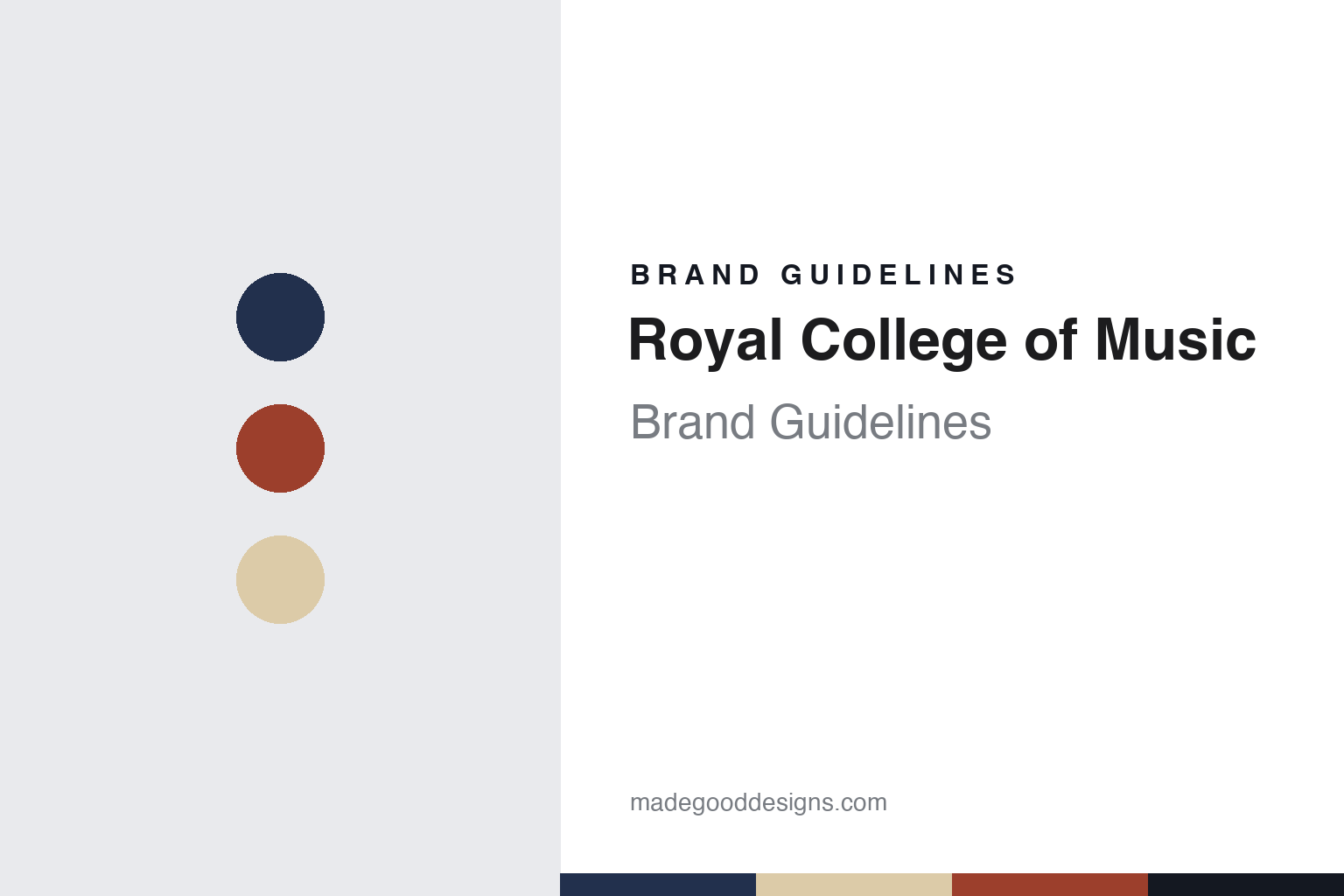
This guide’s Royal College of Music palette is Albertopolis navy #22304D, Ink #141821, Blomfield brick #9C3F2C, Buff stone #DCCBA8 and Paper #F7F4EE. The tones are the guide’s own unofficial interpretation, not official Royal College of Music hex codes.
When was Royal College of Music founded?
Royal College of Music was founded in 1882 (charter); opened 1883, in London, England.