Ramtech Brand Guidelines
A 1982 Texas modular builder from Arlington to Mansfield.
Aa
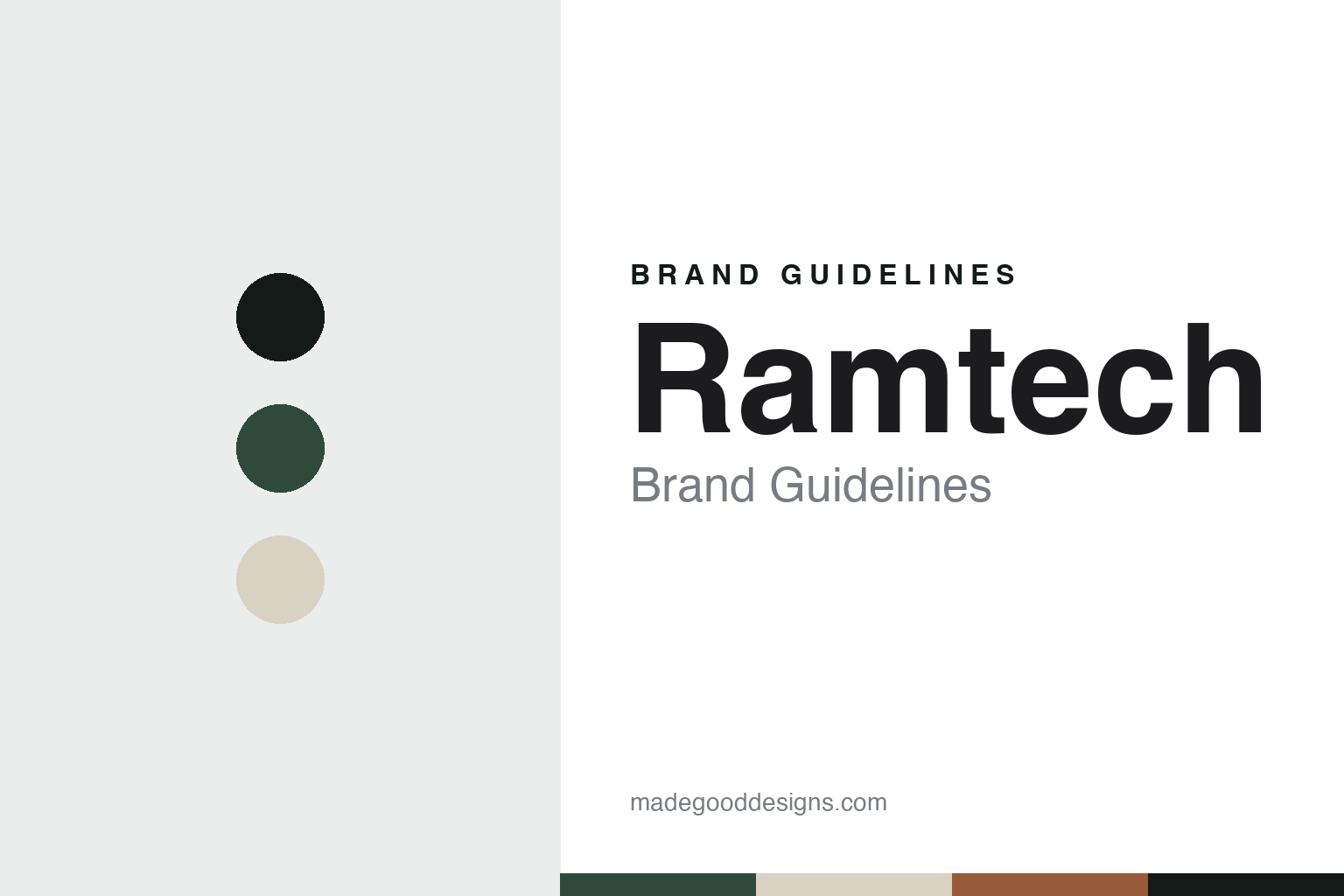
Two constants: a prairie green, ink and limestone palette and a workmanlike sans register. Abstract homage — not a Ramtech product or mark; no building, logo or nameplate is reproduced.
Ramtech Modular Design
A dealership that became a factory.
Ramtech Building Systems is a Texas company that designs, manufactures and installs modular buildings. It traces its start to 1982, when, its history page says, Ramtech Modular Design began operations as a small modular dealership in Arlington, Texas. At the time, the company says, the industry was controlled by a few large modular leasing companies that bought from a network of wholesale manufacturers, most of which could not design and build more sophisticated structures. Frustrated by that limit on the projects it could take on, Ramtech chose to become a direct-sale manufacturer and opened its own plant.
That plant stands on a 20-acre site in Mansfield, Texas, in the southern part of the Dallas–Fort Worth area, where the company is still based. With manufacturing in-house, Ramtech Modular Design was renamed Ramtech Building Systems, and the company says it expanded its manufacturing capacity three times within its first decade. Releases issued in 2026 describe Ramtech Building Systems, Inc. as a design-build company working “since 1982” and, in January 2026, “for over 40 years”.
The company has long been tied to the Modular Building Institute, the trade association of the commercial modular industry. When the institute elected Ramtech’s president, Matt Slataper, as president of its board of directors for a one-year term in May 2026, its announcement listed earlier institute presidents who came from Ramtech: Bob Houchin, Mike Slataper, Linc Moss and Roland Brown. Matt Slataper joined Ramtech in 2018 after more than a decade in financial services, the release says, and his role covers strategy, business development and financial oversight. The company also says its executives have served on the Texas Industrial Building Code Council.
The name is shared with other firms: Ramtech Electronics, a separate British company with its own website, is unrelated to the Texas builder, and this guide covers Ramtech Building Systems only.
Colour
Relocatable and permanent.
Ramtech works in two building types. Relocatable modular buildings are made to be moved and used again, while its permanent modular construction comes in two forms, on a pier and beam foundation or on a concrete slab. The company says its permanent buildings combine off-site manufacturing with on-site construction and match a site-built structure in look, function and life expectancy; that is its own description. It calls itself vertically integrated, offering in-house design, a manufacturer-direct product and complete site construction from a single source.
The customers named in its 2026 releases include commercial companies, educational institutions, healthcare providers and multi-family developers across the Southern United States, and the company says it has completed more than 5,000 projects of all sizes. Its January 2026 appointment of Kelly Williams, a former president of the Modular Building Institute, as vice president of business development was framed around new commercial and multi-family work. The release says Williams served as the institute’s president in 2015–2016, received its Outstanding Achievement Award in 2025 and had earlier held business-development roles at modular and home builders including Champion Home Builders and Clayton Homes; Slataper said he brought experience in markets Ramtech had not fully taken part in before.
An independent account shows the process on one job. In April 2013 the North Dallas Gazette reported that Ramtech, described as a design-build commercial modular construction firm of Mansfield, had installed three modular buildings for First Baptist Church Frisco. The 23,386-square-foot project included a middle-school worship centre with a vaulted ceiling and fellowship classrooms, an adult education building and an office building for the ministry staff. Ramtech acted as general contractor and handled the site preparation; the exteriors used HardiePanel with a stucco finish to match the church’s existing masonry, and the modules were designed and manufactured at the Mansfield plant. The church said it would relocate the buildings to any future site it developed, the paper reported.
Commercial work follows the same pattern. The company’s awards page describes a standard permanent modular pier-and-beam design drawn up for Payne Automotive Group of Weslaco, Texas, so that it could be repeated across several South Texas dealership locations, each with seven offices around the perimeter and a large customer waiting and reception area.
Typography
How the category presents itself.
Modular and portable-building firms sell something people mostly see from the roadside: a cabin at the edge of a building site, a stack of steel modules beside a school, a row of storage containers in a depot yard. Their websites lean on that picture. Product pages show single units and stacked blocks photographed outside and in, often with the furniture and fittings that turn a box into an office or a classroom, and case studies show finished complexes from the air.
The units themselves carry much of the identity. A company name on the side of a cabin is seen by everyone who passes a site, and colour can become a signature: Algeco says the dark grey finish it introduced with its Progress range in 2005 is now emblematic of the market. Some names have become so familiar that the companies ask for them not to be used as generic words; Algeco’s French website has a page making exactly that request.
Much of the selling now happens online. WillScot’s website, rebuilt in 2024 when it folded the Mobile Mini site into its own, offers configurable packages for furniture, entrances and fencing, a fencing estimator and a search for units on sale. Configurators of this kind let a buyer assemble a building from named parts before anyone visits the site.
Behind the cabins sit corporate pages written for investors. Firms in this sector publish fleet sizes, country counts and the names of their owners: Modulaire Group, for example, gives its fleet as more than 330,000 modular space and storage units across 24 countries. This guide uses such figures only as dated, attributed statements, and notes where a claim rests on a company’s own word.
Aa
A workmanlike sans for a Texas modular builder. (Specimen set in Libre Franklin, a sans STAND-IN; NOT the Ramtech logo.)
Ramtech
Recognition from its own industry.
Ramtech’s public record leans on recognition from its own industry. Its awards page says it has received 31 Awards of Distinction from the Modular Building Institute since that programme began in 1987; the awards are presented at the institute’s annual World of Modular convention and trade show. In March 2026 the company announced that Slataper and Williams would give a joint session titled “Navigating Modular Construction: A Practical Roadmap for Architects & Developers” at World of Modular 2026 in Las Vegas, held from 20 to 23 April 2026.
The way the company presents itself follows the same practical line. Its website groups the offer by building type, with pages for relocatable buildings, permanent modular construction and purchase options for relocatable units, alongside a design-team page, an awards page and project case pages with narrated videos. Its wording leans on process terms such as design-build, value engineering and single-source delivery rather than on slogans.
For a design guide, Ramtech shows how a regional modular builder can present a factory, a site crew and a design team as one service. Compare McGrath RentCorp and WillScot, two other US modular and portable-building names. For this guide we use prairie green, ink and limestone with a sans, an unofficial interpretation; no product or logo is reproduced.
Explore & save
Keep Ramtech’s identity on hand — save it to a board in the Made Good inspiration library.
Ramtech identity set
Pin the Ramtech prairie green, ink and limestone palette and the workmanlike sans register to your own board.