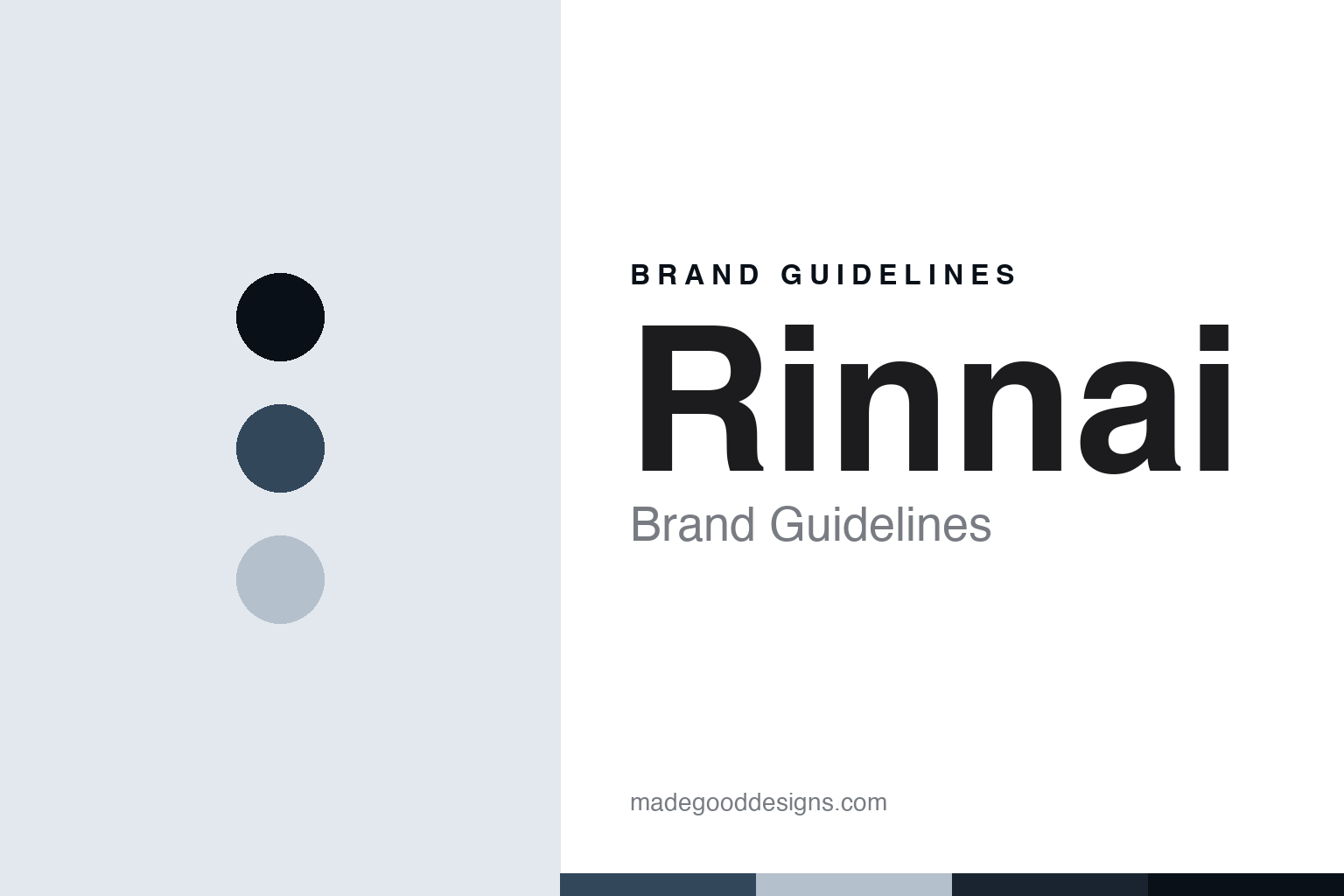
Rinnai Brand Guidelines
The Japanese tankless leader, built in Georgia.
Aa
Two constants: a Rinnai-graphite palette and a tankless-sans register. Abstract homage — not a Rinnai product or mark; no water heater, vent or logo is reproduced.
The Japanese tankless leader, built in Georgia
Rinnai is the 1920 Japanese gas-appliance maker — a tankless water-heater leader by its own account — now assembling tankless units in Georgia.
Rinnai follows Bradford White as the round’s Asian gas-tankless node — a Japanese giant whose on-demand water heaters have become an American standard, now built in the US. Its answer to a round about who owns and where-makes the water heater is a Japanese leader with a Georgia plant: the Japanese tankless leader, built in Georgia.
Its identity is the Japanese tankless leader, built in Georgia. The 1920 founding, the tankless leadership and the US assembly are the story here. The tankless leader. The Japanese tankless leader, built in Georgia.
(Honest notes, so the founding, the ownership, the making and a claim are framed accurately, with the leadership attributed. Rinnai sells tankless water heaters as its heroes; we report its language as the brand’s own. On founding: Rinnai Corporation is Japanese, headquartered in Nagoya, founded on the first of September 1920 by Hidejiro Naito and Kanekichi Hayashi, with the name combining Rin from Hayashi and Nai from Naito. On ownership: it is publicly traded on the Tokyo and Nagoya exchanges, and it is Japan’s largest gas-kitchen-appliance maker. On the claim, attributed rather than asserted: Rinnai says it is a leading brand of tankless water heaters in North America, so we frame the leadership as its own claim. On the making, the key point: its North American arm, Rinnai America Corporation, founded in 1974 and headquartered in Peachtree City, Georgia, opened a US tankless assembly plant in Griffin, Georgia in 2018, so it now assembles tankless units in the US, and the Peachtree City headquarters is a different town from the Griffin plant. On the range: tankless gas water heaters plus home heating and gas appliances. Its designs and the Rinnai name are IP we describe but do not reproduce; there is no official brand hex; these tones are an unofficial interpretation.)
Colour
Rinnai lives in a Rinnai graphite. Click a swatch to copy the hex.
Rinnai’s identity is Japanese, tankless and US-assembling — a Rinnai graphite, an ink, a pale steel, a deep slate, and a paper. The palette leans Rinnai graphite and deep slate: a clean, engineered register that stands in for a Japanese tankless leader rather than a loud logo colour. It signals the Japanese tankless leader, built in Georgia — Japanese, tankless and US-assembling. The honest caveat: with no official brand hex, these values are a clean, unofficial interpretation, not first-party colours.
The lesson is a Rinnai graphite signals a Japanese, tankless identity. Rinnai’s world is the on-demand heater and the Georgia plant. For designers, it is a reminder that a clean graphite and a pale steel can carry a Japanese, tankless brand — an engineered tone held as an accent, not a product shot. Because a dark hue can flatten small text, keep type dark and even and let the colour live in the accents, palette and band. The takeaways: date the founding to 1920 and name Naito and Hayashi; keep it Tokyo-listed and Japanese; attribute the tankless-leader claim; and place the US assembly in Griffin, Georgia, distinct from the Peachtree City HQ.
Typography
The register is a tankless sans — Japanese, tankless, US-assembling.
Rinnai’s identity carries a Japanese, tankless spirit — a global maker that builds locally. A tankless sans captures the mood: clean, modern and engineered, the register of an on-demand specialist. Set in a Rinnai-graphite palette, the tankless sans feels dependable and precise — exactly the personality Rinnai carries. It behaves like a made, machined thing rather than a loud logo, mirroring a vent-dot and a burner-line. (Rinnai’s real products and the name are things we describe but do not reproduce, and the exact typeface is not ours to use.) Because it is not ours to use, the honest description is “a tankless-sans brand,” shown here in a stand-in. The type behaves like the brand: Japanese, tankless and US-assembling.
Aa
A tankless-sans brand — clean and precise. (Specimen set in Sora, a tankless-sans STAND-IN; NOT the Rinnai logo or products.)
The water-heater node
Rinnai stands for the Japanese tankless leader, built in Georgia.
Rinnai sits fourth in the round as its Asian gas-tankless node. A Rinnai-graphite palette, a tankless sans and a 1920 founding make one thing — the Japanese tankless leader, built in Georgia — the whole identity: Japanese, tankless and US-assembling. The 1920 founding is the pitch, the tankless leadership is the claim, and the US assembly is the twist. The point is a Japanese tankless giant that now builds in the US, in a round about who owns and where-makes the water heater.
Put to work, the identity is the brand told straight, the claim attributed and the plant placed. A brand in this spirit would date the founding to 1920 and name Naito and Hayashi, keep it Tokyo-listed and Japanese, attribute the tankless-leader claim, and place the US assembly in Griffin, Georgia distinct from the Peachtree City HQ. A reader in this spirit would keep the facts right: Rinnai makes gas tankless heaters; it dates to 1920; it is Japanese and public; and it assembles tankless units in Georgia. Rinnai sits after Bradford White and before Navien. The honest editorial moves are to date the founding, to attribute the claim, to place the plant, and to keep the two Georgia towns distinct.
For designers and brand-builders, Rinnai carries the water-heater node: a foreign leader can build locally — attribute the “leader” claim. The lessons: a Japanese giant can localise its making, here Rinnai in Georgia; a founding is dated to 1920, by Hidejiro Naito and Kanekichi Hayashi, in Nagoya, the name combining Rin and Nai; an ownership is kept, publicly traded on the Tokyo and Nagoya exchanges, Japan’s largest gas-kitchen-appliance maker; a claim is attributed, that Rinnai says it is a leading tankless brand in North America; a making is placed, Rinnai America of Peachtree City opened a US tankless assembly plant in Griffin, Georgia in 2018, two different Georgia towns; and a range is noted, tankless gas water heaters plus heating and appliances. It is also a reminder to attribute a superlative: Rinnai is the Japanese, publicly traded tankless leader by its own account, now assembling in Georgia — with the palette here an unofficial interpretation. The hook is that pairing: Rinnai is the Japanese tankless leader, built in Georgia, the 1920 Japanese gas-appliance maker, a tankless water-heater leader by its own account, now assembling tankless units in Georgia. Read that way, Rinnai is less a single water heater than the Japanese tankless leader, built in Georgia: Japanese, tankless, US-assembling. The lesson for a brand is that a foreign leader can build locally, and attributing the claim keeps it honest. Rinnai made the-Japanese-tankless-leader-built-in-Georgia the identity — proof that a localising leader can carry a node.
Explore & save
Keep Rinnai’s identity on hand — save it to a board in the Made Good inspiration library.
Rinnai identity set
Pin the Rinnai-graphite palette and the tankless-sans register to your own board.


