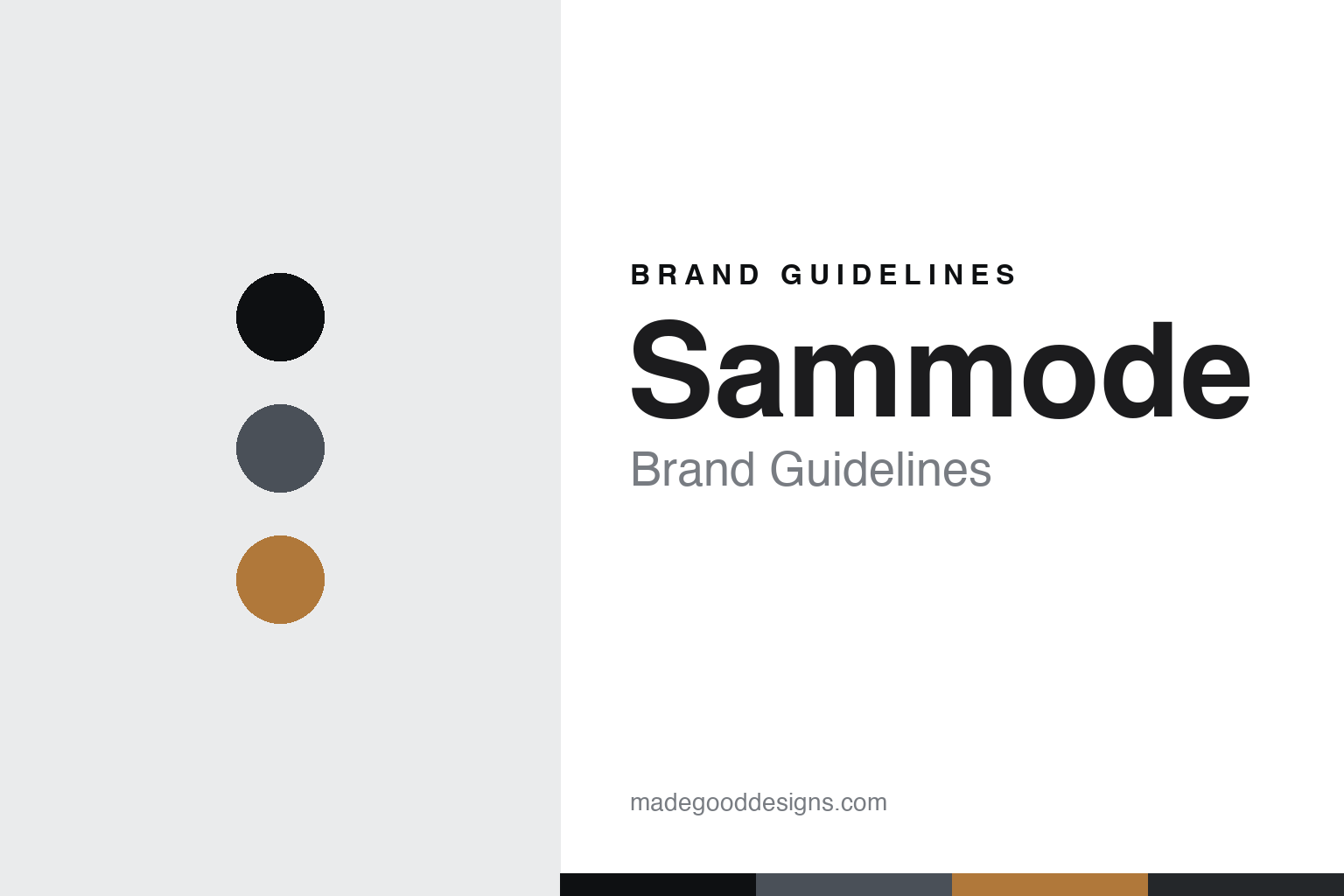
Sammode Brand Guidelines
The sealed tube, reissued.
Aa
Two constants: a steel-and-amber palette and a modernist sans register. Abstract homage — not a Sammode fixture or wordmark.
The sealed tube, reissued
Sammode built robust sealed tube lighting — and reissues French modernists via Sammode Studio.
Sammode is a lesson in industrial heritage as the identity. A French lighting manufacturer since 1927, it built its name on robust, sealed tubular fixtures — waterproof, extreme-temperature, architectural — and, through its design-led line Sammode Studio, reissues French modernist designers using that same engineering.
Its identity is the sealed tube, reissued. Sammode’s industrial tubes and its Studio’s faithful modernist reissues are the work it is known for. Engineering, made design. A near-century-old maker that turned its factory into a design tool.
(Honest notes, so the story stays precise. Sammode is a French company founded in October 1927 by Louis Lemaire in Châtillon-sur-Saône; its name is an acronym for a “society for the application of modern electric lighting methods,” and it began as an industrial and technical manufacturer. It is independent and family-owned across four generations, led by chief executive Emmanuel Gagnez, and it makes its products in France, at its own factory in Châtillon-sur-Saône in the Vosges — not Brittany — with an R&D centre at Lamotte-Beuvron and its headquarters and showroom in Paris. Its core signature is robust, sealed tubular fixtures rated for water and extreme temperatures; separately, Sammode Studio is a distinct design-led line that reissues French modernists — the Pierre Guariche collection was reissued in 2019 with the designer’s estate, alongside Michel Mortier — and commissions new designer work. An important correction: Sammode does not reissue Jean-Louis Domecq or Jieldé designs, which belong to a separate company; and Guariche’s original lamps were historically produced by Disderot, with Sammode as the modern reissuer. Those reissued designs are the original designers’ heritage IP, which we describe but never reproduce, and there is no official brand hex — these tones are an unofficial interpretation. This is design commentary and does not promote any product.)
Colour
Sammode lives in a steel-and-amber palette. Click a swatch to copy the hex.
Sammode’s identity is industrial, robust and functional — a steel, an ink, an amber, a graphite, and an aluminium. The palette leans steel and amber: the register of a sealed metal tube and a warm glow. It signals engineering and heritage over decoration. The honest caveat: with no published brand hex, these values are an original, unofficial interpretation, not first-party colours.
The lesson is a steel-and-amber palette signals an industrial, engineered identity. Sammode’s world is an industrial, robust, functional object. For designers, it is a reminder that a palette of real metal tones warmed by an amber glow can carry a house built on engineering — and that a design-led line can borrow that same material honesty. Because a mid steel can fail as small text, keep type dark and let the colour live in the accents, palette and band. The takeaways: build on real engineering; let a design line grow from it; keep the palette industrial; and treat any single hex as unofficial.
Typography
The register is a modernist sans — functional, engineered, clean.
Sammode’s identity carries a functional, engineered, clean spirit — a robust object, not a decorative flourish. A modernist sans captures the mood: geometric, precise and utilitarian, the register of industrial design and mid-century modernism. Set in a steel-and-amber palette, the modernist sans feels functional and clean — exactly the personality Sammode carries. It is engineered rather than ornamental, mirroring a sealed metal tube. (Sammode’s real fixtures, its Studio’s reissued designs and its wordmark are things we describe but do not reproduce, and the exact typeface is not ours to use.) Because it is not ours to use, the honest description is “a modernist-sans spirit,” shown here in a stand-in. The type behaves like the brand: functional, engineered and clean.
Aa
A modernist-sans spirit — functional and engineered. (Specimen set in Space Grotesk, a modernist-sans STAND-IN; NOT the Sammode wordmark or any reissued design.)
Industrial heritage as identity
Sammode stands for the sealed tube, reissued.
Sammode is a lesson in making industrial heritage the identity. A steel-and-amber palette, a modernist sans and a near-century of engineering make robust, sealed lighting the whole brand — and its Studio line turns that engineering into design. The heritage is the differentiator. The differentiator is a real manufacturing pedigree — sealed tubes made in France since 1927 — put to a design-led purpose through faithful modernist reissues.
Put to work, the identity is a heritage as design. A house building in this spirit would honour its engineering roots and let a design line grow from them, reissuing worthy classics with credit and making everything at home, so the customer buys into genuine manufacture and design history. The lesson Sammode teaches is that a real industrial heritage plus a disciplined design line can build a brand: the engineering gives it integrity, and the reissues give it design credibility — with the original designers credited. The heritage is the personality, and the making is the proof.
For designers and brand-builders, Sammode offers a clear takeaway: let a design line grow from real engineering. The lessons: honour your manufacturing roots; reissue with credit; make it at home; and be accurate about the story. It is also a reminder to stay precise: Sammode was founded in 1927 in Châtillon-sur-Saône, is family-owned and makes in France in the Vosges, and its Studio line reissues Pierre Guariche and Michel Mortier — not Jieldé — with the designers’ estates; those reissues are described but never reproduced, and the palette here is an unofficial interpretation. Sammode made the sealed tube a design object — proof that engineering can be the difference.
Explore & save
Keep Sammode’s identity on hand — save it to a board in the Made Good inspiration library.
Sammode identity set
Pin the steel-and-amber palette and the modernist-sans register to your own board.