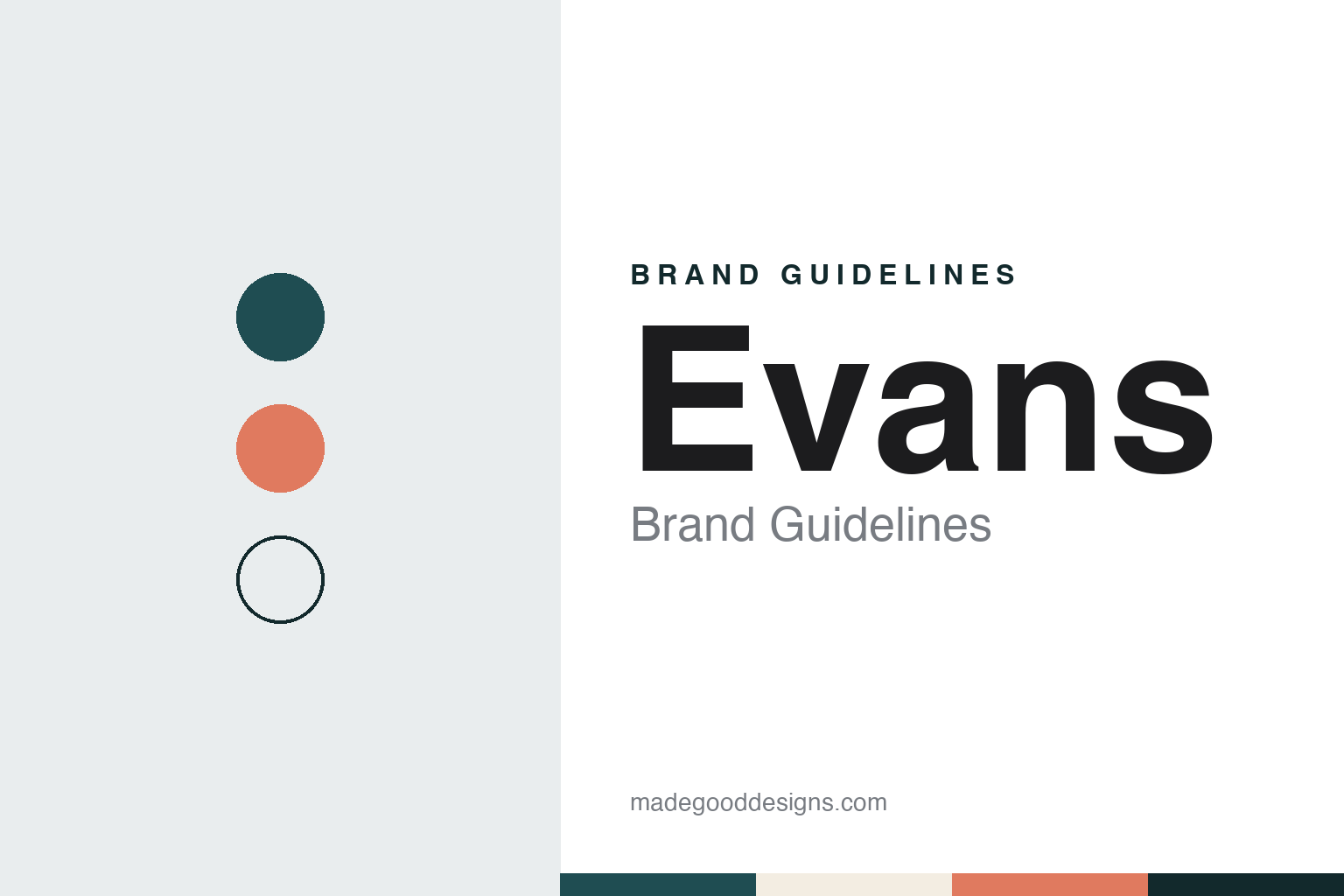
Evans Brand Guidelines
The 1930 British plus-size chain that became an online brand.
Aa
Two constants: a deep teal, coral and cream palette and a geometric sans register. Abstract homage — not an Evans product or mark; no shop sign, logo or garment is reproduced.
Evans Outsize
A manufacturer’s shops on the British high street.
Evans is a British womenswear brand for larger sizes. English Wikipedia says it was founded in 1930 by the manufacturer Jack Green, and Retail Gazette gave the same founding year when it reported on the brand’s sale in December 2020. For four decades it traded as an independent limited company.
In its early decades the chain traded as Evans Outsize. That was the name under which it joined the Burton Group, the menswear tailoring business founded by Montague Burton that was then diversifying into women’s clothing. A history of Burton published by the heritage blog Building Our Past in January 2017 lists “Evans Outsize (1970)” among the group’s later acquisitions, ahead of Dorothy Perkins in 1979. A company history of the Arcadia Group, as Burton was later renamed, gives the date as 1971 and describes the purchase of “Evans Outsizes” as Burton’s move into the women’s trade beyond its small Peter Robinson chain; the sources therefore differ by a year.
Under Burton the chain grew across the country. English Wikipedia says Evans introduced mail-order buying in 1972, shortly after it had expanded to more than 77 branches nationwide. The same company history of Arcadia names Evans among the formats, alongside Top Shop, Dorothy Perkins and Principles for Women, through which the group sold mostly private-label clothing to women.
Colour
Brochures, labels and a website.
Evans reached its customers through print as well as shops. English Wikipedia dates the earliest Evans brochure to 1994, carried in Good Housekeeping and Prima magazines and running to just 12 pages. In 1997 the brand added SeVen, a more fashion-led label aimed at younger customers, and it began selling online in the same year.
Collaborations gave the brand new labels within its stores. In 2012, according to English Wikipedia, the British label Clements Ribeiro introduced a range called Swan for Evans. The brand also looked abroad: Wikipedia says Evans launched in the United States in 2011 and began delivering to more than 100 countries.
By the end of the Arcadia era the store estate was small. When Retail Gazette reported the sale of the brand in December 2020, it counted five standalone stores in the UK and around 100 places where Evans clothing was sold inside larger shops and concessions, most of them within other Arcadia stores. The paper described the range as plus-size clothing for women in UK sizes 14 to 32, together with lingerie and accessories.
The way those concessions worked goes back to the group’s property policy. Building Our Past says a review of the Burton Group’s portfolio in the 1990s, known as “Townprint,” led it to place several house brands together within a single building, so that shops often shared their premises with sister brands such as Dorothy Perkins. In 1998, the same history says, Debenhams was demerged and the Burton Group was renamed the Arcadia Group; since 2002 Arcadia had been owned by Philip Green’s family.
Typography
Shop signs, catalogues and size ranges.
Plus-size fashion chains in Britain, North America and Australia present themselves through the same tools as any other clothing retailer: a shop sign, a logo, a website, a loyalty scheme and, for some, a printed catalogue. Their size ranges are part of how they describe themselves: Penningtons gives its range as 12 to 32 on its website, and a 2025 trade directory listed Yours Clothing at 14 to 40, up from 16 to 36 in 2018.
The formats vary widely. Some chains grew from a single trading pitch: Yours Clothing began as a market stall in England in 1994 and moved online in 2007, according to the Lincolnshire Free Press. Others are long-established store chains in shopping centres and on high streets, and the category also includes brands that grew out of mail-order catalogues before moving online. Yours Clothing, for example, now sells through its own stores and websites, and also stocks a menswear label from the same owner.
Ownership is just as varied, and it often explains the identity a shopper sees. Some chains are run by their founders, some belong to listed retail groups, and others have passed between owners after administrations or creditor-protection filings. Reitmans, the Montreal group that bought Penningtons in 1995, closed its second plus-size chain, Addition Elle, in 2020 and later revived the name as a range inside its Penningtons stores. The Evans brand moved from Britain’s Arcadia Group to Australia’s City Chic Collective in 2020 and on to the owner of Yours Clothing in 2023, according to TheIndustry.fashion.
Names and logos also change: Penningtons announced a shortened PENN. logo in September 2022, and its website now uses both forms together. This guide sets out what can be checked about each brand, from founders and owners to the ranges they name, and treats every palette and typeface shown here as an unofficial interpretation.
Aa
A clean geometric sans for an online fashion name. (Specimen set in Jost, a sans STAND-IN; NOT the Evans logo.)
Evans
Administration, an Australian owner and a British one.
The Arcadia Group, Evans’s parent, entered administration in November 2020. Evans was the earliest of the group’s brands to be bought out of administration, Retail Gazette reported in January 2021. In December 2020 the administrators, Deloitte, announced the sale of the Evans brand, e-commerce and wholesale business to City Chic Collective, the listed Australian plus-size retail group; Retail Gazette reported that the deal covered the brand and its intellectual property, the customer base and the inventory, and was expected to complete on 23 December.
The stores were not part of the deal. FashionUnited reported on 21 December 2020 that City Chic would run Evans as an online-only brand, and that Arcadia would close the few remaining Evans stores in due course. City Chic’s chief executive said in the same report that the two businesses had already worked together for five years, with Evans selling City Chic clothing. In January 2021 Retail Gazette reported that the five standalone stores and some 100 Evans concessions and outlets inside other Arcadia stores had closed permanently. Evans no longer trades from a store estate of its own.
City Chic’s ownership lasted less than three years. On 4 August 2023 FashionUnited reported that AK Retail Holdings, the British group that had bought M&Co earlier that year, had acquired the Evans brand, its intellectual property and customer base, together with City Chic’s business in Europe, the Middle East and Africa; as a result City Chic’s German online retailer, Navabi, was to cease trading. Under a transition arrangement described in the same report, AK Retail Holdings could sell the non-Evans stock it took over, while City Chic could sell its remaining Evans-branded products in Australia, New Zealand and North America. Retail Gazette described the buyer as the owner of both M&Co and Yours Clothing. English Wikipedia now describes Evans as an online women’s clothing retailer operated in the UK by Yours Clothing, selling plus-size clothing, lingerie, wide-fitting shoes, swimwear and accessories.
For a design guide, Evans shows how a high-street name can survive the loss of every shop and two changes of owner by living on as a website and a label. Compare Yours Clothing, the British plus-size retailer whose owner now runs Evans, and City Chic, the Australian chain that owned it from 2020 to 2023. For this guide we use a deep teal, a coral and a cream with a sans, an unofficial interpretation; no product or logo is reproduced.
Explore & save
Keep Evans’s identity on hand — save it to a board in the Made Good inspiration library.
Evans identity set
Pin the Evans deep teal, coral and cream palette and the geometric sans register to your own board.
Source & notes
Frequently Asked Questions
What font can I use to match the Evans look?
This guide describes Evans’ type as “A clean geometric sans for an online fashion name”. Its type specimen is set in Jost from Google Fonts as a stand-in; Jost is not Evans’ own lettering.
What colours are in the Evans palette?
This guide’s Evans palette is Deep teal #1F4D52, Harbour ink #12292C, Coral #E07A5F, Cream #F3EDE2 and Paper #FAF8F4. The tones are the guide’s own unofficial interpretation, not official Evans hex codes.
When was Evans founded?
Evans was founded in 1930, in United Kingdom. Evans is known for Plus-size womenswear, lingerie and accessories.
Who founded Evans?
Evans was founded in 1930 by Jack Green, a clothing manufacturer.
Who owns Evans?
Evans is owned by AK Retail Holdings, owner of Yours Clothing, since August 2023.