Change Lingerie Brand Guidelines
The Danish lingerie chain from Farum to Canada.
Aa
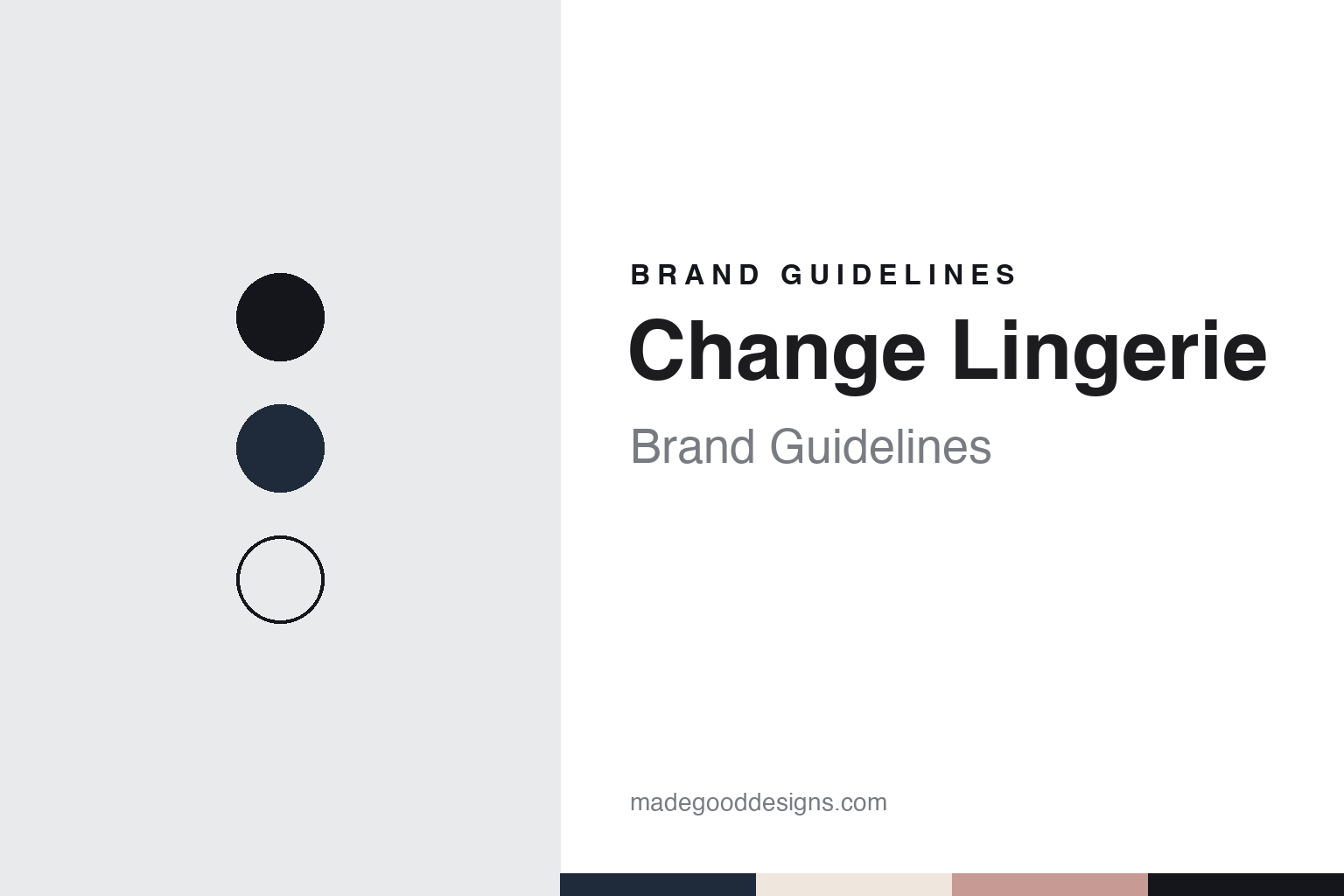
Two constants: a navy, oat and dusty rose palette and a geometric sans register. Abstract homage — not a Change Lingerie product or mark; no garment, logo or shop sign is reproduced.
Change of Scandinavia
Two founders, one bra and a first shop.
Change Lingerie is a Danish lingerie brand sold mainly through its own chain of shops. The company behind it is Change of Scandinavia, as Private Equity Wire named it in 2013 and FashionUnited in 2026. In its own history the company says it was founded in 1995 in Denmark by Claus Walther Jensen and Gitte Breil. Private Equity Wire also gave 1995 in July 2013, describing Claus Jensen as chief executive and lead shareholder. Other dates appear in trade press: FashionUnited wrote in August 2025 that the two co-founders started Change at the beginning of the 1990s, and in July 2026 it called Change a lingerie brand founded in 1997. The company gives its headquarters as Farum in Denmark, as did Private Equity Wire in 2013; FashionUnited placed the brand in Copenhagen in 2026.
The company ties its range to one early design. It says that in 1997 the designer Lissi Lid developed the first Lissi bra, which it calls the foundation of Change Lingerie, and Lissi Collection and Lissi Classic remain named lines on its website today, alongside collections it calls Florence, Rose and Romance. Its range covers bras, briefs, nightwear and loungewear, the categories its shop menus list.
Retail came next. The company dates its first shop to 2001 and places it in Ringsted, Denmark; Private Equity Wire in 2013 described the first concept store, opened in 2001, as being in Copenhagen. The company lists its first shop in Germany in 2006, the launch of online shopping at change.com in 2007 and the introduction of its loyalty programme, Club CHANGE, in 2008. Private Equity Wire reported more than one million Club Change members in 2013; the company now says it has more than two million. It also lists Intimate, a sub-brand aimed at a younger generation of customers, introduced in 2014, and the opening of its 200th shop in 2015.
Colour
Investors, Twilfit and Palmers.
The first outside investor on record arrived in 2013. Private Equity Wire reported on 9 July 2013 that the private-equity firm Metric Capital Partners had completed an investment in Change of Scandinavia, made through a credit instrument with equity participation, to support a reorganisation of the company’s ownership structure. The same report described Change as running a vertically integrated value chain and distributing mainly through more than 160 single-brand shops in Europe, North America and the Far East, as well as online. It was Metric Capital Partners’ eighth transaction since the firm began investing in April 2012.
Change has also bought other lingerie businesses. The company says that in 2020 it acquired the Swedish lingerie brand Twilfit, which then had 55 shops. The company also says it opened its first production facility in China in 2021. FashionUnited reported in July 2026 that Change garments are produced in Europe and Asia.
The most recent step came in Austria. The Austrian lingerie company Palmers had to file for insolvency in February 2025, FashionUnited reported on 26 August 2025, after it was unable to secure financing. In July 2025 Change was confirmed as the investor, the same report said. By late August, FashionUnited reported, citing the imprint of the Palmers webshop and an earlier report in the trade magazine Textilwirtschaft, Claus Walther Jensen had become the board of Palmers Textil AG, and the previous executive board members had left. In July 2026 FashionUnited again described Change of Scandinavia as the company that had secured the insolvent Palmers about a year earlier.
Typography
Lingerie and underwear chains.
Lingerie and underwear chains in Europe and North America present themselves first through their shops. A short name on the fascia, often set in a simple serif or sans, is repeated on bags, boxes, tissue and labels, so the sign on the street and the parcel on the doorstep carry the same mark. Many chains keep their colour schemes to a few soft or dark tones, and when they renew a shop concept they publish the change in terms of lighting, furniture and a new range of colours.
The formats vary widely. Some chains trade from small boutiques in shopping centres and on high streets; others run larger stores built around fitting rooms and a fitting service, and some began as catalogue or online retailers before opening shops of their own, or never opened any. Shop-in-shop areas inside department stores and fashion retailers carry a brand’s fixtures and signs into someone else’s floor, and franchise partners take the same format to markets the owner does not run directly.
Ownership is just as mixed. Some chains are still run by their founders or founding families, some belong to listed retail groups that operate several chains side by side, and others have passed through private-equity owners, administrations and rescue deals. The companies usually describe these changes on corporate pages about their history, founders and owners, while trade and business press record the dates.
Collections are presented by name rather than by number: named lines that return season after season, sleepwear and loungewear ranges, swimwear, sub-brands aimed at younger customers, and services such as loyalty clubs and online shops. For a designer, these chains show how a consistent name, a narrow palette and a recognisable shop format can hold a brand together across many countries and channels.
Aa
A geometric sans for a Danish lingerie chain. (Specimen set in Jost, a sans STAND-IN; NOT the Change Lingerie logo.)
CHANGE
Shops, shop-in-shops and two sets of numbers.
The brand writes its name in capitals, as CHANGE, on its website and in the name of its loyalty programme, and its pages also use CHANGE Lingerie. Published counts of its shop network differ. On its history page the company says it has more than 300 shops across nine markets, including Europe and Canada, with more than 2,000 employees. FashionUnited wrote in July 2026 that the brand was available in around 400 shops in Europe and Canada and employed more than 3,000 people. Both figures are given here as their sources state them.
Germany, where Change opened its first shop outside Denmark in 2006, has more recently become a wholesale market as well. FashionUnited reported on 10 July 2026 that Change had opened shop-in-shop areas in the first half of the year with the fashion retailers CJ Schmidt in Husum and Stackmann in Buxtehude, in northern Germany, and was then adding the Baden-Württemberg retailer Zinser, where its lingerie went on sale at seven locations, bringing the total to nine points of sale. Change’s head of wholesale told FashionUnited that the openings showed the brand had arrived in German specialist retail.
The pieces of the Change story sit in a clear order: a founding pair in Denmark in the 1990s, one bra design dated to 1997, a first shop in 2001, a loyalty club from 2008, outside investment from 2013, the purchase of Twilfit in 2020 and the move into Palmers in 2025.
For a design guide, Change Lingerie shows how a single short word, set in capitals, can carry a chain from one Danish town into several countries and into other retailers’ floors. Compare Lindex, a Nordic chain that began with lingerie, and Hunkemöller, another European lingerie chain. For this guide we use a deep navy, oat and a dusty rose with a sans, an unofficial interpretation; no product or logo is reproduced.
Explore & save
Keep Change Lingerie’s identity on hand — save it to a board in the Made Good inspiration library.
Change Lingerie identity set
Pin the Change Lingerie navy, oat and dusty rose palette and the geometric sans register to your own board.
Source & notes
Frequently Asked Questions
What font can I use to match the Change Lingerie look?
This guide describes Change Lingerie’s type as “A geometric sans for a Danish lingerie chain”. Its type specimen is set in Jost from Google Fonts as a stand-in; Jost is not Change Lingerie’s own lettering.
What colours are in the Change Lingerie palette?
This guide’s Change Lingerie palette is Nordic navy #1F2A3A, Night ink #14161C, Oat #EFE6DE, Dusty rose #C79A93 and Paper #F8F6F3. The tones are the guide’s own unofficial interpretation, not official Change Lingerie hex codes.
When was Change Lingerie founded?
Change Lingerie was founded in 1995 (company date), in Denmark.
Who founded Change Lingerie?
Change Lingerie was founded by Claus Walther Jensen and Gitte Breil in 1995 (company date).