J/Boats Brand Guidelines
The Johnstone family’s garage-built J/24 and its licensed builders.
Aa
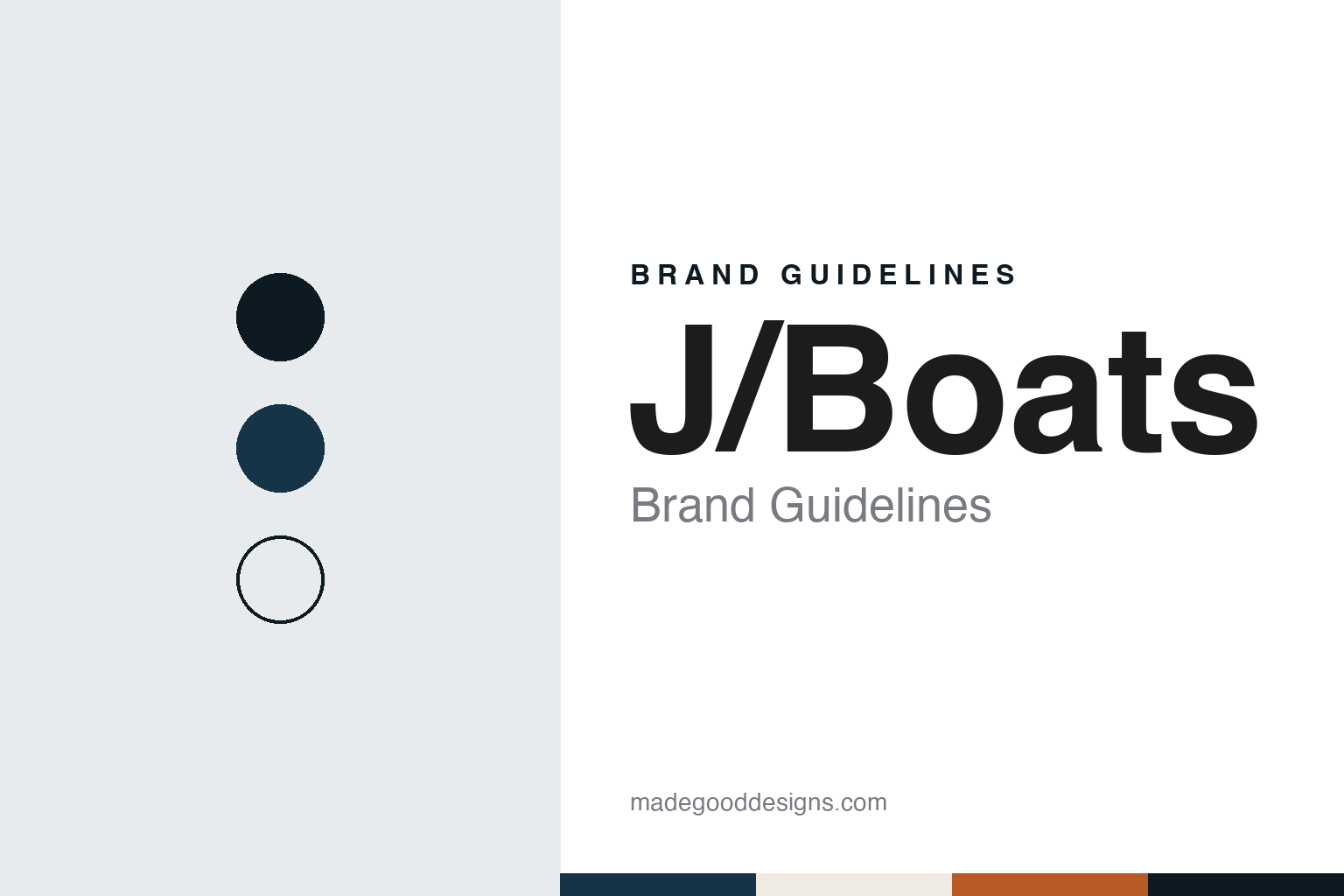
Two constants: a Narragansett blue, dune sand and spinnaker orange palette and a condensed sans register. Abstract homage — not a J/Boats product or mark; no yacht, logo or sail insignia is reproduced.
A boat in a garage
An advertising salesman, a correspondence course and a 24-footer.
J/Boats began with one boat built at home. Soundings, in a March 2016 profile by Steve Knauth, says Rod Johnstone designed the boat that became the J/24 while working as an advertising salesman for that magazine, drawing on what he had learned on a Westlawn School of Yacht Design correspondence course, and built it in his garage in Stonington, Connecticut. Twenty-four feet, Soundings notes, was the largest boat that would fit in the garage. The fibreglass-and-balsa prototype had a fractional rig and a fin keel, and it later served as the master plug for production.
The company’s own history, on its “About Us” page, dates the start of the project to 1975 and says the family raced the prototype through the summer of 1976. Everett Pearson, owner of the boatbuilder Tillotson Pearson in Warren, Rhode Island, then agreed to produce the design in return for the United States building rights, and a makeshift factory was set up that winter in an old textile mill in nearby Fall River, Massachusetts. Display advertisements in Soundings spread the word.
The second founder came from the marketing side of the industry. The company says Rod’s brother Bob Johnstone, then a vice president of marketing at AMF/Alcort, the maker of the Sunfish dinghy at the time, had tried without success to interest his employer in a boat of this kind, and in February 1977 joined his brother instead. Rod contributed the design and the prototype, Bob the start-up funding, and the two formed a 50–50 partnership. J/Boats gives 1977 as its founding year, and English Wikipedia, citing the boat database Sailboatdata and Anthony Dalton’s book J/Boats: Sailing to Success, agrees.
From the beginning the company concentrated on design and marketing rather than on running its own yard. English Wikipedia, citing Practical Sailor, says J/Boats intentionally left production to Pearson’s company, and that arrangement, in which J/Boats designs and licensed builders build, still shapes how the brand works today.
Colour
A slash, a length and a family of designers.
The name of every model is part of the identity. English Wikipedia explains that J/Boats designs are named “J/” followed by the boat’s length overall: in feet for the early boats such as the J/24, in decimetres from 1994, and in metres from 2021, starting with the J/9. All are monohull, sloop-rigged keelboats built of cored fibreglass sandwich, the same article says. The slash and the number have become a shorthand that owners, class associations and race programmes use for the boats.
The J/24 remains the reference point. Soundings reported in 2016 that more than 5,500 had been built and that regattas were sailed under the International J/24 Class Association by more than 150 fleets worldwide. It describes a simple rig, an uncomplicated deck layout and strict one-design rules, so that older boats could compete with newer ones, and quotes Daniel MacNaughton’s Encyclopedia of Yacht Design on how Johnstone designed it without reference to any handicapping rule.
Design has stayed in the family. The company says a second generation of Johnstones has been at the helm since 1988, and that since 1992 Jeff Johnstone, as president, and Alan Johnstone, as vice president and designer, have run the company from its headquarters in Newport, Rhode Island, with eight members of the second and third generations on the board of directors. English Wikipedia credits Rod Johnstone with the original designs and Alan Johnstone as chief designer.
The range has grown well beyond one-design racing. English Wikipedia says that by 2020 the company had built almost 10,000 boats to Johnstone designs and listed eight models then in production. Its current website groups the boats into day sailers, one-design sport boats and performance cruisers, and in November 2020 Scuttlebutt Sailing News carried the company’s announcement of the J/9, a 28-foot day sailer with a large cockpit and a simple sail plan, presented in a statement after that autumn’s boat shows were cancelled.
Typography
Design and documentation.
The cruising sailboat builders in this guide mostly present themselves through a place and a name. A yard is often named after a founder, a family or a home port, and that name appears on the hull, on the sail insignia and on the stand at a boat show. Some builders keep an emblem chosen decades ago; others have redrawn their logos as the company changed hands. Where a logo date or a designer is given in this guide, it comes from the builder’s own history or a dated source.
The model range is usually the clearest part of the identity. Builders name their yachts by length, by a number or by a short series name, and their websites group the boats that way, with brochures, layout drawings and configurators for each model. Naval architects and interior designers are named only as the builders or the sailing press credit them, and the same design office may work for several yards.
Boat shows and yard events carry much of the presentation. Builders publish calendars of shows, open days at the yard and owners’ regattas or rallies, and some run brokerage pages for used boats of their own make. Dealers and sales partners in other countries often carry the builder’s name alongside their own, which is why a brand can look the same at a show in Düsseldorf, Southampton or Cannes.
Ownership varies widely. Some yards are still run by the founding family in a second or third generation; others belong to listed groups that hold several boat brands, or to investors who have bought and sold them. Corporate pages describe founders, owners and sister brands; this guide sets those accounts beside dated reporting in the sailing and trade press, and keeps each company’s own claims clearly marked as its own.
Aa
A condensed sans — a nod to the slash-and-number model names on sails and hulls. (Specimen set in Barlow Semi Condensed, a sans STAND-IN; NOT the J/Boats logo.)
J/Boats
Designed in Newport, built under licence.
Because J/Boats licenses rather than builds, the question of where a J is made has several answers. The company’s builders page in 2026 lists four licensed builders: J/Composites in Les Sables-d’Olonne, France, for Europe; CCF Composites in Bristol, Rhode Island, for North America; Red Dragon Yachts in Xiamen, China, for Asia and the Pacific; and J/Boats Argentina, in San Isidro, for South America. The licensing model goes back to the original agreement with Tillotson Pearson in Fall River.
The French yard has been profiled in the trade press. The British trade site Marine Industry News, in a visit published in October 2026, says Didier Le Moal, its chief executive and president, founded J Composites in 1994 to build J/Boats designs under licence for the European market, with interiors adapted to European customers. The yard assembled its first boat that year, and in 2001 it launched the J/109, which the article describes as the first model developed jointly by the French team and J/Boats. It builds with composite sandwich structures and resin infusion, employs about 60 people, and makes an estimated 200 boats a year, according to Le Moal, who also said there were close to 2,000 examples of the J/70 sport boat on the water.
The same article gives a sense of how the brand presents its boats through the French yard: three ranges of performance cruisers, sport boats and day sailers, and a deliberately short options list, with a choice of cabin layout and wood colour rather than wide customisation. Le Moal describes the boats as sailing boats first, with the rest fitted around that aim.
J/Boats, Inc. is a privately held company, English Wikipedia says, and the company names eight family members on its board. Its own pages present it through the founders’ story, the family board and the long list of J/ classes rather than through a factory.
For a design guide, J/Boats shows how a naming system and a founding story can hold a brand together when the boats are built by different yards on different continents. Compare Catalina Yachts, another American sailboat name from the same era, and Hinckley, a New England yacht builder. For this guide we use Narragansett blue, dune sand and a spinnaker orange with a condensed sans, an unofficial interpretation; no product or logo is reproduced.
Explore & save
Keep J/Boats’s identity on hand — save it to a board in the Made Good inspiration library.
J/Boats identity set
Pin the J/Boats Narragansett blue, dune sand and spinnaker orange palette and the condensed sans register to your own board.
Source & notes
Frequently Asked Questions
What font can I use to match the J/Boats look?
This guide describes J/Boats’ type as “A condensed sans — a nod to the slash-and-number model names on sails and hulls”. Its type specimen is set in Barlow Semi Condensed from Google Fonts as a stand-in; Barlow Semi Condensed is not J/Boats’ own lettering.
What colours are in the J/Boats palette?
This guide’s J/Boats palette is Narragansett blue #163447, Harbour ink #0E1A22, Dune sand #EFEBE3, Spinnaker orange #B85A24 and Paper #F9F8F5. The tones are the guide’s own unofficial interpretation, not official J/Boats hex codes.
When was J/Boats founded?
J/Boats was founded in 1977, in Rhode Island, United States.
Who founded J/Boats?
J/Boats was founded by Rod Johnstone and Bob Johnstone in 1977.