Catalina Yachts Brand Guidelines
A California sailboat builder that ended up in Largo, Florida.
Aa
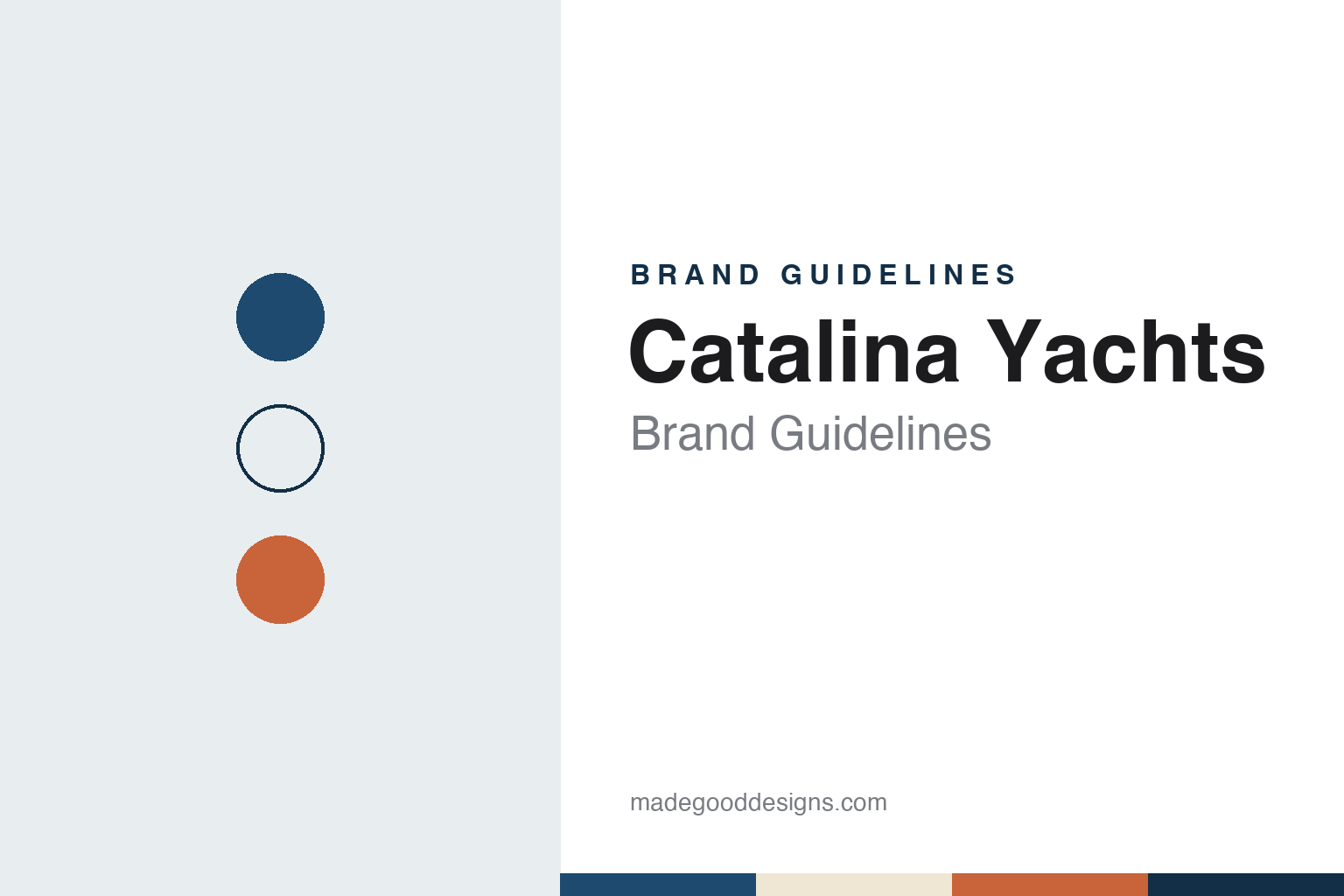
Two constants: a channel blue, gelcoat cream and sunset rust palette and a plain-spoken sans register. Abstract homage — not a Catalina Yachts product or mark; no logo, sail insignia or hull graphic is reproduced.
From Coronado to Catalina
A loan, some tooling and a 22-foot boat.
Catalina Yachts was an American builder of fibreglass sailboats founded by Frank Butler in southern California. English Wikipedia dates the founding to 1969 and places it in Hollywood, California; Marine Industry News also gave 1969 in July 2026. The company’s own history page, and a May 2026 report by Peter Swanson in Loose Cannon carried by Scuttlebutt Sailing News, give 1970. The company’s timeline settles the detail in its own way: it says the opening model, the Catalina 22, was built in North Hollywood in July 1969.
Butler came to boatbuilding through a debt. English Wikipedia says that in 1961 the builder of a boat he had ordered ran out of money after borrowing from him, and handed over the tooling instead of repaying the loan. Butler took control of the business and renamed it Wesco Marine and later Coronado Yachts; some early Coronado boats carry the Wesco Marine nameplate on the transom, the article says. In 1969 he sold Coronado to the Whittaker Corporation, which already owned Columbia Yachts, stayed on for a year, and then left to start Catalina.
The Catalina 22 was a design that Columbia had turned down, according to English Wikipedia. The company’s timeline says Butler hoped to build 100 of them; by February 1975, it says, hull number 5,000 was complete. The Catalina 27 followed in March 1970 and the Catalina 30 in December 1974, the timeline says. In May 2026 Loose Cannon reported that the 22 had been in continuous production for decades, with as many as 18,000 sold.
In 1978, English Wikipedia says, Catalina built the Catalina 38 from moulds for a Sparkman & Stephens racing design bought from the bankrupt Yankee Yacht Company. Butler reworked it with a new interior, a Catalina deck, a taller mast, a shorter boom and a relocated rudder, the article says. The company’s timeline adds that by 1980 the 22 was being built at Catalina’s east and west coast plants and also in England, Australia and Canada.
Colour
Two coasts, one name on the transom.
In May 1984 Catalina bought Morgan Yachts of Largo, Florida, according to the company’s timeline, which says Morgan became the company’s Morgan Division, building cruising and charter boats and many Catalina models on the east coast. English Wikipedia also dates the Morgan purchase to 1984. For the next two decades the timeline records boats being completed on both coasts: hull milestones at the Woodland Hills plant in California through the 1990s and early 2000s, and in Largo from the mid-1990s. In August 2005, the timeline says, the Largo plant added three buildings and about 56,000 square feet of manufacturing space.
The range ran from small boats to mid-sized cruisers. English Wikipedia describes Catalina as a builder of fibreglass monohull sloops from eight to 54 feet, with the smallest boats sold under the Capri nameplate. The timeline lists dinghies and day-sailers under the Expo and Capri names alongside the cruising yachts, and from the 1980s an owners’ magazine, Mainsheet, which the company says began publication in March 1983. In later years the company also added True North, a line of Downeast-style powerboats, according to Marine Industry News.
The business stayed in private hands. In December 1998, the company’s timeline says, Frank Butler took Sharon Day, vice president of sales, and Gerry Douglas, vice president of engineering, as partners in his privately held company. New models continued to appear at the United States Sailboat Show in Annapolis, Maryland, through the 2010s, the timeline says, the last it lists arriving in October 2016.
The company described itself in plain terms. Its history page says Butler set out to build sound boats at a fair price and that new designs carry over proven features rather than starting again each time, which it says gives the line continuity. Its website carried the line “Owned. Designed. Built in America.” Those are the company’s own words.
Typography
How the builders present themselves.
The cruising sailboat builders in this guide mostly present themselves through a place and a name. A yard is often named after a founder, a family or a home port, and that name appears on the hull, on the sail insignia and on the stand at a boat show. Some builders keep an emblem chosen decades ago; others have redrawn their logos as the company changed hands. Where a logo date or a designer is given in this guide, it comes from the builder’s own history or a dated source.
The model range is usually the clearest part of the identity. Builders name their yachts by length, by a number or by a short series name, and their websites group the boats that way, with brochures, layout drawings and configurators for each model. Naval architects and interior designers are named only as the builders or the sailing press credit them, and the same design office may work for several yards.
Boat shows and yard events carry much of the presentation. Builders publish calendars of shows, open days at the yard and owners’ regattas or rallies, and some run brokerage pages for used boats of their own make. Dealers and sales partners in other countries often carry the builder’s name alongside their own, which is why a brand can look the same at a show in Düsseldorf, Southampton or Cannes.
Ownership varies widely. Some yards are still run by the founding family in a second or third generation; others belong to listed groups that hold several boat brands, or to investors who have bought and sold them. Corporate pages describe founders, owners and sister brands; this guide sets those accounts beside dated reporting in the sailing and trade press, and keeps each company’s own claims clearly marked as its own.
Aa
A plain-spoken semi-condensed sans for a practical, owner-facing register. (Specimen set in Barlow Semi Condensed, a sans STAND-IN; NOT the Catalina Yachts logo.)
Catalina Yachts
A sale, a pause, an auction and a new owner.
In May 2025 Catalina Yachts and True North Yachts were bought by the owner of Daedalus Yachts, Marine Industry News and Scuttlebutt Sailing News reported; English Wikipedia dates the agreement to April 2025. By then Catalina was building in Largo. In mid-October 2025 the company’s president, Patrick Turner, announced a “temporary production pause” while it reorganised, citing “short-term financial challenges,” Sail reported on 17 October 2025; Trade Only Today reported on 20 October that existing orders were to be fulfilled.
In May 2026 the Butler family announced the liquidation of the factory’s contents. On 9 June 2026 the remaining assets, tooling and unfinished hulls were sold piecemeal at a public auction, according to Marine Industry News; Loose Cannon reported beforehand that nine boats in various stages of completion were among the lots. English Wikipedia describes the sale as the end of the company’s 57-year history.
The name did not end there. On 1 July 2026 Scuttlebutt Sailing News reported that C & T Composites, a marine manufacturing and composites company based in Largo, was taking over the Catalina and True North brands, and on 2 July Marine Industry News reported that the firm had acquired them. Patrick Turner, Catalina’s former president, leads C & T Composites as chief executive, both reports say. The Catalina Yachts company that Frank Butler founded no longer builds boats; the brand now belongs to C & T Composites.
For a design guide, Catalina Yachts shows how a builder’s name, painted on tens of thousands of transoms, can outlast the factory that made them. Compare J/Boats, another American sailboat name, and Hinckley, another American yacht builder. For this guide we use a channel blue, gelcoat cream and a sunset rust with a sans, an unofficial interpretation; no product or logo is reproduced.
Explore & save
Keep Catalina Yachts’s identity on hand — save it to a board in the Made Good inspiration library.
Catalina Yachts identity set
Pin the Catalina Yachts channel blue, gelcoat cream and sunset rust palette and the plain-spoken sans register to your own board.
Source & notes
Frequently Asked Questions
What font can I use to match the Catalina Yachts look?
This guide describes Catalina Yachts’ type as “A plain-spoken semi-condensed sans for a practical, owner-facing register”. Its type specimen is set in Barlow Semi Condensed from Google Fonts as a stand-in; Barlow Semi Condensed is not Catalina Yachts’ own lettering.
What colours are in the Catalina Yachts palette?
This guide’s Catalina Yachts palette is Channel blue #1D4A6E, Deep harbour #122F47, Gelcoat cream #EFE6D4, Sunset rust #C9643A and Sail white #F7F5F0. The tones are the guide’s own unofficial interpretation, not official Catalina Yachts hex codes.
When was Catalina Yachts founded?
Catalina Yachts was founded in 1969 (the company’s own history says 1970), in California, United States.
Who founded Catalina Yachts?
Catalina Yachts was founded by Frank Butler in 1969 (the company’s own history says 1970).