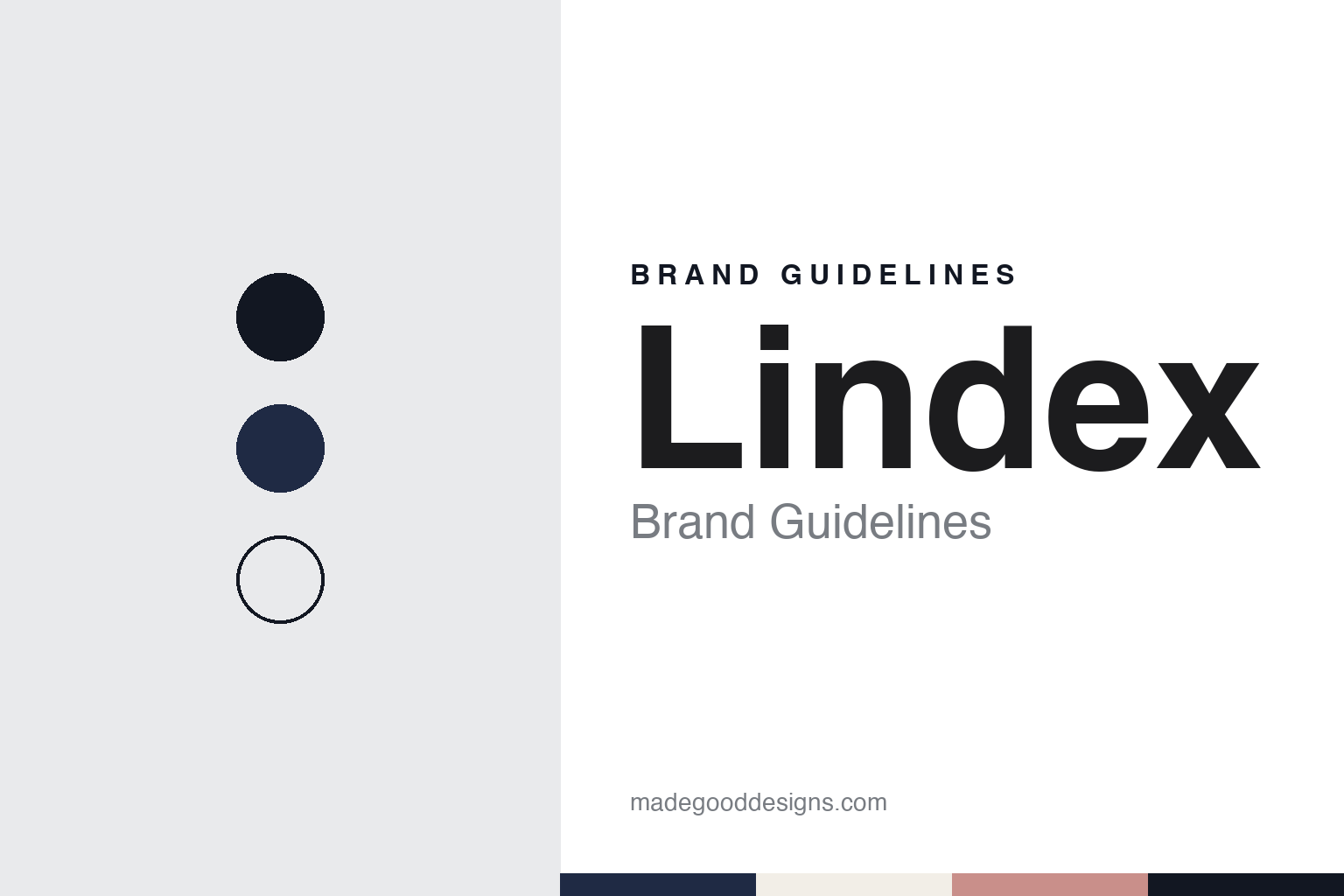
Lindex Brand Guidelines
The Alingsås lingerie shop that became a Nordic fashion chain.
Aa
Two constants: a navy, linen and dusty-rose palette and a clean sans register. Abstract homage — not a Lindex product or mark; no garment, logo or shop sign is reproduced.
Fynd in Alingsås
A small-town lingerie shop takes a Gothenburg name.
Lindex began in 1954 in Alingsås, a town north-east of Gothenburg in western Sweden. The Swedish newspaper Expressen, writing for the chain’s sixtieth anniversary in September 2014, said it was started by Ingemar Boman and Bengt Rosell as an underwear shop called Fynd, a Swedish word for a find or a bargain, before it eventually became Lindex. Swedish Wikipedia adds that the partners soon bought a company called Lindex in Gothenburg, whose name was gradually given to the shops that followed. The company itself still gives 1954 and Alingsås as its founding year and place.
The early business was built on lingerie. Swedish Wikipedia says that during the 1960s the range was widened to womenswear, especially jumpers and blouses, and that the chain opened in Norway in 1969; children’s clothes followed in the 1980s. For a long time Lindex stayed a Swedish and Norwegian business, with Alingsås as its base.
In the 1980s the chain changed hands. The archive history published by ICA, the Swedish grocery group, records that its wholesale arm ICA Eol bought Lindex and the clothing chain Gulins in that decade, as part of a move into specialist goods that a former chief executive describes on the site. Swedish Wikipedia says the chain also tried Finland, Denmark and Britain in this period, and later closed its shops in Denmark and Britain to concentrate on its core markets.
ICA did not keep it long. According to the private-equity firm IK Partners, formerly Industri Kapital, its IK 1989 fund bought Lindex from ICA in August 1993 and sold out in April 1995 through a listing on the Stockholm Stock Exchange. During those two years, IK says, Lindex sold the Gulins chain, opened a buying office in Hong Kong and introduced a new loyalty card.
Colour
Lingerie first, then womenswear and kidswear.
As a listed company in the late 1990s and 2000s, Lindex kept returning to underwear. In 2001 Aftonbladet reported that it was buying Twilfit, a lingerie chain with 61 shops concentrated around Stockholm, to strengthen its position in women’s underwear; at the time Lindex had 347 shops in Sweden, Norway, Finland and Germany, the paper said. The fit was short-lived. In July 2005 the news agency TT, in a report carried by Aftonbladet, said Lindex was selling the Twilfit chain and brand, with 38 owned and ten franchised shops, to a group of investors, while keeping six shops in Stockholm and Uppsala and converting them to Lindex.
Swedish Wikipedia records two other changes from the same years: the head office moved from Alingsås to Gothenburg in 2004, and online sales through lindex.com began in 2007. Expansion turned east, with shops in the Baltic states, the Czech Republic and Slovakia, which the encyclopedia dates through press reports from 2004 to 2010.
Today the company describes its range as womenswear, lingerie, kidswear and cosmetics. On its corporate site it says it has about 430 stores in 17 markets, nine of them franchised, sells online in 32 markets and also sells through ASOS, Zalando, Boozt, About You, Manor and John Lewis; Lindex says it employs about 4,300 people, about 500 of them at the Gothenburg head office. In October 2025 it opened a store of its own in Denmark, at Rødovre Centrum outside Copenhagen, selling womenswear, lingerie and kidswear on about 600 square metres, according to its press release.
The brand has also tried new names around its underwear business. In January 2022 the Swedish trade magazine Market reported that Lindex had launched Female Engineering, which it calls a femtech brand. Habit, another trade title, reported in May 2023 that Lindex had been majority owner of the underwear brand Closely since its launch in October 2020, and that the brand’s two founders were leaving it. Lindex now lists Lindex, Female Engineering and Closely as its three brands.
Collaborations have been part of its public face. Expressen reported that the sixtieth-anniversary season in 2014 included a collection by Jean Paul Gaultier covering womenswear, kidswear, underwear and accessories.
Typography
Shop signs, ranges and owners.
Lingerie and underwear chains in Europe and North America present themselves first through their shops. A short name on the fascia, often set in a simple serif or sans, is repeated on bags, boxes, tissue and labels, so the sign on the street and the parcel on the doorstep carry the same mark. Many chains keep their colour schemes to a few soft or dark tones, and when they renew a shop concept they publish the change in terms of lighting, furniture and a new range of colours.
The formats vary widely. Some chains trade from small boutiques in shopping centres and on high streets; others run larger stores built around fitting rooms and a fitting service, and some began as catalogue or online retailers before opening shops of their own, or never opened any. Shop-in-shop areas inside department stores and fashion retailers carry a brand’s fixtures and signs into someone else’s floor, and franchise partners take the same format to markets the owner does not run directly.
Ownership is just as mixed. Some chains are still run by their founders or founding families, some belong to listed retail groups that operate several chains side by side, and others have passed through private-equity owners, administrations and rescue deals. The companies usually describe these changes on corporate pages about their history, founders and owners, while trade and business press record the dates.
Collections are presented by name rather than by number: named lines that return season after season, sleepwear and loungewear ranges, swimwear, sub-brands aimed at younger customers, and services such as loyalty clubs and online shops. For a designer, these chains show how a consistent name, a narrow palette and a recognisable shop format can hold a brand together across many countries and channels.
Aa
A clean sans — a Gothenburg shop-sign register. (Specimen set in Inter Tight, a sans STAND-IN; NOT the Lindex logo.)
Lindex
A Swedish chain inside a Finnish listed group.
The current ownership dates from 2007. The Finnish advisory firm Summa Capital, which acted for the buyer, says the Helsinki department-store group Stockmann announced a public offer for Lindex in October 2007, said in December that it would complete the offer after receiving acceptances for more than 90 per cent of the shares, and finished the delisting and squeeze-out in early 2008. Expressen described the chain in 2014 as Finnish-owned but still run from Gothenburg.
In time the Swedish brand gave its name to the group. In a release dated 21 March 2024, Stockmann said its annual general meeting had voted to rename the parent company Lindex Group Oyj, or Lindex Group Abp in Swedish and Lindex Group plc in English, with a new group logo; it said the Stockmann department stores would keep their own name and that the Lindex shops and online store would carry on under the Lindex brand. Lindex describes itself as a wholly owned subsidiary of Lindex Group plc, which is listed on Nasdaq Helsinki.
On manufacturing, the company is plain. Lindex says it owns no factories and works with selected independent suppliers, supported by five production offices in Bangladesh, Hong Kong, India, China and Turkey. Its Swedish distribution centre is in Alingsås, the town where the business started; Swedish Wikipedia, citing the trade magazine Market, says an automated centre there went into operation in 2024.
Identity work on a chain of this size happens at many scales at once: shop fascias in Nordic high streets and Baltic shopping centres, in-store signs for lingerie, womenswear and kidswear departments, swing tickets, carrier bags and the online shop. A guide to Lindex therefore has to work in a restrained register that can sit on a store front, a size label and a product page without changing character. A clear sans, generous white space and a muted palette of navy, linen and a soft rose give that range of uses a single voice, while leaving room for the seasonal colour of the collections themselves.
For a design guide, Lindex shows how a brand born as a single lingerie shop can carry its name through several owners, a stock-market listing and a parent company that eventually took that name too. Compare Change Lingerie, a Nordic lingerie chain, and Hunkemöller, a Dutch one. For this guide we use navy, linen and a dusty rose with a sans, an unofficial interpretation; no product or logo is reproduced.
Explore & save
Keep Lindex’s identity on hand — save it to a board in the Made Good inspiration library.
Lindex identity set
Pin the Lindex navy, linen and dusty-rose palette and the clean sans register to your own board.
Source & notes
Frequently Asked Questions
What font can I use to match the Lindex look?
This guide describes Lindex’s type as “A clean sans — a Gothenburg shop-sign register”. Its type specimen is set in Inter Tight from Google Fonts as a stand-in; Inter Tight is not Lindex’s own lettering.
What colours are in the Lindex palette?
This guide’s Lindex palette is Harbour navy #1F2A44, Ink #121722, Linen #F2EEE7, Dusty rose #C98F8A and Paper #FAF8F4. The tones are the guide’s own unofficial interpretation, not official Lindex hex codes.
When was Lindex founded?
Lindex was founded in 1954 (as Fynd), in Alingsås, Sweden.
Who founded Lindex?
Lindex was founded by Ingemar Boman and Bengt Rosell in 1954 (as Fynd).