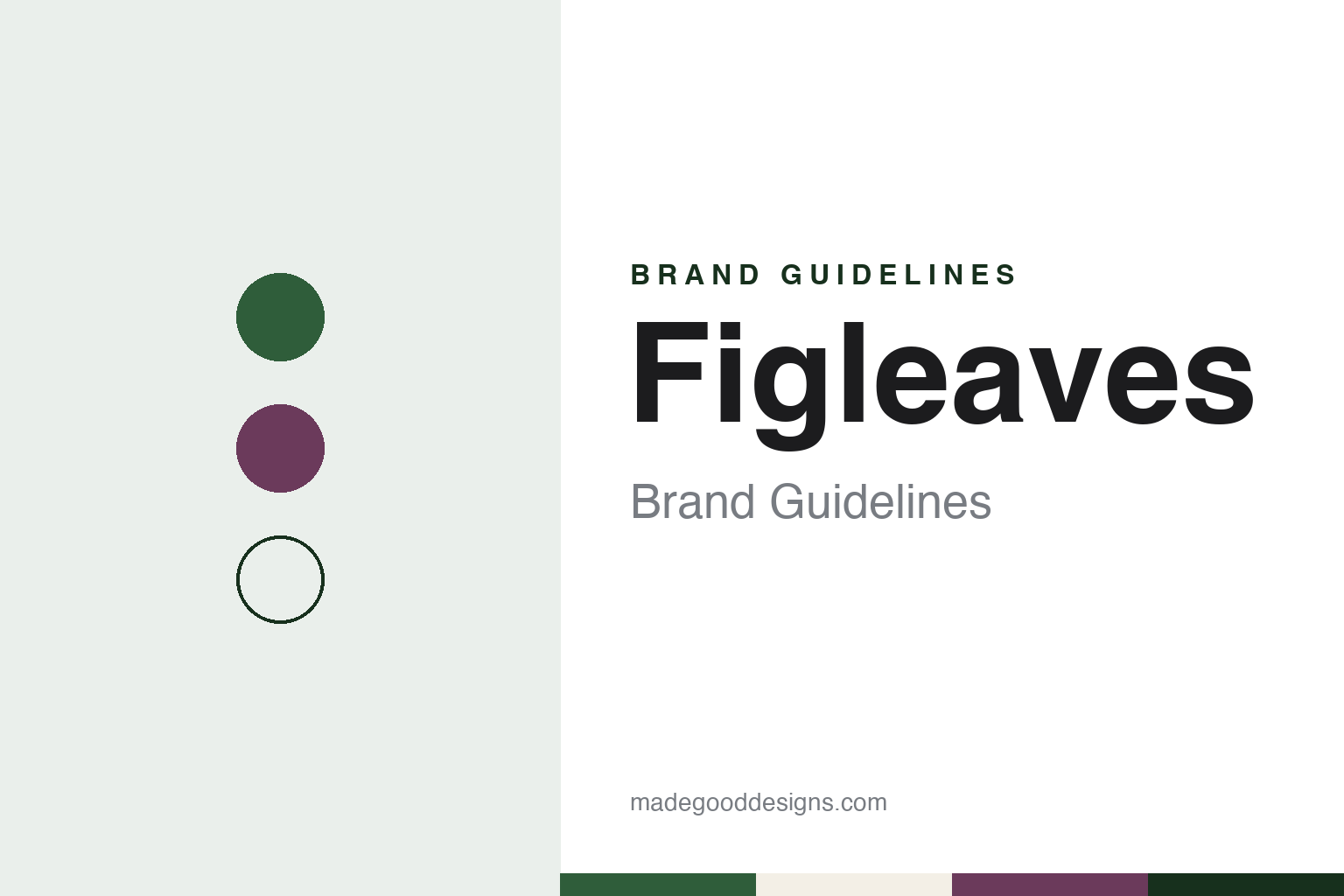
Figleaves Brand Guidelines
The British online lingerie retailer, 1998 to 2021.
Aa
Two constants: a leaf green, fig purple and cream palette and a rounded geometric sans register. Abstract homage — not a Figleaves product or mark; no garment, web page, logo or label is reproduced.
Figleaves.com, 1998
A lingerie retailer that traded online.
Figleaves was a British online lingerie retailer that traded as Figleaves.com. It was set up in 1998 by Daniel Nabarro and Michael Ross, according to the lingerie trade magazine Underlines in January 2021 and to Wikipedia; The Independent, profiling the business in February 2008, described Nabarro as its founder and, at that time, its chairman. The press described it throughout as an online lingerie specialist: it sold lingerie, swimwear and nightwear from other labels and, later, under its own name.
The Independent reported in 2008 that Figleaves had moved into the United States in 2002, and that in 2005 the private equity group Balderton Capital had bought a stake of nearly 40% in return for an undisclosed investment. At that time the company’s headquarters were in north Finchley, in north London, and its site carried about 200 underwear brands, ranging from Calvin Klein to Rigby & Peller, the paper said. About a fifth of its roughly one million customers were men, according to the same report.
In June 2010 the Manchester home-shopping group N Brown bought the entire share capital of Figleaves, Marketing Week and FashionUnited both reported on 15 June 2010. At the time, those reports said, the site offered more than 100 brands, drew about 1.2 million visitors a month and delivered to more than 100 countries, including the United States. The existing management team stayed on to work out how the business would fit into N Brown’s portfolio, FashionUnited reported. Wikipedia gives the company’s later head office as Stevenage, in Hertfordshire, with a warehouse and customer service centre at Haverhill, in Suffolk.
Colour
Many labels, then an own label.
Figleaves began as a shop for other companies’ labels. The range on its site, as the 2008 and 2010 reports describe it, ran across lingerie, swimwear and nightwear from well over a hundred brands, with Calvin Klein and Rigby & Peller among the names The Independent mentioned.
Over time the retailer added collections under its own name. Underlines reported in January 2021 that the own Figleaves brand was sold not only on the Figleaves website but also through JD Williams, another N Brown business, and on Amazon and eBay.
One own-label range shows how the brand presented its products. Underlines reported in September 2019 that the Juliette Lace range, launched about three years earlier, had appeared in 12 colourways, and that for the company’s 21st birthday it was given a limited edition combining an animal print with a foil finish, with a balcony-style basque added to the bras in the range. In May 2020 the same magazine reported a Mindful Swimwear range for spring and summer 2020, which the company said used a paper-based printing method, one version printed on recycled fabric.
For the palette in this guide we took the name literally: a leaf green and a fig purple, set against a soft cream. Those tones are our own choice, made for this guide, and are not taken from any Figleaves website, label or packaging. The rounded sans used for the specimen is likewise a stand-in, picked to suit a name that was, for most of its life, a web address typed into a browser.
The retailer’s own-label ranges, as Underlines described them, were built around named collections and colourways rather than a single signature product, which is how this guide treats the brand: as a retailer’s name first and a product label second.
Typography
Lingerie chains and their shop fronts.
Lingerie and underwear chains in Europe and North America present themselves first through their shops. A short name on the fascia, often set in a simple serif or sans, is repeated on bags, boxes, tissue and labels, so the sign on the street and the parcel on the doorstep carry the same mark. Many chains keep their colour schemes to a few soft or dark tones, and when they renew a shop concept they publish the change in terms of lighting, furniture and a new range of colours.
The formats vary widely. Some chains trade from small boutiques in shopping centres and on high streets; others run larger stores built around fitting rooms and a fitting service, and some began as catalogue or online retailers before opening shops of their own, or never opened any. Shop-in-shop areas inside department stores and fashion retailers carry a brand’s fixtures and signs into someone else’s floor, and franchise partners take the same format to markets the owner does not run directly.
Ownership is just as mixed. Some chains are still run by their founders or founding families, some belong to listed retail groups that operate several chains side by side, and others have passed through private-equity owners, administrations and rescue deals. The companies usually describe these changes on corporate pages about their history, founders and owners, while trade and business press record the dates.
Collections are presented by name rather than by number: named lines that return season after season, sleepwear and loungewear ranges, swimwear, sub-brands aimed at younger customers, and services such as loyalty clubs and online shops. For a designer, these chains show how a consistent name, a narrow palette and a recognisable shop format can hold a brand together across many countries and channels.
Aa
A rounded geometric sans for a name that lived on a web address. (Specimen set in Outfit, a sans STAND-IN; NOT the Figleaves logo.)
Into Simply Be
The site closed in February 2021.
N Brown changed course in 2020. Its strategy, as an N Brown spokesperson told Underlines in January 2021, was to focus on five core brands — Simply Be, JD Williams, Ambrose Wilson, Jacamo and Home Essentials — and to fold other brands into them or close them. Figleaves was folded into Simply Be, which Retail Gazette describes as a plus-size womenswear brand. The Figleaves site and warehouse were to close from the end of February 2021, and from March its products were to be traded from N Brown’s head office in Manchester and sent out from distribution centres in Oldham and Hadfield.
Retail Gazette reported on 15 March 2021 that N Brown had closed the Figleaves website in February, as part of its plan to concentrate on its five core fascias, and that Figleaves had moved onto the Simply Be site the week before. In the same report, the paper said Simply Be was adding third-party womenswear labels, including Finery and Nobody’s Child. In May 2022, reporting N Brown’s annual results, the same paper described Figleaves as having been integrated into Simply Be over the year. Figleaves.com, the stand-alone retailer launched in 1998, therefore closed as a separate business in February 2021, after 22 years of trading online, and its range moved onto the Simply Be site.
The dates give the outline: a specialist website started in 1998, part-owned by Balderton Capital from 2005, bought by N Brown in 2010 and absorbed into N Brown’s Simply Be in 2021.
For a design guide, Figleaves shows how a retailer’s identity can live almost entirely in a name and a web address, and what happens to that identity when a group folds it into a larger brand. Compare Bravissimo, another British lingerie retailer, and Bluebella, a London lingerie brand. For this guide we use leaf green, fig purple and soft cream with a sans, an unofficial interpretation; no product or logo is reproduced.
Explore & save
Keep Figleaves’s identity on hand — save it to a board in the Made Good inspiration library.
Figleaves identity set
Pin the Figleaves leaf green, fig purple and cream palette and the rounded geometric sans register to your own board.
Source & notes
Frequently Asked Questions
What font can I use to match the Figleaves look?
This guide describes Figleaves’ type as “A rounded geometric sans for a name that lived on a web address”. Its type specimen is set in Outfit from Google Fonts as a stand-in; Outfit is not Figleaves’ own lettering.
What colours are in the Figleaves palette?
This guide’s Figleaves palette is Leaf green #2F5D3A, Forest ink #17301D, Fig purple #6B3A5B, Soft cream #F3EFE6 and Paper #FAF8F3. The tones are the guide’s own unofficial interpretation, not official Figleaves hex codes.
When was Figleaves founded?
Figleaves was founded in 1998, in United Kingdom. Figleaves is known for Online lingerie, swimwear and nightwear.
Who founded Figleaves?
Figleaves was founded by Daniel Nabarro and Michael Ross in 1998.