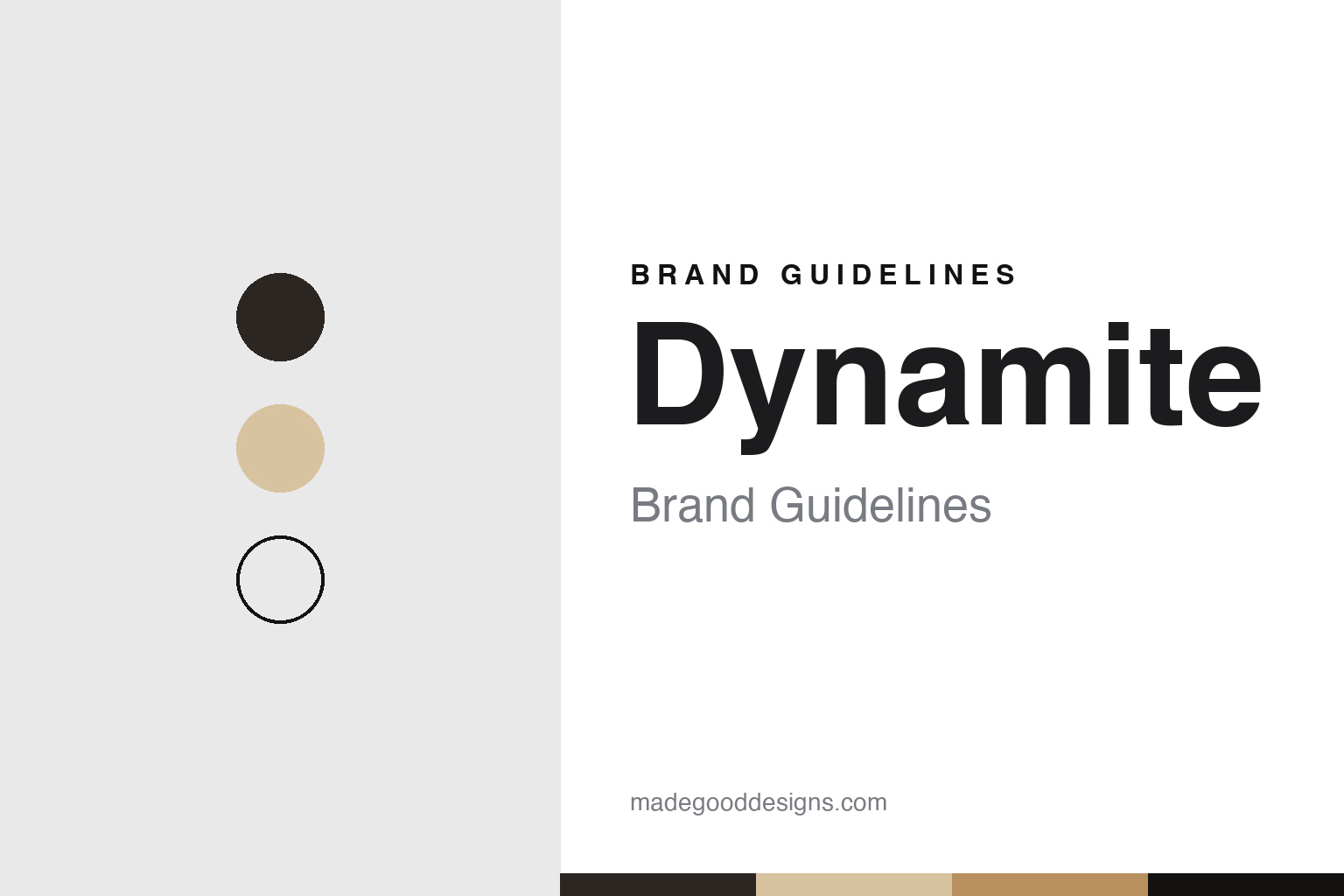
Dynamite Brand Guidelines
A Montreal banner for the working wardrobe, from desk to dinner.
Aa
Two constants: an espresso, champagne and brass palette and a light geometric capitals register. Abstract homage — not a Dynamite product or mark; no sign, logo or garment is reproduced.
Garage, then Dynamite
A second banner for young working women.
Dynamite is the younger of two banners run by Groupe Dynamite of Montreal. The group itself is older than the name. The McCord Stewart Museum’s online encyclopedia of Quebec fashion, in an entry published in 2019, says Groupe Dynamite began in 1975 with a Garage boutique in Montreal’s Place Versailles shopping centre, and that Andrew Lutfy took over the company in the 1980s. CBC News wrote in November 2024 that the company was founded in 1975 with a single store in Montreal, and the group’s own website says it has been “in fashion since 1975.”
The Dynamite name followed in 1984. According to the McCord Stewart Museum, Lutfy created the brand that year to reach young working women, while Garage concentrated on the teenage market; the museum describes both labels as trendy, affordably priced fast fashion. English Wikipedia says the Dynamite store that opened the banner was at Carrefour Laval, the shopping centre north of Montreal, in 1984.
The name has a plain source. In a 2024 press kit for its new flagship, the company explained that the word “dynamite” comes from the Greek dunamis, meaning power. English Wikipedia describes the Dynamite logo as the word set in thin, black capital letters on a white ground, and says the brand is styled in capitals as DYNAMITE; English Wikipedia’s article on the group, citing its investor pages, likewise writes the two banners as GARAGE and DYNAMITE.
Both banners are run from a single head office. The McCord Stewart Museum placed it in the Town of Mount Royal in 2019, and English Wikipedia gives the same location for the group. English Wikipedia says the group creates, designs, markets and distributes its collections from that head office.
Colour
Workwear, then day to night.
For most of its history Dynamite has been tied to the office wardrobe. When FashionUnited reported on its new flagship in September 2024, it described the brand as known for its “traditional 9-to-5 workwear outfitting and style.” The group’s brands page now presents Dynamite with the line “Serving looks from brunch to dinner,” and the 2024 flagship was presented as a move towards clothes for the whole day, “from day to night.”
That flagship opened in 2024 at Royalmount, a new shopping, dining and entertainment development in Montreal. FashionUnited reported that the store covers 8,000 square feet, that it coincided with the brand’s 40th anniversary, and that its concept rests on curated collections, exclusive capsules and on-site stylists, with fitting rooms designed for one-to-one service. At the time Dynamite operated 93 stores across Canada and the United States, the report said.
The materials are spelled out in the company’s press kit for the store, issued through the v2com newswire in October 2024. It describes three arches at the entrance, 15 feet high and 24 feet wide, crazy-paving floors with a custom waterjet pattern, brass fixtures, microcement walls and touches of gold leaf and champagne metallics. Inside, the company says, a digital installation called Future/Nature by the artist Berenice Golmann, curated by Massivart, gives the shop a gallery-like setting, and merchandise is kept at a single height across the floor.
Earlier, English Wikipedia recorded 86 Dynamite stores in July 2019, 81 in Canada and five in the United States. For the group as a whole, the McCord Stewart Museum gave 5,200 employees and more than 400 stores in Canada, the United States and the Middle East as of 2018, when it described Groupe Dynamite as a private company still belonging to Lutfy.
The palette in this guide takes its warm metals and pale stone from that written description of the Royalmount store, not from any brand file.
Typography
How the chains present themselves.
Youth and mall fashion chains in the United States and Canada mostly present themselves through their stores: the shop sign above a mall unit, the shopping bag and the labels on the rails. Few of them publish a formal identity manual, so what can be described is what the companies show in their stores, on their websites and in their announcements, and what the business press has reported about them.
The formats vary. Some chains began as a single surf or skate shop and moved into enclosed malls; PacSun traces itself to a Newport Beach surf shop of 1980 and opened a mall store the following year, and Zumiez started in 1978 as a shop in Seattle’s Northgate Mall. Others built their business on catalogues and later online shops, and several now trade across the United States, Canada and further abroad.
Ownership is just as varied. Some chains are still run by founders or their families, some are listed on stock exchanges, and others are owned by private-equity firms or brand-licensing groups, often after a Chapter 11 or other restructuring. Those changes are part of each brand’s story, and the guides here give them as dated facts, with the store estate described as it stood at the date of the source.
On the rails, these retailers mix outside labels with their own brands and with licensed ranges, from surf and skate names to sports and entertainment partnerships, and they name those collections in their own announcements. Each guide in this series sets out who founded the chain, who owns it now, how it has traded and what it sells, and separates what independent dated sources report from what the company says about itself.
Aa
Light geometric capitals, close to the thin caps of the wordmark. (Specimen set in Jost, a sans STAND-IN; NOT the Dynamite logo.)
Groupe Dynamite
Creditor protection, then a stock-market listing.
The group’s recent history has two turning points. On 9 September 2020, Retail Insight Network reported that Groupe Dynamite had filed for creditor protection under Canada’s Companies’ Creditors Arrangement Act, and that the Superior Court of Québec, Commercial Division, had granted the initial order it sought. The company said it would also seek recognition of the proceedings in the United States under Chapter 15 of the US Bankruptcy Code. At the time it ran more than 300 stores across North America under the Garage and Dynamite names, with 530 head-office and warehouse staff and 3,800 store employees, according to the same report; Narcity reported the filing the same day and said most of those stores were in Canada. The group said store staff would be offered transfers or relocation if their stores closed.
The second turning point came four years later. On 21 November 2024, CBC News reported that Groupe Dynamite had launched its initial public offering on the Toronto Stock Exchange, with its subordinate voting shares trading under the symbol GRGD. Andrew Lutfy, the chief executive and owner, would keep 87 per cent of the company, the report said. CBC put the group at nearly 300 stores across Canada and the United States, with 6,000 employees; the group’s website now describes more than 300 stores across North America and a team of 7,200.
Through both events Dynamite has stayed paired with Garage under one owner and one head office, with Garage aimed at a younger customer.
For a design guide, Dynamite shows how a mall banner for office clothes can move towards a quieter, gallery-like setting of brass, arches and light capitals. Compare its sister banner Garage and Forever 21. For this guide we use espresso, champagne and a burnished brass with a sans, an unofficial interpretation; no product or logo is reproduced.
Explore & save
Keep Dynamite’s identity on hand — save it to a board in the Made Good inspiration library.
Dynamite identity set
Pin the Dynamite espresso, champagne and brass palette and the light geometric capitals register to your own board.
Source & notes
Frequently Asked Questions
What font can I use to match the Dynamite look?
This guide describes Dynamite’s type as “Light geometric capitals, close to the thin caps of the wordmark”. Its type specimen is set in Jost from Google Fonts as a stand-in; Jost is not Dynamite’s own lettering.
What colours are in the Dynamite palette?
This guide’s Dynamite palette is Espresso #2B2622, Night black #141210, Champagne #D8C3A0, Burnished brass #B88F5E and Ivory #F5EFE6. The tones are the guide’s own unofficial interpretation, not official Dynamite hex codes.
When was Dynamite founded?
Dynamite was founded in 1984 (group since 1975), in Montreal, Quebec.
Who owns Dynamite?
Dynamite is owned by Groupe Dynamite Inc. Dynamite is known for Workwear, day-to-night dressing.