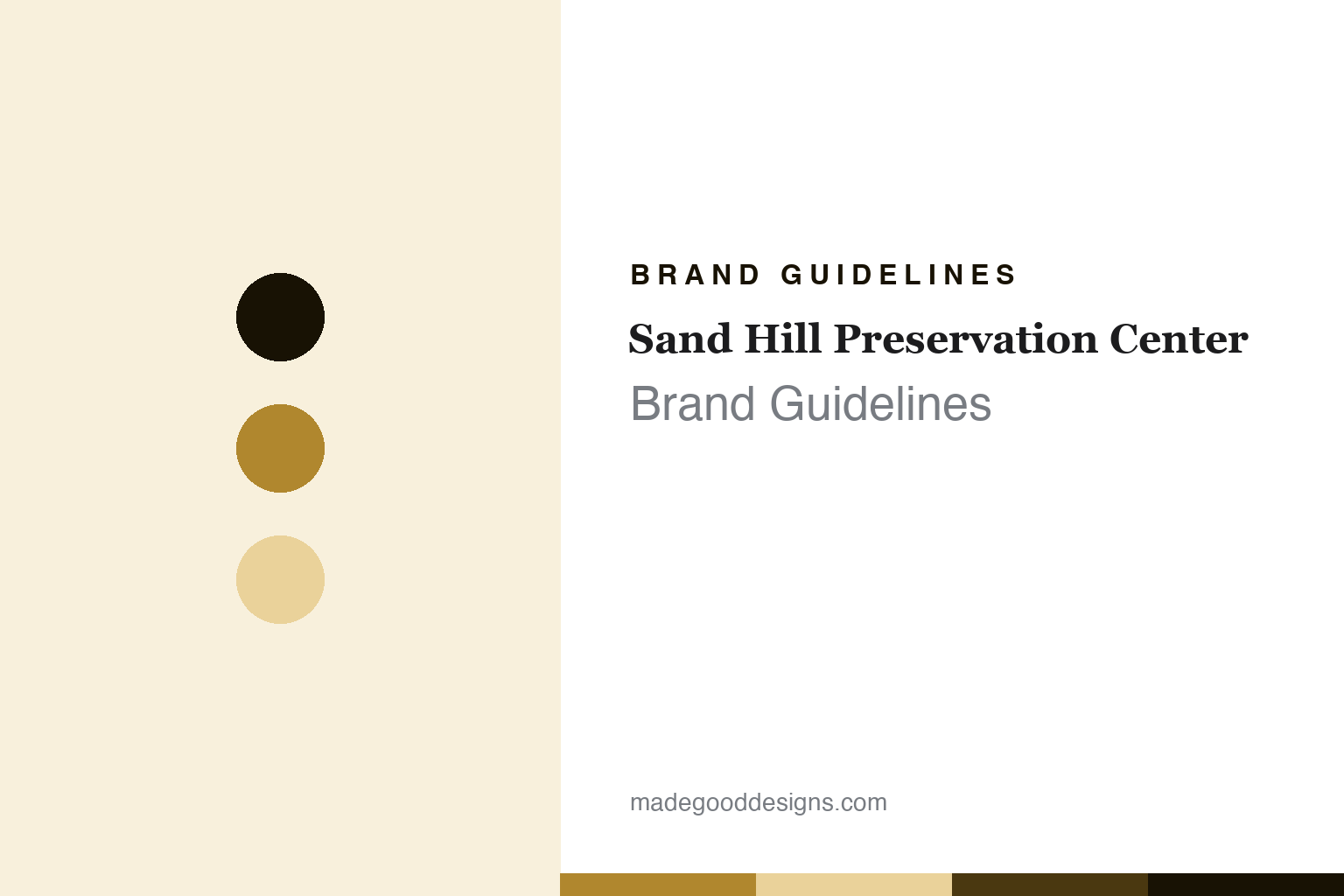
Sand Hill Preservation Center Brand Guidelines
The family seed-and-poultry gene bank.
Aa
Two constants: a prairie-amber palette and a gene-bank-serif register. Abstract homage — not a Sand Hill product or mark; no seed-packet artwork or logo is reproduced.
The family seed-and-poultry gene bank
Sand Hill Preservation Center is the Iowa family gene bank, from 1988, preserving thousands of heirloom seed varieties and heritage poultry breeds.
Sand Hill Preservation Center brings the mission round its keeper — the Iowa family operation, from 1988, that describes itself as a small, home-based, privately-funded gene bank, preserving thousands of heirloom seed varieties and, unusually, heritage poultry breeds. Sand Hill keeps and shares the seed and the birds, and its answer to a round about the mission is preservation itself: keeping the rare from being lost. A brand, kept.
Its identity is the family seed-and-poultry gene bank. The gene-bank mission, the thousands of preserved varieties and the heritage poultry are the story here. A brand, kept. The family seed-and-poultry gene bank.
(Honest notes, so the structure stays exact, and no credential is over-claimed. Sand Hill Preservation Center preserves and sells seed and heritage poultry as its heroes — a collection of some two to two-and-a-half thousand heirloom varieties, alongside heritage poultry breeds, with a strand of 4-H education — and we report its performance language as the organisation’s own. It was founded in 1988 by Glenn Drowns, with Linda Drowns joining after they married in 1993, in Calamus, Iowa. On its structure, a careful point: it is a for-profit family operation that describes itself as a small home-based privately-funded gene bank — a mission framing, not a legal nonprofit status — so we do not call it a nonprofit; and it makes no organic-certification claim, so we do not assert one. Its preservation work is recognised: Seed Savers Exchange credited it, in 2018, with saving more than six hundred and seventy-five varieties, and the Livestock Conservancy recognised its heritage turkeys in 1999. Its designs are IP we describe but do not reproduce; there is no official brand hex; these tones are an unofficial interpretation.)
Colour
Sand Hill lives in a prairie amber. Click a swatch to copy the hex.
Sand Hill’s identity is kept, preserving and family — a prairie amber, an ink, a pale wheat, a deep ochre, and a paper. The palette leans prairie amber and pale wheat: a heartland register that nods to an Iowa prairie rather than a loud logo colour. It signals a family seed-and-poultry gene bank. The honest caveat: with no published brand hex, these values are an original, unofficial interpretation, not first-party colours.
The lesson is a prairie amber signals a kept, preserving identity. Sand Hill’s world is a home-based gene bank. For designers, it is a reminder that a prairie amber and a soft pale wheat can carry a preservation brand — the tone of the Iowa prairie. Because these tones can fail as small text, keep type dark and let the colour live in the accents, palette and band. The takeaways: keep the mission preservation; do not call it a nonprofit or certified organic; note the poultry as well as the seed; and treat any single hex as unofficial.
Typography
The register is a gene-bank serif — kept, editorial, preserving.
Sand Hill’s identity carries a kept, editorial, preserving spirit — a gene bank, not a graphics label. A gene-bank serif captures the mood: refined, steady and confident, the register of a preservation collection. Set in a prairie-amber palette, the gene-bank serif feels kept and preserving — exactly the personality Sand Hill carries. It is a kept collection rather than a logo, mirroring seed-packet paper. (Sand Hill’s real catalogue and designs are things we describe but do not reproduce, and the exact typeface is not ours to use.) Because it is not ours to use, the honest description is “a gene-bank-serif operation,” shown here in a stand-in. The type behaves like the brand: kept, editorial and preserving.
Aa
A gene-bank-serif operation — kept and preserving. (Specimen set in EB Garamond, a gene-bank-serif STAND-IN; NOT the Sand Hill logo or any packet art.)
The mission
Sand Hill Preservation Center stands for the family seed-and-poultry gene bank.
Sand Hill Preservation Center brings the mission round its keeper. A prairie-amber palette, a gene-bank serif and a 1988 founding make one thing — the family seed-and-poultry gene bank — the whole identity: kept, preserving and family. The gene-bank mission is the pitch, and the thousands of preserved varieties are the proof. The point is preservation itself, keeping the rare from being lost, in a round about the mission.
Put to work, the identity is the gene bank told straight, structure exact and no credential over-claimed — the preservation named and the poultry included. A steward in this spirit would keep the mission preservation, refuse to call it a nonprofit or certified organic, and note the poultry as well as the seed. A reader in this spirit would keep the facts right: Sand Hill Preservation Center preserves and sells seed and heritage poultry as its heroes — some two to two-and-a-half thousand heirloom varieties, plus heritage poultry breeds, with a strand of 4-H education; it was founded in 1988 by Glenn Drowns, with Linda Drowns joining after they married in 1993, in Calamus, Iowa; it is a for-profit family operation describing itself as a small home-based privately-funded gene bank, not a legal nonprofit, and makes no organic claim; and its preservation is recognised, credited by Seed Savers Exchange in 2018 with saving more than six hundred and seventy-five varieties, and by the Livestock Conservancy in 1999 for its heritage turkeys. Sand Hill sits among the round’s preservation missions. The honest editorial moves are to date it to 1988, to credit the Drownses, to keep the structure exact, and to include the poultry alongside the seed.
For designers and brand-builders, Sand Hill continues the mission: keep the structure exact — a gene bank in spirit is not a nonprofit in law. The lessons: let a preservation mission carry a seed brand; distinguish a mission framing from a legal status; refuse an unclaimed organic label; note an unusual second collection, the poultry; and never reproduce a mark. It is also a reminder to stay precise: Sand Hill Preservation Center is the Iowa family gene bank, from 1988, preserving thousands of heirloom seed varieties and heritage poultry breeds — with the palette here an unofficial interpretation. Read that way, Sand Hill is less a packet than a home-based gene bank: kept, preserving, family. The lesson for a brand is that a preservation mission and an exact structure reinforce each other, and keeping the framing honest keeps the story earned. Sand Hill made the-family-seed-and-poultry-gene-bank the identity — proof that a mission carries the round.
Explore & save
Keep Sand Hill Preservation Center’s identity on hand — save it to a board in the Made Good inspiration library.
Sand Hill Preservation Center identity set
Pin the prairie-amber palette and the gene-bank-serif register to your own board.