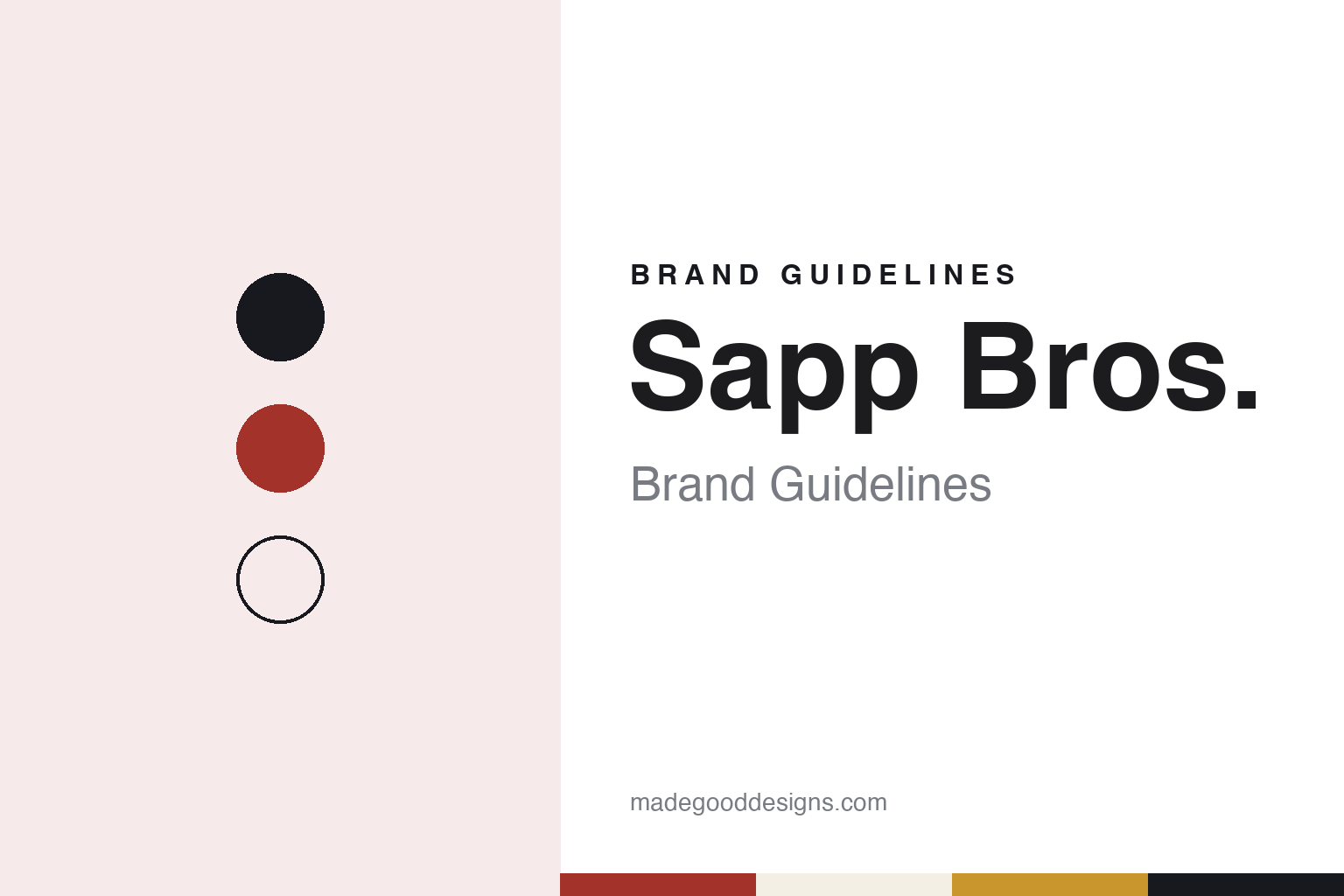
Sapp Bros. Brand Guidelines
A 1971 Omaha truck plaza and a coffee-pot water tower.
Aa
Two constants: a coffee-pot red, prairie gold and enamel cream palette and a roadside slab serif register. Abstract homage — not a Sapp Bros. product or mark; no tower, sign or logo is reproduced.
Truck Plaza
An Omaha truck stop on the edge of the city.
Sapp Bros. began on the western edge of Omaha, Nebraska. The company’s timeline says it was organised as Sapp Bros. Truck Plaza and opened its doors on 7 June 1971. CSP Daily News, reporting in January 2015, names William (Bill) Sapp as the founder of Sapp Bros. Travel Centers Inc. and says he opened the Omaha location in 1971; that year he was chosen for the Hall of Fame award of NATSO, the trade association founded as the National Association of Truck Stop Operators, where he had served on the board from 1993 to 1998.
Growth followed the interstates. The company’s timeline lists a new truck stop with a restaurant at Council Bluffs, Iowa, off Interstate 29, in 1978; a purchased site in Fremont, Nebraska, in 1982; and a new truck stop with a service centre, restaurant and motel in Cheyenne, Wyoming, in 1983, which the company describes as a fuel-spacing step west along Interstate 80. Odessa, Nebraska, followed in 1984 and Commerce City, outside Denver, in 1986, which the company calls its earliest site on the Interstate 70 truck corridor.
The name changed with the customers. In 1988, the timeline says, the business reorganised from Sapp Bros. Truck Stops into Sapp Bros. Travel Centers, in part because of the widening range of travellers using them. The same year brought a new site at Peru, Illinois, on Interstate 80, and more Nebraska stops at York and Ogallala; Salt Lake City opened in 1994, built from the ground up, and in 1996 the company bought a facility near Clearfield, Pennsylvania, which became its easternmost stop on Interstate 80.
Colour
A water tower with a handle and a spout.
The coffee pot is the brand. According to the company’s timeline, it began in 1971 as a plain water tower, put up to supply businesses west of the Omaha metropolitan area on Highway 50 that had no access to city water and sewer. A short time later, the company says, a handle and a pour spout were added to the refurbished tower, and it became a landmark for Omaha residents and Interstate 80 travellers. Sapp Bros. says it has been identified with the coffee-pot symbol ever since, and pairs it with the welcome line “Welcome, Be Our Guest.”
The pot has been rebuilt for newer sites. The timeline records a full remodel of the Council Bluffs travel centre in 2014 that included a new Sapp Bros. water tower. In Utah the idea became a sign structure: Digital Signage Today reported on 8 July 2026, citing a release from the sign maker Yesco, that the travel centre at Toquerville, off Interstate 15, had a new freeway display of about 100 feet topped by a customised coffee pot some 24 feet tall, with illuminated Sapp Bros. logos on each side and red accent lighting on the lid, handle and spout. The same report says Yesco also made 19 exterior and 23 interior sign types for the site, including printed wall murals.
Food sub-brands sit under the pot. The Toquerville centre, which the company dates to 2025, has the Coffee Kettle Cafe, Burrito Bros. and a craft fountain-drink station called Sapp Sipps, according to the timeline. Burrito Bros., the company’s own quick-service format, opened in 2022 at York, Nebraska, and now also runs at Omaha and Toquerville. The company says it does not sell alcohol in its travel centres, describes itself as a business based on Christian values, and works with ministries to hold services at many locations; CSP Daily News reported in 2015 that its earliest chapel was built at the Omaha location in the early 1980s.
Typography
How the category presents itself.
A motorway service area or a fuel-and-convenience chain has to be recognised at speed, from a slip road or a forecourt, and then again at the counter. The identities in this group are therefore spread across many surfaces: the roof sign and the forecourt canopy, the store fascia, the cup and the receipt, and a website where the company sets out who it is. The guides that follow look at what each company publishes about itself and what dated independent sources add.
In Britain the operator’s own name often sits above a row of partner brands. Moto’s website lists coffee, bakery, burger and food-hall partners alongside its own name and its own charging brand, Moto CHARGE, launched in 2026; English Wikipedia describes how Welcome Break’s 2006 wordmark set a green word and a white word on black, and how each site was given a mural of a local landmark. The operator’s mark becomes the frame, and the partners fill it.
Food sub-brands, mascots and member programmes carry much of the personality. Some chains put their own name on a food counter, as Welcome Break does with The Good Breakfast, and some gather offers into a named section of a website or an app, as Moto does with My Moto for families, business travellers, coach drivers and HGV drivers. Where a chain uses a mascot or a member programme, the guides describe it as the company presents it.
Ownership is part of the story too. Several of these businesses have passed between caterers, investment funds, pension schemes and fuel retailers, and some carry a different name in a neighbouring market, as Welcome Break’s Northern Ireland sites carry Applegreen’s. Each guide gives owners and site counts only as a dated source states them, and marks clearly what rests on the company’s own word.
Aa
A sturdy roadside slab serif — a name meant to be read from the interstate. (Specimen set in Zilla Slab, a slab-serif STAND-IN; NOT the Sapp Bros. logo.)
Sapp Bros.
Travel centres and a fuel business.
Sapp Bros. is two businesses under one name. Its website describes Sapp Bros., Inc. as a group of 18 travel centres stretching from Toquerville, Utah, to Clearfield, Pennsylvania, mostly along Interstate 80, alongside a petroleum wholesale business that supplies fuels, lubricants, propane, diesel exhaust fluid and other products through more than 30 wholesale outlets. CSP Daily News counted 16 travel centres in seven states in January 2015: Colorado, Illinois, Iowa, Nebraska, Pennsylvania, Utah and Wyoming.
The fuel side has its own history. The company’s timeline says Sapp Bros. Petroleum was incorporated in Nebraska in 1980, merged with Poland Oil of Grand Island and Pro Oil of Ogallala in 1996, and went on to add a run of regional oil and propane firms across Nebraska and western Iowa through the 2000s. In 1999 it formed SBT, Inc. as its transport arm, and the company says it still moves fuel and lubricants in its own truck fleet. In June 2023 it held an open house for a biodiesel blending facility at Roca, Nebraska, according to its news page.
The travel-centre map also kept growing. The timeline lists Nebraska City in 2001, a rebuilt Columbus site in 2005, Harrisonville, Missouri, off Interstate 49, in 2017, and Toquerville in 2025. The company marked its 55th anniversary from June 2026 with charity campaigns across all 18 centres, according to its news page.
Other fuel and travel-stop names in this series include Love’s and Casey’s.
For a design guide, Sapp Bros. shows how a single object, a water tower given a handle and a spout, can become the whole identity of a travel-centre chain and be rebuilt as signage at new sites. Compare it with Love’s and Casey’s. For this guide we use coffee-pot red, prairie gold and enamel cream with a serif, an unofficial interpretation; no product or logo is reproduced.
Explore & save
Keep Sapp Bros.’s identity on hand — save it to a board in the Made Good inspiration library.
Sapp Bros. identity set
Pin the Sapp Bros. coffee-pot red, prairie gold and enamel cream palette and the roadside slab serif register to your own board.