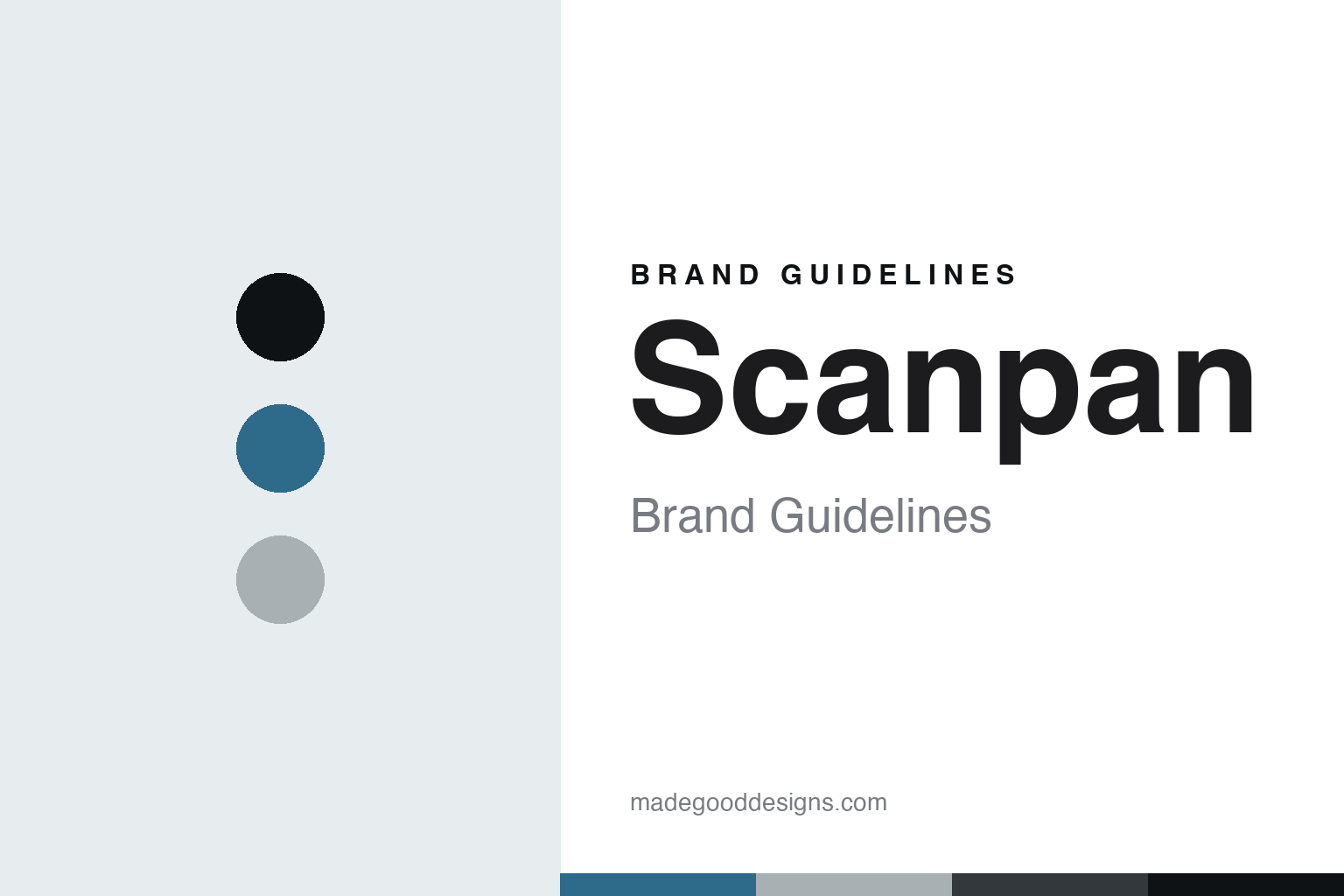
Scanpan Brand Guidelines
Cast in Denmark.
Aa
Two constants: a Danish-blue palette and a Nordic-sans register. Abstract homage — not a Scanpan pan, surface or wordmark.
Cast in Denmark
Scanpan is a Danish maker whose non-stick cast-aluminium cookware is cast at its own factory in Denmark.
Scanpan is a lesson in a cast-in-Denmark non-stick specialty as the identity. A Danish maker since 1956, it does one thing distinctively: it casts its own non-stick cast-aluminium pans at its factory in Denmark, and was an early mover in PFOA-free, recycled-aluminium cookware. Its answer to how a specialist pan is made is a caster’s and an environmental one: pour recycled aluminium in Denmark, and make a durable non-stick that does not rely on the chemistry the industry later abandoned. A Danish non-stick pan, actually cast at home.
Its identity is the specialist pan, cast non-stick in Denmark. Scanpan’s Danish casting, its recycled aluminium and its PFOA-free non-stick are the work it is known for. A capability, made a signature. A maker that kept the casting in Denmark.
(Honest notes, so the story stays precise. Scanpan was founded in 1956 in Ryomgård, Denmark, and it casts its non-stick cast-aluminium cookware at its own Danish factory, using recycled aluminium — an early PFOA-free non-stick pioneer, now with a ceramic-titanium non-stick, sold in many countries. One important, honest scope note: the made-in-Denmark claim applies to its cast-aluminium non-stick lines; its stainless-steel ranges are widely reported to be made in China, and the company does not clarify the origin of every component — so we anchor the made-in-Denmark story to the Danish-cast non-stick cookware, not the whole catalogue. Its designs and wordmark are its IP, described but never reproduced, and there is no official brand hex — these tones are an unofficial interpretation. This is design commentary and does not promote any product.)
Colour
Scanpan lives in a Danish-blue palette. Click a swatch to copy the hex.
Scanpan’s identity is clean, Danish and considered — a Danish blue, an ink, a cast aluminium, a slate, and a chalk. The palette leans Danish blue and aluminium: the register of Scandinavian clarity and a cast-aluminium pan. It signals casting and responsibility over show. The honest caveat: with no published brand hex, these values are an original, unofficial interpretation, not first-party colours.
The lesson is a Danish-blue palette signals a cast-in-Denmark identity. Scanpan’s world is a non-stick, cast-aluminium, made-in-Denmark object. For designers, it is a reminder that a Danish blue and a cast-aluminium grey can carry a brand built on home casting and responsibility — the blue of a Nordic sky and the grey of recycled aluminium. Because these tones can fail as small text, keep type dark and let the colour live in the accents, palette and band. The takeaways: cast it at home; use recycled material; scope the origin claim honestly; and treat any single hex as unofficial.
Typography
The register is a Nordic sans — clean, even, modern.
Scanpan’s identity carries a clean, even, modern spirit — a considered Scandinavian object, not a rustic one. A Nordic sans captures the mood: neat, functional and calm, the register of a Danish maker. Set in a Danish-blue palette, the Nordic sans feels clean and even — exactly the personality Scanpan carries. It is modern rather than ornate, mirroring a cast non-stick pan. (Scanpan’s real designs and wordmark are things we describe but do not reproduce, and the exact typeface is not ours to use.) Because it is not ours to use, the honest description is “a Nordic-sans spirit,” shown here in a stand-in. The type behaves like the maker: clean, even and modern.
Aa
A Nordic-sans spirit — clean and even. (Specimen set in Manrope, a Nordic-sans STAND-IN; NOT the Scanpan wordmark or any pan design.)
The specialist’s pan
Scanpan stands for casting non-stick in Denmark.
Scanpan is a lesson in making home casting and responsibility the identity. A Danish-blue palette, a Nordic sans and a cast-aluminium pan make one thing — a non-stick pan actually cast in Denmark — the whole maker: clean, Danish and considered. The Danish casting is the differentiator. The differentiator is doing the making at home when the category outsourced it, casting recycled aluminium in Denmark, and moving early to a PFOA-free non-stick.
Put to work, the identity is home casting plus responsibility as design. A maker building in this spirit would keep the actual casting in its own country, choose recycled material and safer chemistry before it was required, and be precise that the home-made claim applies to the lines it truly casts at home. It would treat the Danish factory as the point. A brand learning from it would see that keeping a hard, capital-heavy step at home is a real differentiator in a category that mostly offshored, provided the claim is scoped honestly — cast aluminium in Denmark, not every line. It would say plainly its non-stick cast aluminium is made in Denmark while its stainless is not. A brand learning from it would notice that keeping a capital-heavy step like casting at home is both a genuine differentiator and a claim that must be scoped precisely, because a customer who discovers one line is offshore will doubt the rest unless the maker drew the line first. And it would treat early, unforced choices — recycled aluminium, PFOA-free non-stick before it was required — as proof that responsibility is built in, not bolted on, and let that record speak quietly for itself. The lesson Scanpan teaches is that home casting and responsibility can build a brand: the Danish making gives it substance, and the honest scope keeps it credible. The casting is the personality, and the Danish non-stick pan is the proof.
For designers and brand-builders, Scanpan closes this round about the specialist’s pan on the home-casting pole: keep the casting at home, choose responsible materials, and scope the claim honestly. The lessons: cast it domestically; use recycled material; scope the origin claim; and never reproduce a protected design. It is also a reminder to stay precise: Scanpan is a Danish maker founded in 1956, its non-stick cast-aluminium cookware cast at its own factory in Denmark, while its stainless is made elsewhere — with the palette here an unofficial interpretation. Scanpan made home casting the maker — proof that made-where can be the difference.
Explore & save
Keep Scanpan’s identity on hand — save it to a board in the Made Good inspiration library.
Scanpan identity set
Pin the Danish-blue palette and the Nordic-sans register to your own board.