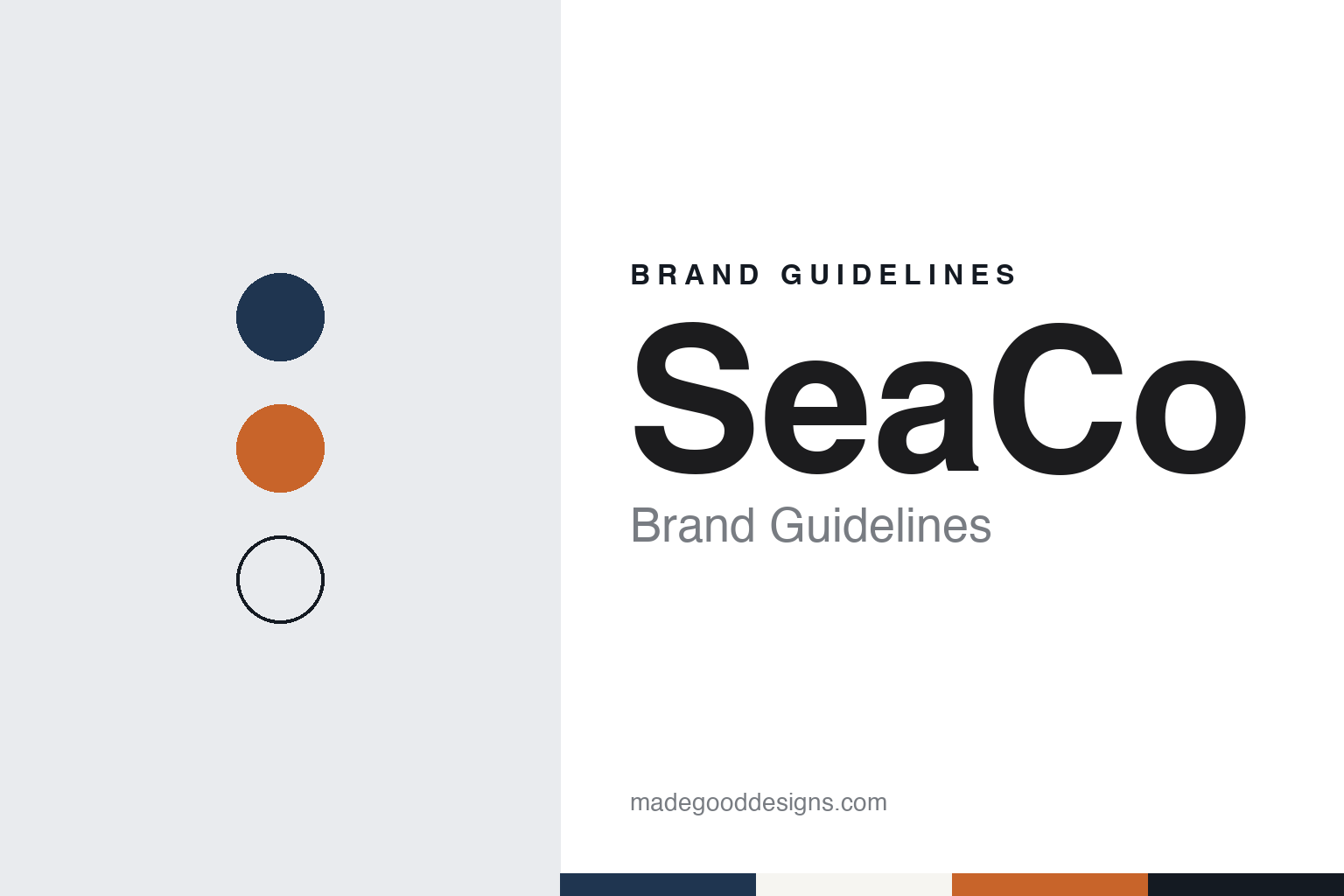
SeaCo Brand Guidelines
The container lessor that outlived the group that founded it.
Aa
Two constants: a Seaco harbour navy, box orange and reefer white palette and a Condensed sans register. Abstract homage — not a Seaco product or mark; no container, logo or livery is reproduced.
Sea Containers
A box lessor that built hotels, trains and ferries.
Seaco is a marine container lessor whose roots go back to Sea Containers, a company founded in 1965 by James Sherwood, a Yale University graduate and former United States Navy officer, English Wikipedia says. Its first business was leasing cargo containers to shipping lines. Sea Containers became a public company in 1968 and was floated on the New York Stock Exchange in 1974, according to Wikipedia. Seaco’s own website says the business originated in 1965 and was incorporated in Bermuda in 1973.
Over the following decades Sea Containers spread far beyond boxes. Wikipedia lists the Orient-Express Hotels chain, in which it held a stake until 2005; the Venice Simplon-Orient-Express train service, relaunched in 1982 with restored carriages from the 1920s; Sealink British Ferries, acquired in 1984; fast ferries under the Hoverspeed and SeaCat names; and, from 1996, the Great North Eastern Railway, which ran the InterCity East Coast rail franchise in Britain until the group handed it back in December 2007. In 1989 the British transport group Tiphook made a takeover bid, which failed after shareholders backed the company’s own plan of asset sales and restructuring, Wikipedia records.
Containers stayed at the centre of the group. In 1998 Sea Containers and General Electric Capital Corporation formed a joint venture, GE SeaCo, which carried out most of the group’s container leasing, according to Wikipedia. Seaco’s website describes the same step as a 1998 joint venture between General Electric Capital Corporation and Sea Containers Ltd.
The wider group did not survive. In March 2006 Sea Containers announced that it was leaving ferry operations and began selling assets, and on 16 October 2006 it filed for Chapter 11 bankruptcy in the United States, Wikipedia says. While the rest of the group was wound down and liquidated, its remaining marine container interests were transferred on 11 February 2009 to a new company, SeaCo Ltd, whose main shareholders were the former company’s bondholders and two of its UK pension funds. Sea Containers itself no longer trades; the container business is the part that carried the name forward.
Colour
Dry boxes, reefers, specials and tanks.
Seaco’s website sorts its fleet into four kinds of box. Dry freight containers, in standard and high-cube sizes, are for non-perishable cargo such as electronics, furniture, apparel and dry foods. Refrigerated containers come in the same two heights, and the company calls itself a leading reefer lessor with a fleet of more than 200,000 units. Dry freight specials, among them palletwides, flatracks, rolltrailers and open tops, take heavy or out-of-gauge cargo such as yachts, railcars, lumber and mining machinery. Tank containers run, Seaco says, from T11 to T75 types, with capacities from 12,000 to 46,000 litres.
The services follow the same plain structure. Seaco offers operating and finance leases over short and long terms, including sale and leaseback; container sales from its depot network; a One-Way Move option, under which a box can be picked up in one place and returned in another, subject to the company’s terms; and management of other owners’ container fleets under asset-management agreements. Customers deal with the company through a portal it calls Seaweb, and its site has tools to find a depot, look up a unit, authorise tank tests and download tank certificates.
Some of its boxes are its own designs. In October 2016 Seaco announced the SeaPC+, a 40-foot high-cube cellular palletwide container that combined features of two earlier types, its Cellular Palletwide Container, or CPC, and the SeaCell. The company said it had come to own both after merging the fleets of Seaco and Cronos in January 2015. Cellular palletwide boxes carry two Europallets side by side while still fitting the standard slots on container ships, Seaco explained.
The company gives its scale in round numbers: more than 2.4 million TEU, more than 360 depots, 23 offices and more than 220 staff, according to its website in November 2026. Its office list runs from London and Hamburg to Singapore, Shanghai, Tokyo, Seoul, Mumbai and Houston, with regional sites for Africa, Germany and Oceania. Seaco says it joined the Institute of International Container Lessors, the trade association for lessors of marine containers and chassis, in January 2021, opened a Dubai office in March 2022 and joined the UN Global Compact and its UK network in July 2023.
Typography
How container lessors present themselves.
Container lessors own the steel boxes that shipping lines fill and move. A carrier that does not want to buy every box it needs can lease them for a few months or many years, return them at a depot and lease again somewhere else. The lessors earn their names on the boxes themselves: a company wordmark, often in a strong blue, orange or green, painted on the doors and sides of containers that travel the world’s ports and railways for years.
Their websites are built around that fleet. Most sort it by box type: standard and high-cube dry containers for general cargo; refrigerated containers, or reefers, for chilled and frozen goods; tank containers for liquids; and specials such as flat racks, open tops and palletwide boxes for cargo that does not fit a standard van. Photographs of stacked dry, reefer and tank containers, as the companies publish them, do much of the visual work, together with technical sheets that give each box’s dimensions and standards.
The next layer is the network. Lessors publish depot maps and depot finders, lists of regional offices and customer portals where shipping lines can book, return and track their units. Many also sell boxes: pages for the sale of used containers offer units at the end of their marine life for storage, conversion or one more trip, and some lessors invite outside investors to own container portfolios that the lessor manages.
Behind the boxes sits finance. Container leasing is a business of long-lived assets and long contracts, so ownership matters, and many of the companies in this series have been merged, listed, taken private or folded into larger groups. Their investor pages and press releases are where those changes are recorded, and this guide sets out what each company’s own pages and dated reports show.
Aa
A condensed sans — “Right container, right place, right time.” (Specimen set in Archivo Narrow, a sans STAND-IN; NOT the Seaco logo.)
Seaco
HNA, Bohai Leasing and a Stonepeak purchase.
Ownership has changed hands twice since the Sea Containers years. English Wikipedia says GE SeaCo was sold to China’s HNA Group on 15 December 2011 and has since operated as Seaco. The company’s own account says HNA acquired it in 2011 and that it then became a wholly owned subsidiary of Bohai Leasing, the HNA-controlled lessor listed in Shenzhen. In a 2017 news post Seaco said Bohai Leasing had acquired Cronos in January 2015 and folded its container leasing into Seaco Global, which then opened sales offices in Brisbane and Sydney.
The latest change came in December 2025. On 16 December 2025 Stonepeak and Textainer announced through Business Wire that Typewriter Ascend Ltd, an entity controlled by the infrastructure investor Stonepeak and an affiliate of Textainer, had completed its acquisition of Global Sea Containers Limited, known as Seaco, from a wholly owned subsidiary of Bohai Leasing. The companies said the combined fleet of Textainer and Seaco would come to about 8.3 million cost equivalent units, or CEU, and described it as the largest and most diversified container fleet in the world on that basis. Seaco’s website repeats that description and says the deal supports Textainer’s long-standing aim to be customers’ “first call” for containers.
The name has shifted in small ways along the way. Wikipedia writes SeaCo for the company formed in 2009 and GE SeaCo for the joint venture, while the company’s website today uses Seaco and Seaco Global, with the line “Right container, right place, right time.” It counts its experience as 60 years, back to 1965, and describes the four box families, dry freight, reefers, specials and tanks, before its services.
For a design guide, Seaco shows how a lessor’s name can outlast the group that founded it: the hotels, trains and ferries went their separate ways, and the boxes kept the name. Compare Textainer, the Stonepeak portfolio company behind the 2025 purchase, and Cronos, whose fleet Seaco absorbed in 2015. For this guide we use a harbour navy, a box orange and a reefer white with a condensed sans, an unofficial interpretation; no product or logo is reproduced.
Explore & save
Keep SeaCo’s identity on hand — save it to a board in the Made Good inspiration library.
Seaco identity set
Pin the Seaco harbour navy, box orange and reefer white palette and the Condensed sans register to your own board.