Serapian Brand Guidelines
The woven leather.
Aa
Two constants: a Byzantine-plum palette and a Milanese sans register. Abstract homage — not a Serapian design or weave.
The woven leather
Serapian is a Milan house built on hand-woven Mosaico leather, made in Italy.
Serapian is a lesson in a weave as the identity. A Milan house, it is built on Mosaico — a hand-woven leather technique of interlaced strips that catches the light like a mosaic, introduced by its founder in the 1940s and woven by a tiny handful of artisans. A bag, woven from leather by hand.
Its identity is the woven leather. Serapian’s hand-woven Mosaico, made in Milan, is the work it is known for. A technique, made a signature. A quiet Milanese house whose weave is its name.
(Honest notes, so the story stays precise. Serapian was founded in 1928 in Milan by Stefano Serapian — an Armenian émigré, whose name also appears as Stepan — and its Mosaico weave dates to the 1940s, predating and paralleling Bottega Veneta’s intrecciato, from which it is distinct. It is not independent today: the Richemont group acquired it in 2017, though a third-generation family member still guides its bespoke service. It is genuinely made in Italy, in Milan, where the Mosaico is hand-woven by around four highly skilled artisans — the weave takes years to learn and hours per bag, and each inner tag is signed by its maker. Its Mosaico weave, its bag designs and its logo are protected IP, described but never reproduced, and there is no official brand hex — these tones are an unofficial interpretation. This is design commentary and does not promote any product.)
Colour
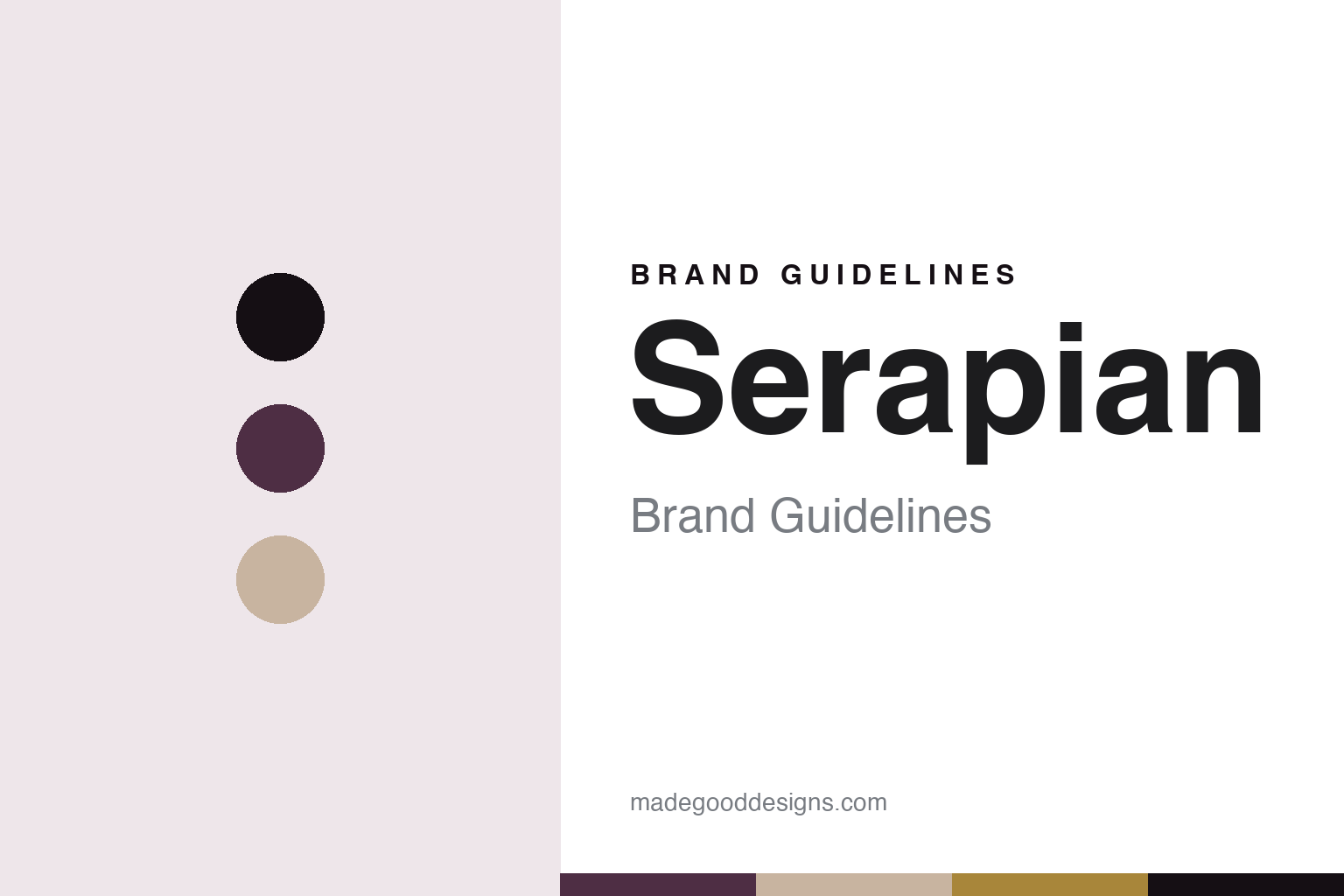
Serapian lives in a Byzantine-plum palette. Click a swatch to copy the hex.
Serapian’s identity is refined, understated and Milanese — a Byzantine plum, an ink, a leather, a gold, and a chalk. The palette leans Byzantine plum and gold: the register of a mosaic-like woven leather. It signals craft and discretion over show. The honest caveat: with no published brand hex, these values are an original, unofficial interpretation, not first-party colours.
The lesson is a Byzantine-plum palette signals a refined, Milanese identity. Serapian’s world is a hand-woven, made-in-Milan, discreet object. For designers, it is a reminder that a deep plum and a warm gold can carry a brand built on a weave — the plum of an interlaced leather and the gold of a quiet finish. Because these tones can fail as small text, keep type dark and let the colour live in the accents, palette and band. The takeaways: own the weave; make it in Milan; keep it discreet; and treat any single hex as unofficial.
Typography
The register is a Milanese sans — clean, refined, quiet.
Serapian’s identity carries a clean, refined, quiet spirit — a discreet luxury object, not a loud one. A Milanese sans captures the mood: even, elegant and modern, the register of a quiet Milan house. Set in a Byzantine-plum palette, the Milanese sans feels clean and refined — exactly the personality Serapian carries. It is quiet rather than flashy, mirroring a hand-woven leather that whispers. (Serapian’s real designs and weave are things we describe but do not reproduce, and the exact typeface is not ours to use.) Because it is not ours to use, the honest description is “a Milanese-sans spirit,” shown here in a stand-in. The type behaves like the maker: clean, refined and quiet.
Aa
A Milanese-sans spirit — clean and refined. (Specimen set in Sora, a Milanese-sans STAND-IN; NOT the Serapian wordmark or any bag/weave design.)
A weave as identity
Serapian stands for the woven leather.
Serapian is a lesson in making a weave the identity. A Byzantine-plum palette, a Milanese sans and hand-woven Mosaico make one technique the whole maker — refined, understated and Milanese. The weave is the differentiator. The differentiator is a genuine, rare skill — a hand-woven leather learned over years by a tiny team, made in Milan, that no logo could replace.
Put to work, the identity is a weave as design. A maker building in this spirit would own a signature technique, keep it hand-made by few skilled hands, and let the craft rather than a monogram be the mark, so the customer buys into a weave rather than a badge. It would sign each piece by its maker. It would be honest that it is Richemont-owned while its craft stays Milanese. The lesson Serapian teaches is that a weave can build a brand: the technique gives it distinction, and the Milan making gives it substance. The weave is the personality, and the hand is the proof.
For designers and brand-builders, Serapian offers a clear takeaway: let a signature technique be the mark, not a logo. The lessons: own the weave; keep it hand-made; sign each piece; and be honest about ownership. It is also a reminder to stay precise: Serapian is a Milan house founded in 1928 by Stefano Serapian, owned by Richemont since 2017, hand-weaving Mosaico leather in Milan — with the palette here an unofficial interpretation. Serapian made the woven leather the maker — proof that a weave can be the difference.
Explore & save
Keep Serapian’s identity on hand — save it to a board in the Made Good inspiration library.
Serapian identity set
Pin the Byzantine-plum palette and the Milanese-sans register to your own board.