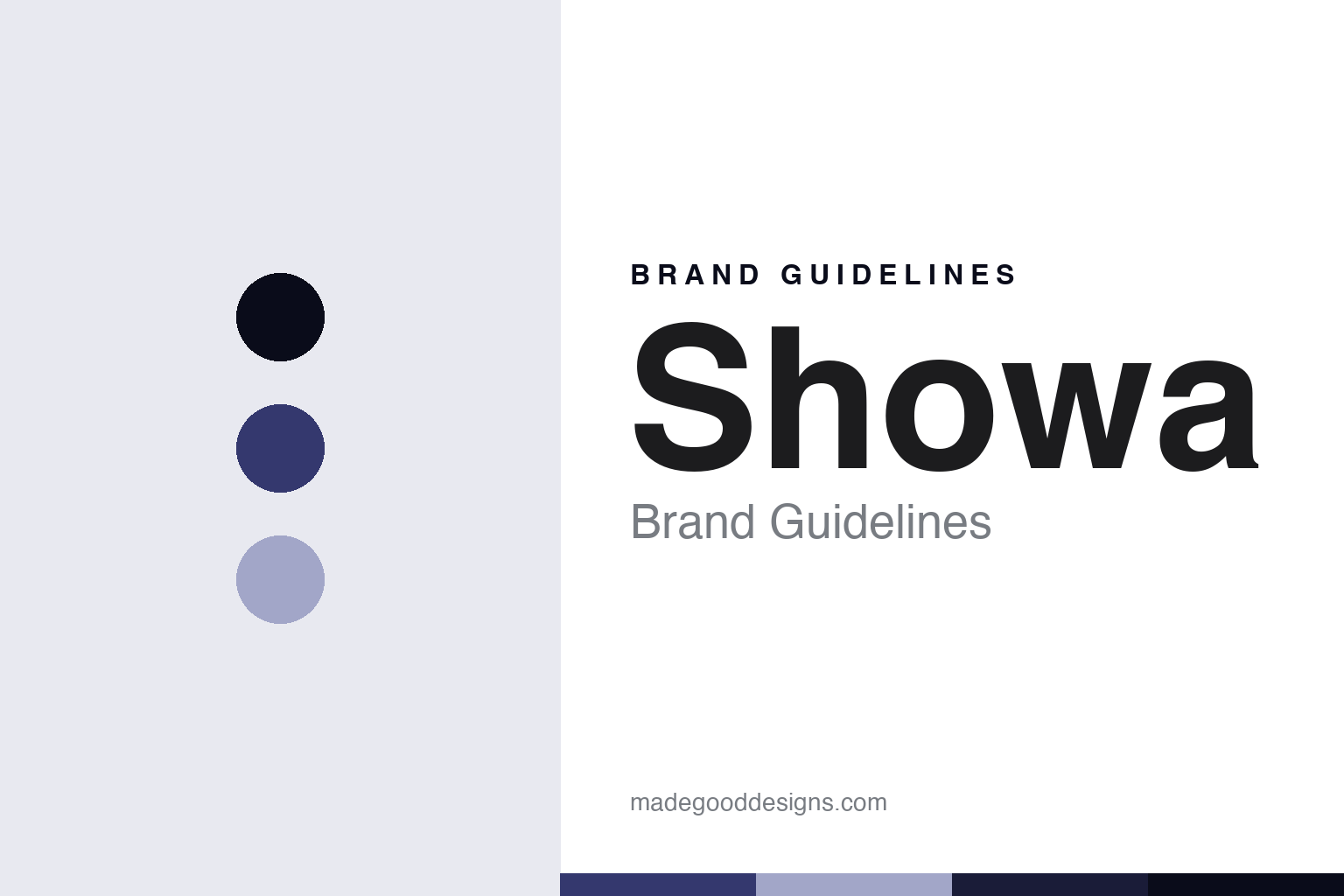
Showa Brand Guidelines
The Japanese coated glove.
Aa
Two constants: an indigo palette and an industrial-sans register. Abstract homage — not a Showa glove, logo or coating diagram.
The Japanese coated-glove maker
Showa is the Japanese work-glove maker founded in Himeji in 1954, a genuine manufacturer of coated grip gloves across plants in Japan and Southeast Asia.
Showa is a lesson in how being a real maker can be an identity. From Himeji, in Japan, Showa makes coated and dipped work gloves — nitrile, latex, PU — including the ubiquitous back-exposed grip glove worn on assembly lines everywhere. Its answer to how a glove becomes a name is manufacturing itself: own the plants, own the coating tech, and make the world’s everyday work glove. A Japanese coated glove, made by an actual manufacturer.
Its identity is the Japanese coated-glove maker. Showa’s coated grip gloves, and its genuine factories, are the work it is known for. A glove, for the line. A real maker, not a badge.
(Honest notes, so the story stays precise. Showa Glove Co., Ltd. was established in October 1954 in Himeji, in Hyogo, Japan (as Showa Kako, a chemical company), later renamed Showa Co. and then Showa Glove; the founder is not named on its corporate pages, so we do not invent one. On where its gloves are made — the crux of this round — Showa is a genuine vertically-integrated manufacturer: it makes in Japan (Himeji, plus plants in Fukushima and elsewhere in the Himeji area) and also runs its own plants in Malaysia, Vietnam and Myanmar, so we describe it as designed and partly made in Japan with high-volume production across Southeast Asia — a real manufacturer, not a Japanese-badged importer. Its signature is the GRIP glove (1994), the back-exposed nitrile-coated assembly glove, alongside the breathable-waterproof TEMRES line, whose cult reputation we attribute as reported; its claim to the first fully-coated PVC glove (1954) we also attribute. In the US it sells the Atlas line and owns the Best glove business. Its chairman and president are living individuals described only from public facts. Its name and product marks are IP, described but never reproduced, and there is no official brand hex; these tones are an unofficial interpretation. This is design commentary and does not promote any product.)
Colour
Showa lives in an indigo palette. Click a swatch to copy the hex.
Showa’s identity is industrial, Japanese and precise — an indigo, an ink, a periwinkle, a navy, and a paper. The palette leans indigo and periwinkle: the register of a nitrile-coated glove and a factory line. It signals manufacturing over fashion. The honest caveat: with no published brand hex, these values are an original, unofficial interpretation, not first-party colours.
The lesson is an indigo palette signals an industrial, coated-glove identity. Showa’s world is an industrial, technical, Japanese object. For designers, it is a reminder that a deep indigo and a soft periwinkle can carry a brand built on coated gloves — the blue of dipped nitrile and the neutral of a knit liner. Because these tones can fail as small text, keep type dark and let the colour live in the accents, palette and band. The takeaways: be a real maker; own the coating tech; be honest about the plant geography; and treat any single hex as unofficial.
Typography
The register is an industrial sans — technical, plain, precise.
Showa’s identity carries an industrial, plain, precise spirit — a manufacturer, not a fashion label. An industrial sans captures the mood: even, functional and modern, the register of a coated work glove. Set in an indigo palette, the industrial sans feels technical and precise — exactly the personality Showa carries. It is a factory floor rather than a boutique, mirroring a dipped grip glove. (Showa’s real logo and product marks are things we describe but do not reproduce, and the exact typeface is not ours to use.) Because it is not ours to use, the honest description is “an industrial-sans spirit,” shown here in a stand-in. The type behaves like the maker: industrial, plain and precise.
Aa
An industrial-sans spirit — technical and precise. (Specimen set in Work Sans, an industrial-sans STAND-IN; NOT the Showa logo or any product mark.)
The work glove
Showa stands for the coated glove of a real maker.
Showa is a lesson in how being a real manufacturer can be an identity. An indigo palette, an industrial sans and a coated grip glove make one thing — the Japanese coated work glove — the whole identity: industrial, Japanese and precise. The genuine factories are the differentiator, and the coating tech is the meaning. The point is a house that does not badge someone else’s gloves but makes its own, from Himeji to Southeast Asia, and whose back-exposed nitrile grip glove is on assembly lines around the world.
Put to work, the identity is manufacturing, honestly mapped, as design. A maker in this spirit would own its plants, own its coating innovations, and be candid about the geography — designed and partly made in Japan, high-volume production across Southeast Asia. A brand learning from it would see that being a real maker is a durable identity — that a company which owns its factories and its coating patents has an authority a rebrander cannot claim — and that being precise, established 1954 in Himeji, making in Japan and in Malaysia, Vietnam and Myanmar, keeps the story honest. Showa is the round’s clearest example of the opposite end of the spectrum from a pure importer: where a distributor sources someone else’s gloves, Showa runs the plants, so its Japan-plus-Southeast-Asia geography is a manufacturer’s map, not a badge’s excuse. There is a nice cross-thread, too: Showa absorbed the American and Canadian “Best” glove businesses and sells the Atlas line in the US, showing how a Japanese maker can carry other markets’ heritage names while keeping its own manufacturing core. The lesson Showa teaches is that real manufacturing can hold an identity: the plants give it authority, and the honest geography keeps it credible. The maker is the personality, and the coated glove is the proof.
For designers and brand-builders, Showa holds the Japan pole in this round of the work glove: be a real maker, and map the make honestly. The lessons: own your plants; own your innovations; describe the plant geography plainly; carry acquired names without hiding your core; and never reproduce a logo or coating diagram. It is also a reminder to stay precise: Showa is the Japanese work-glove maker founded in Himeji in 1954, a genuine manufacturer of coated grip gloves across plants in Japan and Southeast Asia — with the palette here an unofficial interpretation. Showa made real manufacturing the identity — proof that being an actual maker can be the difference.
Explore & save
Keep Showa’s identity on hand — save it to a board in the Made Good inspiration library.
Showa identity set
Pin the indigo palette and the industrial-sans register to your own board.