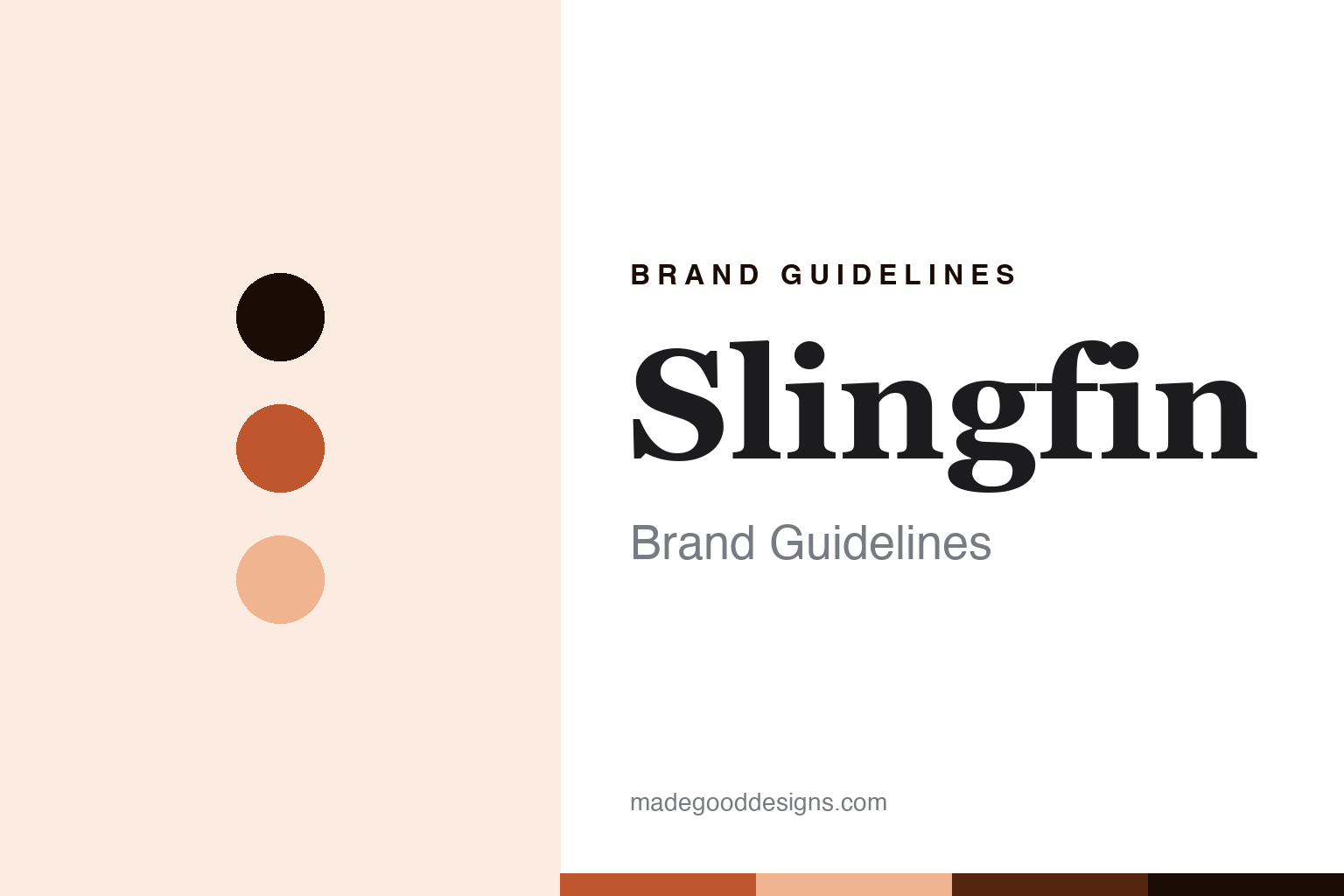
Slingfin Brand Guidelines
The employee-owned alpine tent maker.
Aa
Two constants: a burnt-orange palette and an employee-owned-serif register. Abstract homage — not a Slingfin product or mark; no tent silhouette or logo is reproduced.
The employee-owned alpine tent maker
Slingfin is the employee-owned California tent maker founded by a veteran of The North Face, Sierra Designs and Mountain Hardwear.
Slingfin brings the round its employee-owned maker — the Berkeley, California house, from 2010, of four-season and expedition tents, founded by a designer with decades at the biggest names in the trade, and owned by the people who work there. Slingfin makes alpine tents, and its answer to a round about the cottage shelter is the pedigree and the ownership — a freestanding tent from a veteran designer, at a company its employees own. A brand, employee-owned.
Its identity is the employee-owned alpine tent maker. The employee ownership, the veteran founder and the freestanding construction are the story here. A brand, employee-owned. The employee-owned alpine tent maker.
(Honest notes, so the story stays precise, and the corrections stay in. Slingfin, at slingfin.com, makes four-season and expedition tents as its heroes — the CrossBow and the WindSaber among them — and we report its performance language as the brand’s own marketing. It was founded in 2010 by Martin Zemitis, in Berkeley, California. On who owns it, the theme that anchors this entry, it states it is employee-owned and fiercely independent, self-funded, with no private equity — confirmed. On its founder’s pedigree, a genuine cross-link, Martin Zemitis worked at The North Face from the early 1980s, then Sierra Designs and Mountain Hardwear; a fourth famous name sometimes attached to him we could not confirm, so we do not add it. On where it is made, a theme of this round, it names factories it works with across several countries — Taiwan, Hong Kong, Korea, Vietnam, Japan and Germany, plus a long-standing family-owned supplier — but states no single made-in country, so we print none. On its construction, its signature is a patented pole-and-webbing system it brands “WebTruss,” on freestanding aluminium-pole tents. Its designs and marks are IP we describe but do not reproduce; there is no official brand hex; these tones are an unofficial interpretation.)
Colour
Slingfin lives in a burnt orange. Click a swatch to copy the hex.
Slingfin’s identity is employee-owned, veteran and alpine — a burnt orange, an ink, a pale apricot, a deep rust, and a paper. The palette leans burnt orange and pale apricot: a high-camp register that nods to a four-season tent rather than a loud logo colour. It signals an employee-owned tent maker. The honest caveat: with no published brand hex, these values are an original, unofficial interpretation, not first-party colours.
The lesson is a burnt orange signals an employee-owned, veteran identity. Slingfin’s world is a freestanding, engineered object. For designers, it is a reminder that a burnt orange and a soft pale apricot can carry an outdoor brand — the tone of the high camp. Because these tones can fail as small text, keep type dark and let the colour live in the accents, palette and band. The takeaways: keep it employee-owned; credit the pedigree exactly; state the multi-country making honestly; and treat any single hex as unofficial.
Typography
The register is an employee-owned serif — employee-owned, editorial, veteran.
Slingfin’s identity carries an employee-owned, editorial, veteran spirit — a designer-led tent maker, not a graphics label. An employee-owned serif captures the mood: refined, seasoned and confident, the register of a four-season alpine tent. Set in a burnt-orange palette, the employee-owned serif feels employee-owned and veteran — exactly the personality Slingfin carries. It is a freestanding object rather than a logo, mirroring taut tent fabric. (Slingfin’s real tents and its WebTruss system are things we describe but do not reproduce, and the exact typeface is not ours to use.) Because it is not ours to use, the honest description is “an employee-owned-serif maker,” shown here in a stand-in. The type behaves like the brand: employee-owned, editorial and veteran.
Aa
An employee-owned-serif maker — employee-owned and veteran. (Specimen set in Playfair Display, an employee-owned-serif STAND-IN; NOT the Slingfin logo or any tent.)
The shelter
Slingfin stands for the employee-owned alpine tent maker.
Slingfin brings the round its employee-owned maker. A burnt-orange palette, an employee-owned serif and a Berkeley base make one thing — the employee-owned alpine tent maker — the whole identity: employee-owned, veteran and alpine. The employee ownership is the pitch, and the veteran founder is the pedigree. The point is a freestanding tent from a veteran designer, at a company its employees own, in a round about the cottage shelter.
Put to work, the identity is the ownership told straight, as who-owns — with the pedigree credited exactly and the making stated across countries. A maker in this spirit would keep it employee-owned, credit the pedigree exactly, and state the multi-country making honestly. A reader in this spirit would keep the facts right: Slingfin makes four-season and expedition tents as its heroes, the CrossBow and WindSaber among them; it was founded in 2010 by Martin Zemitis, in Berkeley; it states it is employee-owned and fiercely independent, self-funded; its founder worked at The North Face from the early 1980s, then Sierra Designs and Mountain Hardwear, with a fourth name unconfirmed and so not added; it names factories across Taiwan, Hong Kong, Korea, Vietnam, Japan and Germany plus a family-owned supplier, with no single made-in country; and its signature is a patented WebTruss pole-and-webbing system on freestanding aluminium-pole tents. Slingfin sits at the employee-owned point of the round’s who-owns thread and the multi-country point of the where-made thread. The honest editorial moves are to date it to 2010, to credit Martin Zemitis, to state employee ownership, to credit the pedigree without adding an unconfirmed name, to name WebTruss correctly rather than a generic term, and to print no single made-in country.
For designers and brand-builders, Slingfin continues the cottage shelter: keep it employee-owned — and credit the pedigree exactly. The lessons: let employee ownership be the brand; credit a founder’s documented pedigree without adding an unconfirmed name; name a patented system by its real name; state a multi-country making rather than a single flag; and never reproduce a tent. It is also a reminder to stay precise: Slingfin is the employee-owned California tent maker founded by a veteran of The North Face, Sierra Designs and Mountain Hardwear — with the palette here an unofficial interpretation. Read that way, Slingfin is less a tent than an ownership: employee-owned, veteran, alpine. The lesson for a brand is that employee ownership and a documented pedigree reinforce each other, and keeping it employee-owned keeps the story earned. Slingfin made the-employee-owned-alpine-tent-maker the identity — proof that who-owns can carry a round, its employee-owned house.
Explore & save
Keep Slingfin’s identity on hand — save it to a board in the Made Good inspiration library.
Slingfin identity set
Pin the burnt-orange palette and the employee-owned-serif register to your own board.