Snapdeal Brand Guidelines
The Delhi deals site that became a value marketplace in a box.
Aa
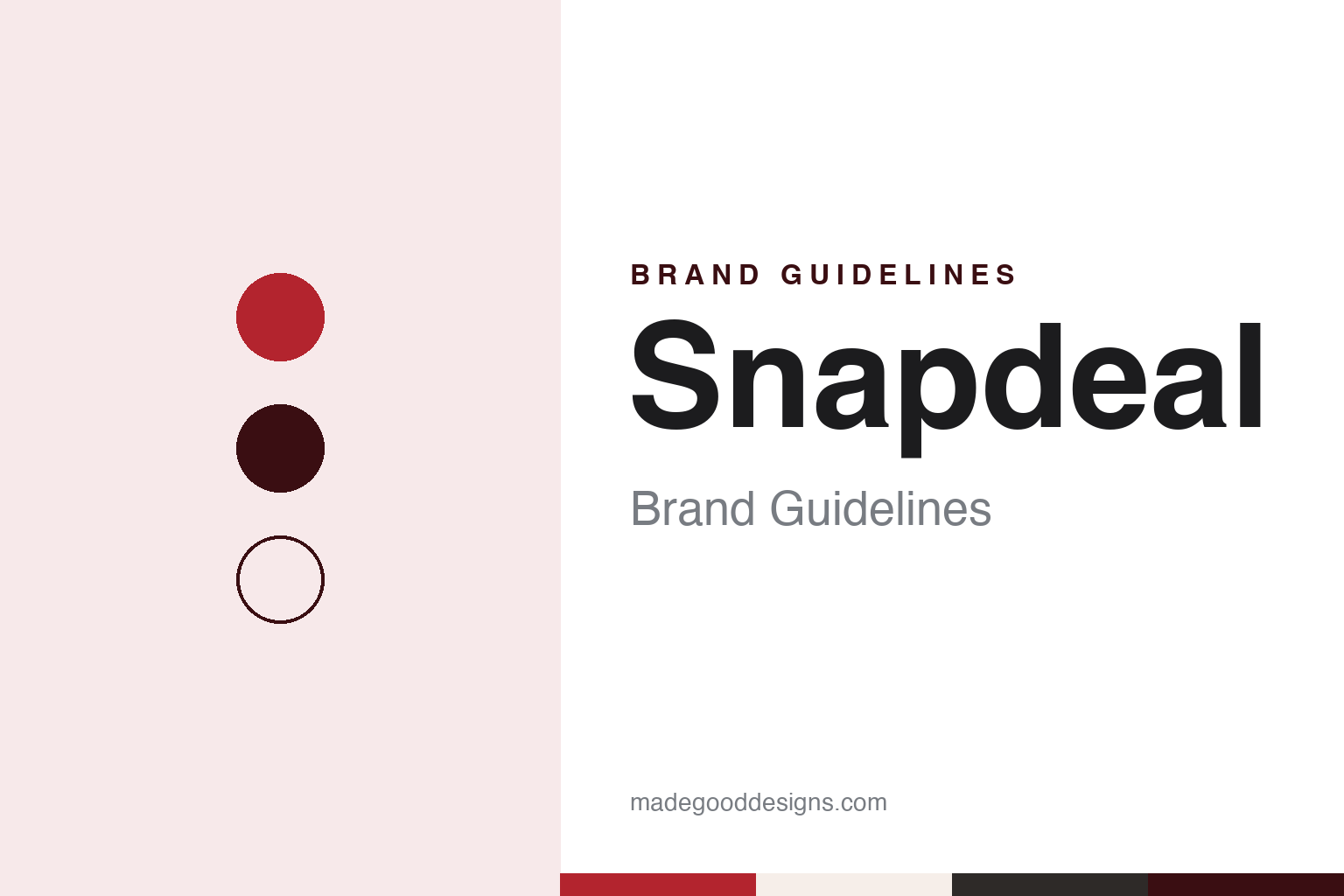
Two constants: a red, maroon and cream palette and a rounded geometric sans register. Abstract homage — not a Snapdeal asset; no logo, app screen or packaging is reproduced.
From deals to a marketplace
Two founders, a deals site and a holding company.
Snapdeal was founded in New Delhi on 4 February 2010 by Kunal Bahl and Rohit Bansal, English Wikipedia says. It began as a daily-deals platform, offering discounts on local services and goods, and changed course in October 2011, when it became an online marketplace on which independent sellers list their own products. The company behind the site, English Wikipedia says, was a holding company called Jasper Infotech.
The early years were a run of small purchases. In June 2010 Jasper Infotech bought Grabbon, a group-buying website based in Bengaluru; in April 2012 it bought eSportsBuy, an online sports-goods shop in Delhi; and in 2013 it added Shopo, a site on which individuals sold to one another. In 2014 came two technology businesses, Doozton, which helped shoppers discover fashion, and Wishpicker, which suggested gifts. English Wikipedia lists a busier 2015: a stake in the comparison site Smartprix, the luxury-fashion site Exclusively.in, the order-management software maker Unicommerce, the payments company Freecharge in April, and an advertising-technology firm later in the year.
Not all of that lasted. By September 2016, Inc42 reported, Snapdeal had decided to shut Exclusively, the premium and luxury fashion site it had bought about eighteen months earlier, as it worked to cut costs. Freecharge was sold in 2017, along with the logistics business Vulcan Express, as part of a reset the company called Snapdeal 2.0, English Wikipedia says. That reset followed talks about a merger with Flipkart, first reported in 2016, which ended in July 2017 without a deal after Snapdeal’s board members could not reach agreement, English Wikipedia says.
What the company kept was the marketplace and Unicommerce. Snapdeal 2.0, as English Wikipedia describes it, meant an asset-light model, with little inventory and spread-out logistics, aimed at shoppers looking for low-priced goods rather than big-name brands.
Colour
Unbox Zindagi and the folded box.
The brand most people now recognise dates from September 2016. That month, Inc42 reported on 14 September, Snapdeal launched a new brand identity under the line “Unbox Zindagi” (“zindagi” is the Hindi word for life) together with a new logo. The mark is built from two arrows that together form a box; the company said the arrows stood for its role as a partner and enabler and pointed to progress, “onwards and upwards.” The campaign that carried it was conceived and produced by Prasoon Joshi and his team at McCann Worldgroup, Inc42 reported.
The new identity was rolled out across every point at which people met the company: the app, the website and mobile site, and the brand’s advertising, which ran on television, in print, on outdoor sites and across video and social channels, according to Inc42. Co-founder and chief executive Kunal Bahl tied the change to a shift in who the company wanted to reach: the next wave of online shoppers from all parts of an increasingly connected India, as he put it.
The colours are not set out in any public guideline. For this guide the palette is our own interpretation, built around a strong red, a deep maroon and a warm cream, with charcoal for text. The rounded geometric sans used for headings here is a stand-in chosen for its friendly, open shapes, not the typeface of the Snapdeal logo.
Since then the brand has leaned on the idea of the bazaar. English Wikipedia says that Snapdeal 2.0 tried to recreate the bustle of India’s markets online, and that the company built its engagement with newer users around video, voice and content in Indian languages. By October 2026, Inc42 reported, Snapdeal described itself as a value e-commerce marketplace, with fashion as its main category and most of its customers living outside India’s big metropolitan cities.
There have been official questions too. In January 2021 the Office of the United States Trade Representative named Snapdeal in its 2020 review of markets where counterfeit goods are sold; Snapdeal asked for the statements to be withdrawn, and it was not included in the 2021 review, released in 2022, English Wikipedia says.
Typography
Indian online retail in public.
This set of guides looks at Indian online retailers and specialty chains, from beauty and baby products to furniture, fashion and books. Most of them meet their customers first on a phone, so the material a design reader can study is the material the companies publish themselves: app screens, the artwork for seasonal sale campaigns, delivery boxes and mailers, and the interiors of the stores some of them have opened.
Several of these brands began online and later added shops. Nykaa, founded in Mumbai in 2012, opened its first store at Delhi airport in 2014, according to English Wikipedia; FirstCry, launched in Pune in 2010, opened its first store in Gujarat within months, a co-founder told Mint in 2024. Others in the set began with physical stores and added online sales later. Each guide notes which way a company grew, and when.
Platform names are described plainly. Many of these businesses trade under a short consumer name while a differently named company owns it: Nykaa is run by FSN E-Commerce Ventures and FirstCry by Brainbees Solutions. Where a brand sits inside a larger group, or was bought by one, the guide gives the owner and the date as the sources report them.
Each guide also draws on corporate pages and press reports on founders, owners and stock-market listings, with the dates those sources give. Store counts and other figures are given as of the date their source reports them. Colours and typefaces are an unofficial interpretation for design study; no logo, product photograph or app screen is reproduced.
Aa
A rounded geometric sans for a friendly, open voice. (Specimen set in Poppins, a sans STAND-IN; NOT the Snapdeal logo.)
AceVector
A group name, a listing and a new chief executive.
In July 2022 the founders gave the business a group structure under a new name, AceVector, which brought together three ventures: the Snapdeal marketplace, the software company Unicommerce and a house of consumer brands called Stellaro Brands, English Wikipedia says. Inc42 reported the same arrangement in July 2025, noting that the three had been consolidated under one roof in 2022 and that Unicommerce had by then become a listed company in its own right in 2024.
The road to a public listing was not straight. Snapdeal filed draft papers for a share sale in 2021 and, Inc42 reported, pulled back on the plan a year later amid turmoil in the markets. In January 2025, ETBrandEquity reported, AceVector named Achint Setia chief executive of Snapdeal, while Himanshu Chakrawarti moved to lead Stellaro Brands. In July 2025 AceVector confidentially pre-filed a draft prospectus with the market regulator SEBI for a listing on the main boards of the BSE and the NSE, Inc42 reported on 19 July 2025.
That listing has now happened. AceVector’s shares began trading on the BSE and the NSE on 5 October 2026, Inc42 reported that day. In July 2025 Inc42 named the co-founders Kunal Bahl and Rohit Bansal, along with SoftBank and Nexus Venture Partners, as the main shareholders of the combined group; its October 2026 report listed the group’s businesses as the marketplace, Unicommerce and Stellaro Brands.
Across those years the Snapdeal name has stayed the same, while the business around it has been rebuilt several times: the shift from deals to a marketplace in 2011, the sale of side businesses in 2017, the new group name in 2022 and a stock-market listing in 2026.
For a design guide, Snapdeal shows how a single strong symbol, a folded box in one colour, can carry a marketplace through a change of strategy and ownership structure. Compare Meesho, another Indian marketplace built around low-priced goods and smaller towns, and Myntra, a fashion-led platform. For this guide we use a red, a deep maroon and a warm cream with a rounded sans, an unofficial interpretation; no product or logo is reproduced.
Explore & save
Keep Snapdeal’s identity on hand — save it to a board in the Made Good inspiration library.
Snapdeal identity set
Pin the Snapdeal red, maroon and cream palette and the rounded geometric sans register to your own board.