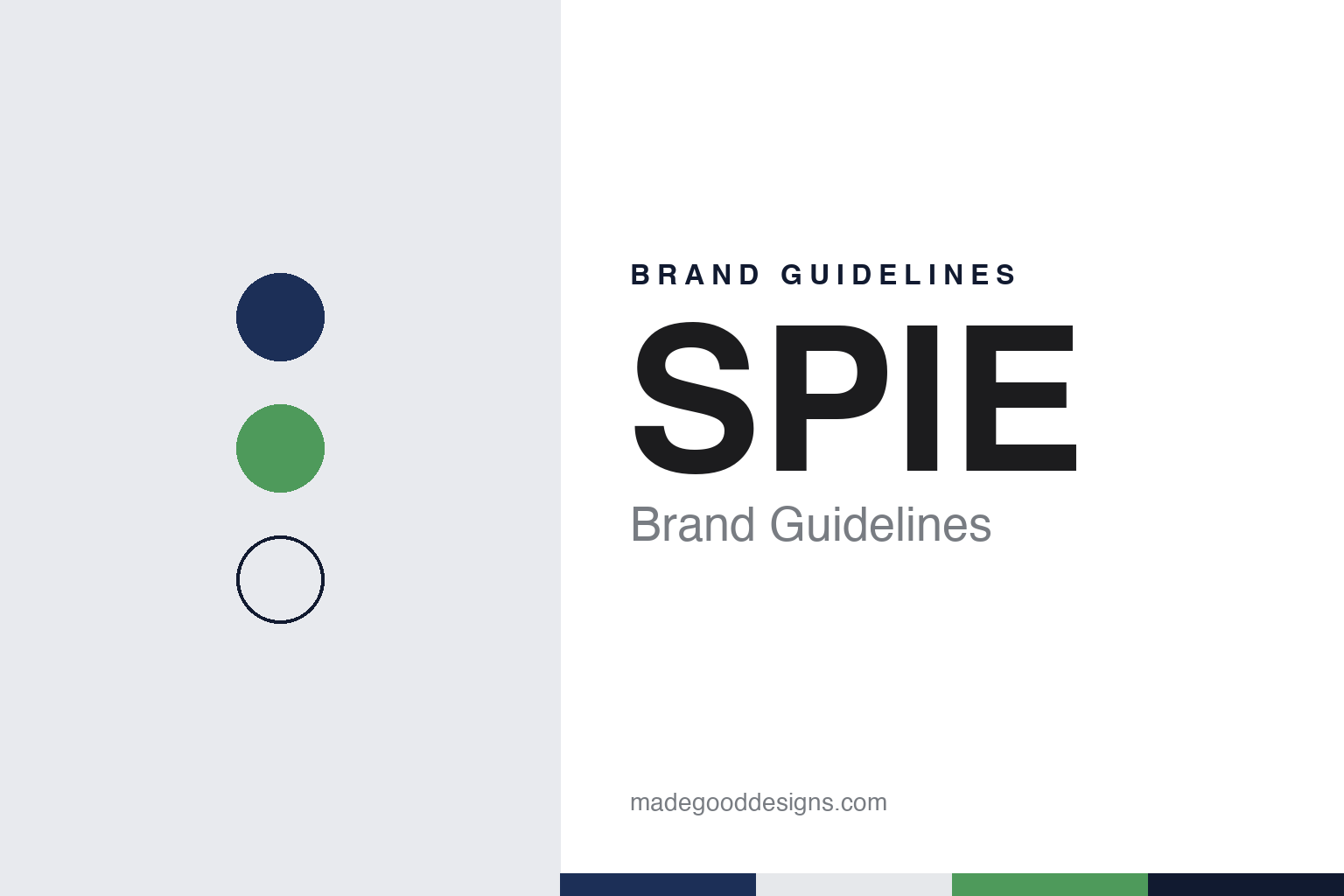
SPIE Brand Guidelines
Four initials from the Paris Metro to a European services group.
Aa
Two constants: an ink blue, fresh green and pale grey palette and a grotesque sans register. Abstract homage — not a SPIE asset; no logo, livery or uniform is reproduced.
The Parisienne électrique
Electrifying the Paris Metro.
SPIE traces its origins to 1900 and to Édouard Empain, the Belgian industrialist behind the Paris Metro. French Wikipedia says Empain had won the tender for the Metro in 1898 and founded, in 1900, the Société parisienne pour l’industrie des chemins de fer et des tramways électriques, also known as the “Parisienne électrique,” to carry out the electrical infrastructure work for the new underground railway. SPIE’s own history describes the same start, placing it in the year of the Paris Exposition, when electric lighting and electric motors were displacing gas and steam.
The company soon grew beyond the Metro. SPIE says that from 1919, while expanding in railway power supply, it diversified into power generation and distribution, building thermal and hydroelectric power stations and a large part of the overhead lines that carried electricity to industry, towns and the countryside.
The sources used for this guide do not say how the company operated during the occupation of 1940–1944.
The French electricity sector was nationalised under a law of April 1946, and SPIE’s history says the company lost the support of the concession companies it had worked for; it recovered by concentrating on three fields: electricity, railway track and electric traction, and pipelines. In 1946 it also took the name Société parisienne pour l’industrie électrique, the source of the initials SPIE, according to both French Wikipedia and the company.
Colour
Batignolles, Schneider and AMEC.
In the late 1960s SPIE merged with the Société de construction des Batignolles, a builder founded in 1871 by Ernest Goüin, to form SPIE Batignolles; French Wikipedia dates the merger to 1967 and the company to 1968. The Empain group was the main shareholder, and after it took control of Schneider in 1969, SPIE Batignolles became part of Empain-Schneider. It absorbed the civil-engineering contractor CITRA in 1972, and in 1981, after the Empain family left the capital, the parent group restructured under the Schneider name, both sources say. One of the more unusual SPIE Batignolles jobs was Anaconda, a wooden roller coaster built to William Cobb’s plans at the park now called Walygator Parc, which French Wikipedia says was the tallest in Europe from 1989 to 2001.
Schneider sold the business in 1997 through an employee buyout in which staff partnered with the British group AMEC; SPIE calls it the largest employee buyout in France by number of participants. In 1998 the holding company took the name SPIE, with three main subsidiaries for construction, energy and rail transport, and electrical engineering. SPIE says the electrical arm then added climate engineering by buying Laurent Bouillet in 1999 and information and communication technology by buying Matra Nortel Communications Distribution in 2001. AMEC exercised its option to take full control in 2003 and the group became AMEC SPIE, while the construction arm was sold to its senior managers and continued separately as Spie Batignolles, the company and French Wikipedia say.
Independence returned in 2006. SPIE says AMEC agreed to sell the group to the investment fund PAI Partners, a deal finalised on 27 July 2006, and the name reverted to SPIE. In 2011 PAI sold it to a consortium led by Clayton, Dubilier & Rice with AXA Private Equity and the Caisse de dépôt et placement du Québec. In 2013, the company says, it reorganised into four markets, which it named Smart city, e-fficient buildings, Energies and Industry services. On 10 June 2015 SPIE listed its shares on the Paris stock market, the company says, and launched an employee share offer at the same time.
Typography
Design and documentation.
Facility-services companies sell work that happens inside other people’s buildings, and the two in this guide describe it in short lists. In a July 2022 release, Atalian grouped its work under five headings: cleaning, security, maintenance and energy management, reception, and catering. EMCOR, a contractor that also maintains buildings, summed up its work in late 2025 with four verbs, saying it would serve customers that “build, power, service and protect facilities and critical infrastructure.”
The people who do the work are the service itself, and staff numbers are among the figures given for both companies. Atalian gave more than 123,000 employees in 35 countries in 2022, and La Tribune de l’Hôtellerie put it at about 63,000 in 15 countries in 2024; English Wikipedia gives EMCOR 40,400 employees in 2024. The photographs of staff at work, the uniforms and the workplace scenes that such companies publish belong to them, and this guide reproduces none of them.
Names matter because a name can tie a company to one service. TFN, the French cleaning firm founded in 1944, renamed itself Atalian in 2009 because, its chief executive told Le Figaro, the old name was too closely associated with cleaning. When Atalian and the British firm Servest formed a joint venture in 2016, it took both names, and Servest’s chief executive told the European Cleaning Journal that a customer should find the same look and feel in an office in London or Frankfurt as in Madrid or Paris.
Ownership can change quickly, as both companies here show, which makes corporate pages on owners and countries, and the annual and sustainability reports that sit beside them, part of how these firms present themselves. EMCOR sold its British business to OCS in December 2025, BIC Magazine reported, and Atalian agreed a recapitalisation with its creditors in June 2026. This guide sets each company’s own account beside dated press and marks what rests on the company’s word.
Aa
A grotesque sans for four initials. (Specimen set in Archivo, a sans STAND-IN; NOT the SPIE logo.)
SPIE
A Cergy-based group across Europe.
Growth since the listing has come largely through acquisitions. SPIE bought Hochtief’s Service Solutions business in Germany in 2013 and the German energy-infrastructure services group SAG on 31 March 2017, which French Wikipedia says took the workforce to 46,650 by the end of that year and extended the network to Poland, Hungary, the Czech Republic and Slovakia. The company lists later purchases including Worksphere in the Netherlands in 2022, Correll, a submarine-cable services specialist for offshore wind farms, in 2023, and ROBUR, an industrial-services business in Germany, in 2024.
Today SPIE is based in Cergy, north-west of Paris. It describes itself as “the independent European leader in multi-technical services in the areas of energy and communications,” with about 55,000 employees across six main European countries, and names its values as proximity, performance and responsibility. Its leadership changed in 2026: the financial daily L’Agefi reported on 6 March 2026 that Gauthier Louette would leave the post of chairman and chief executive and that the group would split the two roles, with Markus Holzke named chief executive. SPIE’s announcement of the same date says Holzke, who joined with the Hochtief deal in 2013 and had run SPIE’s German, Swiss and Austrian business since 2014, would take over after the annual general meeting of 30 April 2026, with Patrick Jeantet as non-executive chairman.
For a design guide, SPIE shows how a set of initials can outlast the long company name they once stood for, through mergers, a buyout and several owners. Compare Equans, the French multi-technical services company that Bouygues bought in 2022, and Atalian, another French services group. For this guide we use an ink blue, a fresh green and a pale grey with a grotesque sans, an unofficial interpretation; no product or logo is reproduced.
Explore & save
Keep SPIE’s identity on hand — save it to a board in the Made Good inspiration library.
SPIE identity set
Save the SPIE ink blue, fresh green and pale grey palette and the grotesque sans register to your own board.