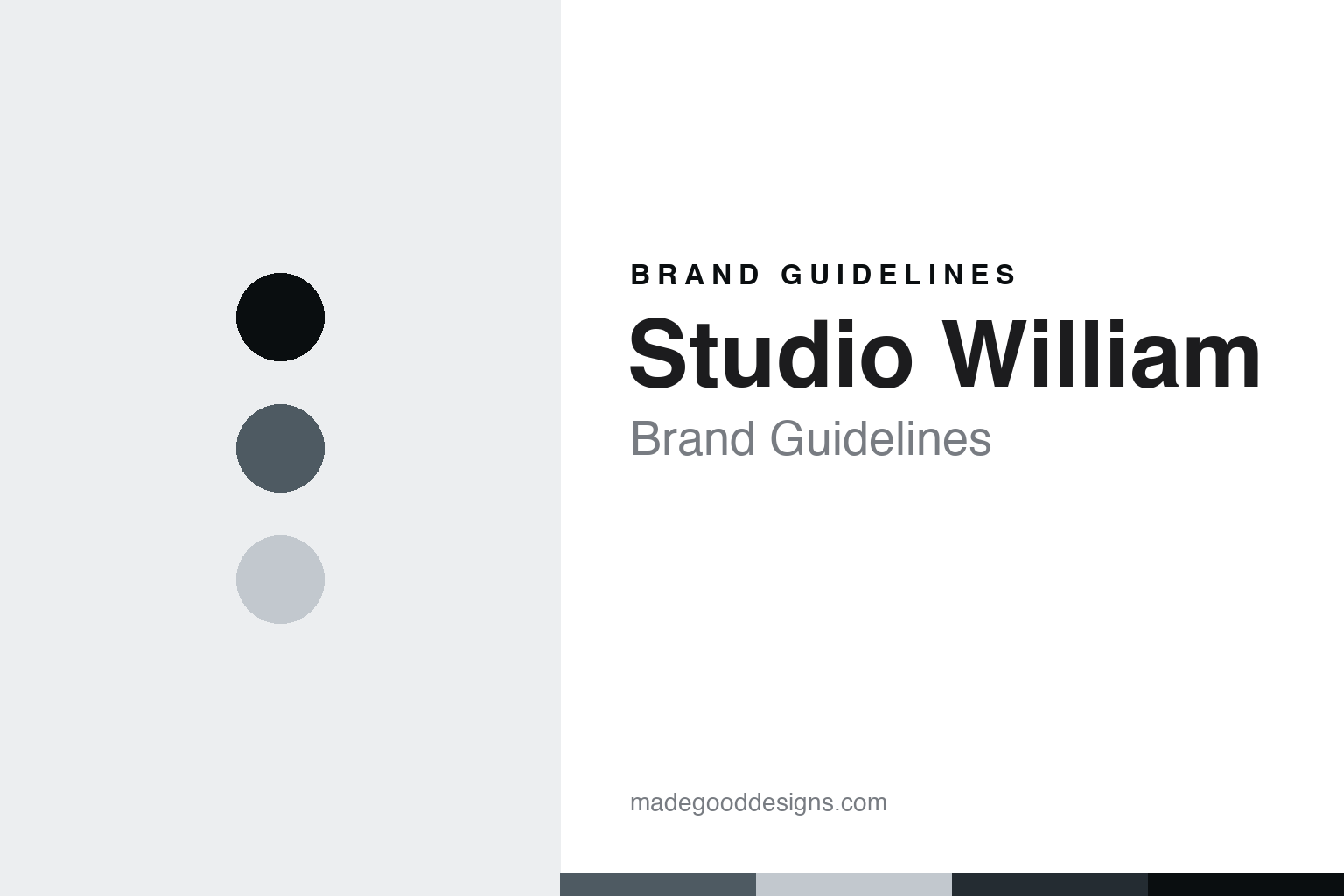
Studio William Brand Guidelines
Designed in the UK, made where unstated.
Aa
Two constants: a sculpted-slate palette and a design-studio-sans register. Abstract homage — not a Studio William product or mark; no cutlery silhouette, no sculptural pattern, and no logo is reproduced.
Designed in the UK, made where unstated
Studio William is the UK design-led flatware studio of William Welch, whose country of manufacture is undisclosed.
Studio William closes the round as its transparency case — the British design-led flatware studio of the designer William Welch, whose sculptural, tree-named ranges are drawn in Gloucestershire, but whose country of manufacture the studio does not state anywhere. Studio William makes design-led flatware, and its answer to a round about the cutlery drawer is design without disclosure — a strongly-designed cutlery whose where-made is simply not told. A brand, designed.
Its identity is designed in the UK, made where unstated. The design authorship, the sculptural ranges and the undisclosed making are the story here. A brand, designed. Designed in the UK, made where unstated.
(Honest notes, so the story stays precise, and the gap stays the gap. Studio William, the studio of Studio William Welch, makes design-led flatware as its hero — sculptural, tree-named ranges such as its mulberry, larch and olive lines — with strong design credentials, and we report its performance language and awards as the brand’s own claims. It is founder-led, by the Royal-College-of-Art-trained designer William Welch, based in Chipping Campden, in Gloucestershire. On where it is made, the star theme of this round, it is the round’s designed-here-made-undisclosed case: its country of manufacture is not stated anywhere — it speaks of models being sent to “the factory,” unnamed — and Gloucestershire is its headquarters and design studio, not stated as its production site, so we do not assert where it is made. On who owns it, a theme of this round, it is founder-led; the exact founding year we could not verify. Its designs are IP we describe but do not reproduce; there is no official brand hex; these tones are an unofficial interpretation.)
Colour
Studio William lives in a sculpted slate. Click a swatch to copy the hex.
Studio William’s identity is designed, sculptural and undisclosed — a sculpted slate, an ink, a pale ash, a deep graphite, and a paper. The palette leans sculpted slate and pale ash: a sculptural, considered register that nods to a strongly-shaped cutlery rather than a loud logo colour. It signals a design studio. The honest caveat: with no published brand hex, these values are an original, unofficial interpretation, not first-party colours.
The lesson is a sculpted slate signals a designed, sculptural identity. Studio William’s world is a forged, shaped object. For designers, it is a reminder that a sculpted slate and a soft pale ash can carry a cutlery brand — the tone of a design studio. Because these tones can fail as small text, keep type dark and let the colour live in the accents, palette and band. The takeaways: design the shape; report the making as unstated; keep it founder-led; and treat any single hex as unofficial.
Typography
The register is a design-studio sans — designed, plain, sculptural.
Studio William’s identity carries a designed, plain, sculptural spirit — a design studio, not a graphics label. A design-studio sans captures the mood: clean, considered and confident, the register of design-led flatware. Set in a sculpted-slate palette, the design-studio sans feels designed and sculptural — exactly the personality Studio William carries. It is a forged object rather than a logo, mirroring brushed stainless. (Studio William’s real flatware and its sculptural patterns are things we describe but do not reproduce, and the exact typeface is not ours to use.) Because it is not ours to use, the honest description is “a design-studio-sans studio,” shown here in a stand-in. The type behaves like the brand: designed, plain and sculptural.
Aa
A design-studio-sans studio — designed and sculptural. (Specimen set in Manrope, a design-studio-sans STAND-IN; NOT the Studio William logo, a pattern or any cutlery.)
The flatware
Studio William stands for designed in the UK, made where unstated.
Studio William closes the round as its transparency case. A sculpted-slate palette, a design-studio sans and a Chipping Campden studio make one thing — designed in the UK, made where unstated — the whole identity: designed, sculptural and undisclosed. The design authorship is the pitch, and the undisclosed making is the honest gap. The point is a strongly-designed cutlery whose where-made is simply not told, the far end of a round that maps who really makes the cutlery drawer.
Put to work, the identity is design told straight, as an honest gap — with the making left unstated and the studio credited. A maker in this spirit would design the shape, report the making as unstated, and keep it founder-led. A reader in this spirit would keep the facts right: Studio William makes design-led flatware as its hero — sculptural, tree-named ranges such as mulberry, larch and olive — with strong design credentials; it is founder-led, by the Royal-College-of-Art-trained designer William Welch, based in Chipping Campden, in Gloucestershire; its country of manufacture is not stated anywhere, with Gloucestershire its headquarters and design studio rather than a stated production site, so no where-made claim is made; and the exact founding year is unverified. Studio William closes the round’s where-made spectrum at the designed-here-made-undisclosed end — the counterpart to the genuine own-factory makers and the offshore Gense — and makes the transparency gap itself the subject. The honest editorial moves are to credit William Welch, to name Chipping Campden as the studio, to decline a where-made claim the studio does not support, and to leave the founding year unverified.
For designers and brand-builders, Studio William completes the cutlery drawer: design the shape — and report the making as unstated. The lessons: let design authorship be the brand while treating an undisclosed where-made as itself the story; separate a design studio from a stated production site; decline a where-made claim the source does not support; leave a founding year unverified rather than invent one; and never reproduce a piece of cutlery. It is also a reminder to stay precise: Studio William is the UK design-led flatware studio of William Welch, whose country of manufacture is undisclosed — with the palette here an unofficial interpretation. Read that way, Studio William is less a fork than a design studio: sculptural, British-designed, made where unstated. The lesson for a brand is that strong design and an honest gap can coexist, and declining an unstated where-made keeps the story earned. Studio William made designed-in-the-UK-made-where-unstated the identity — proof that a transparency gap can close a round about who really makes the cutlery drawer.
Explore & save
Keep Studio William’s identity on hand — save it to a board in the Made Good inspiration library.
Studio William identity set
Pin the sculpted-slate palette and the design-studio-sans register to your own board.