Swann Galleries Brand Guidelines
A New York book auction that became a house for works on paper.
Aa
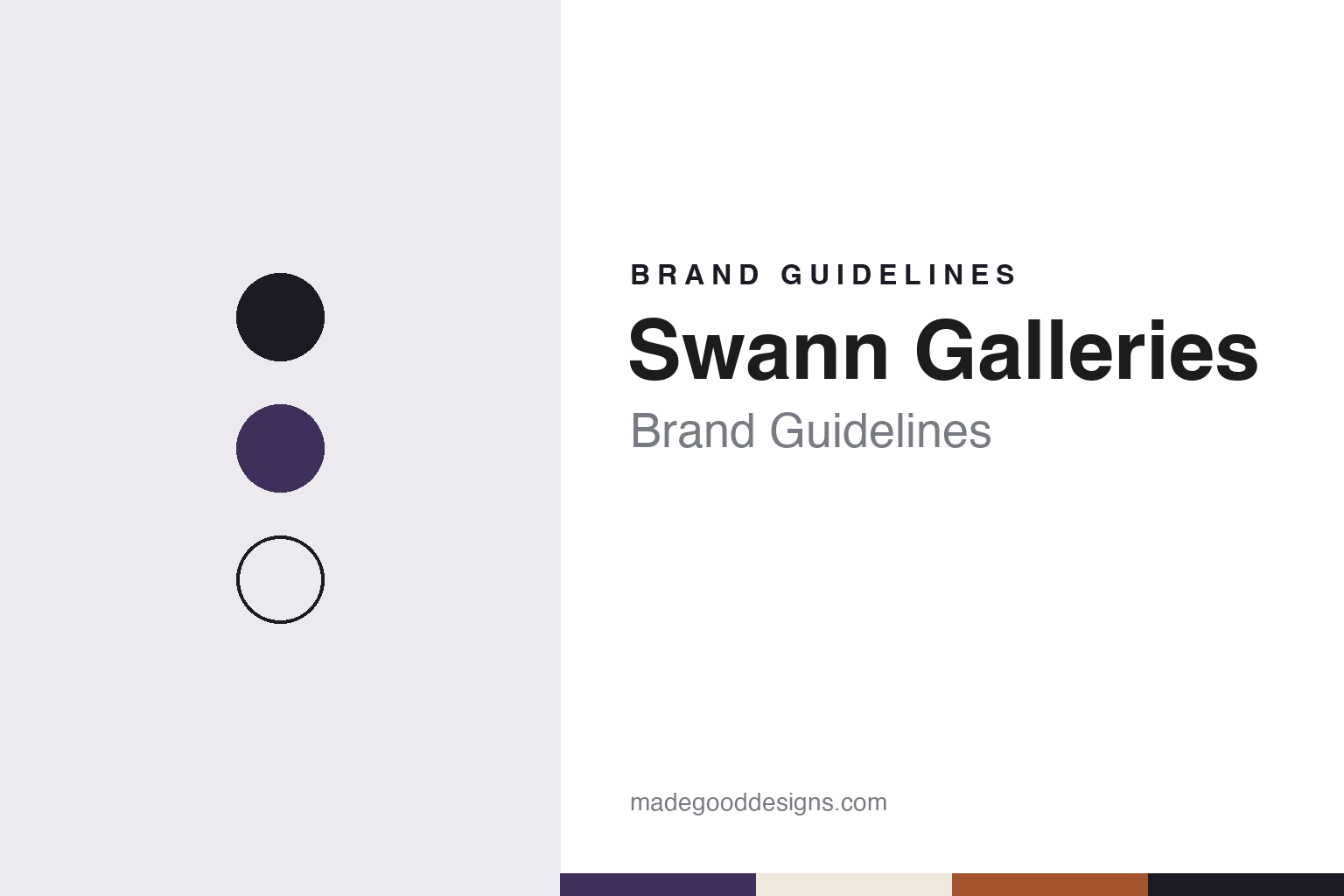
Two constants: an ink violet, rag paper and rust palette and a bookish serif register. Abstract homage — not a Swann Galleries asset; no catalogue, logo or lot image is reproduced.
A library too big for a bookshop
An auction house built from one collection of books.
Swann Galleries is a New York auction house that sells rare books and works on paper. English Wikipedia says it was founded in 1941 by the book dealer Benjamin Swann as a family-owned firm, and calls it the oldest continually operating specialist auction house in New York. Its president, Nicholas Lowry, gives a slightly earlier date: in a 2024 interview with Steven Heller in Print, he said the house was founded “back in 1940.”
Lowry’s account explains why a book auction was needed at all. His grandfather, Louis Cohen, founded New York’s Argosy Bookstore in 1925. In the late 1930s, Lowry told Print, Cohen bought a library too large for the shop to absorb, so he set up his nephew, Benjamin Swann, in business as a book auctioneer. For its first few years, Lowry said, all the house did was sell books from that original collection.
The business then passed to the family that still runs it. English Wikipedia says George Lowry acquired it from Benjamin Swann in 1970; Nicholas Lowry told Print that his father bought Swann out in 1969, when Swann was ready to retire, and ran the house until 2000. English Wikipedia describes Nicholas Lowry as the third generation at the company’s head and says he was named president in 2001. His family background runs through the trade: in the same interview he said his mother specialised in modern first editions, his father in autographs and his grandmother in maps.
For more than thirty years, according to English Wikipedia, the house has been based on East 25th Street, one block east of Madison Square Park, on the edge of the Murray Hill, Gramercy Park and Flatiron districts.
Colour
Books, maps, posters, photographs and prints.
What began as a book sale has grown into a set of specialist departments, all built around paper. English Wikipedia lists separate departments for books; autographs and manuscripts; maps and atlases; photographs and photographic literature; prints and drawings; vintage posters; illustration art; and African American fine art. It adds that Swann holds annual sales of printed and manuscript African Americana, and puts the total at more than 35 catalogued live auctions a year.
Posters are the department its president leads. The PBS biography of Nicholas Lowry for Antiques Roadshow describes him as president of Swann Auction Galleries, its principal auctioneer and director of the poster department; it says he joined the house in 1994, after graduating from Cornell University in 1990. Lowry appears on Antiques Roadshow as a poster appraiser, and English Wikipedia says other Swann specialists also appraise objects on the programme.
In the 2024 Print interview, Lowry said he had worked with vintage posters for close to thirty years and that his interest began in the mid-1990s, at the Argosy Bookstore, where a storeroom held hundreds of old posters his grandfather had bought. He described learning the field from printed dealers’ catalogues, auction catalogues and a New York poster reference library, and said he went on to curate an exhibition at Poster House, the New York poster museum, on travel posters about New York City. English Wikipedia adds that he sits on the museum’s advisory board. In September 2025 the University of Wyoming announced a free public lecture by Lowry on posters, introducing him as president of Swann Auction Galleries and the poster expert of Antiques Roadshow.
Swann also sits inside wider networks of the book and auction trades. English Wikipedia says it was one of the founding members of International Auctioneers, a group of independent auction houses formed in 1993 with European members in cities including Stockholm, Cologne, Milan, Paris, Zurich, Geneva and Vienna. It also says Swann is the only auction house that is a member of the Antiquarian Booksellers’ Association of America.
Typography
Catalogues, salerooms and screens.
Auction houses and online auction platforms sell other people’s objects, so most of what they publish is about the lots rather than about themselves. The catalogue is the core document: a printed or online book for each sale, with a cover image chosen from the lots, a number and a description for each piece, and notes on where it came from. Many houses now publish the same catalogue as a web page and as a download, and some give a single important lot a catalogue of its own.
Lot photography sets much of the tone. Paintings are usually shown flat and square to the camera, furniture and objects against a plain ground, and jewellery and small pieces close up, so that a bidder in another city can judge them from a screen. The saleroom itself is the other stage: a rostrum, rows of chairs, a wall or screen for the lot on sale and a bank of telephones for absent bidders, as the houses show it in their own photographs and broadcasts.
Online bidding has added a third face. Houses and platforms publish apps and web pages for live and timed sales, with a lot image, the current bid, a countdown or a live video feed, and buttons for bidding and watching lots. Their sites also carry the practical pages, such as viewing hours, addresses of offices and salerooms, and how to consign or collect.
Corporate pages are usually short. They give a founding date, the offices and salerooms, and sometimes the names of owners or of the group a house now belongs to. This guide sets out what can be checked about each house — who founded it, who owns it and where it sells — and marks clearly what rests only on the company’s own word.
Aa
A bookish serif — the register of a rare-book catalogue. (Specimen set in Libre Caslon Text, a serif STAND-IN; NOT the Swann Galleries logo.)
Swann Galleries
A family house built on paper.
Swann’s story starts with a single purchase. According to Nicholas Lowry’s account in Print, a library bought by the Argosy Bookstore family was the reason the auction house existed, and its books filled the first sales. Ownership has stayed within that extended family of booksellers ever since: from Benjamin Swann, the founder, to George Lowry in 1969 or 1970, depending on the source, and then to Nicholas Lowry around 2000 or 2001.
The house keeps the name of its founder rather than the family that has owned it for more than half a century, and it appears in sources both as Swann Galleries and as Swann Auction Galleries: English Wikipedia uses the shorter form, while PBS and the University of Wyoming use the longer one. Its departments map closely onto the categories of the rare-book and print trades, from atlases to photobooks, and the sources above show its people working beyond the saleroom: specialists who appear on public television, a president who has curated a museum exhibition and lectured at a university, and a membership in a booksellers’ association as well as an auction group.
That focus on paper makes the house a clear case for print-led design. Its material is the printed page — books, maps, prints, posters and photographs — and its departments are organised by medium and by subject, with African Americana and African American fine art given their own regular sales, according to English Wikipedia. The palette in this guide borrows from that subject — the warm off-white of old paper, the near-black of printing ink and a single rust tone — and is our own interpretation, not a copy of the house’s materials.
For a design guide, Swann Galleries shows how a specialist auction house can build its identity around one material — paper — and the trades that grew up around it. Compare Doyle, another New York auction house, and Heritage Auctions, a US house built around collectors’ material. For this guide we use an ink violet, a rag-paper off-white, a rust and a near-black with a serif, an unofficial interpretation; no product or logo is reproduced.
Explore & save
Keep Swann Galleries’s identity on hand — save it to a board in the Made Good inspiration library.
Swann Galleries identity set
Save the Swann Galleries ink violet, rag paper and rust palette and the bookish serif register for your own reference.