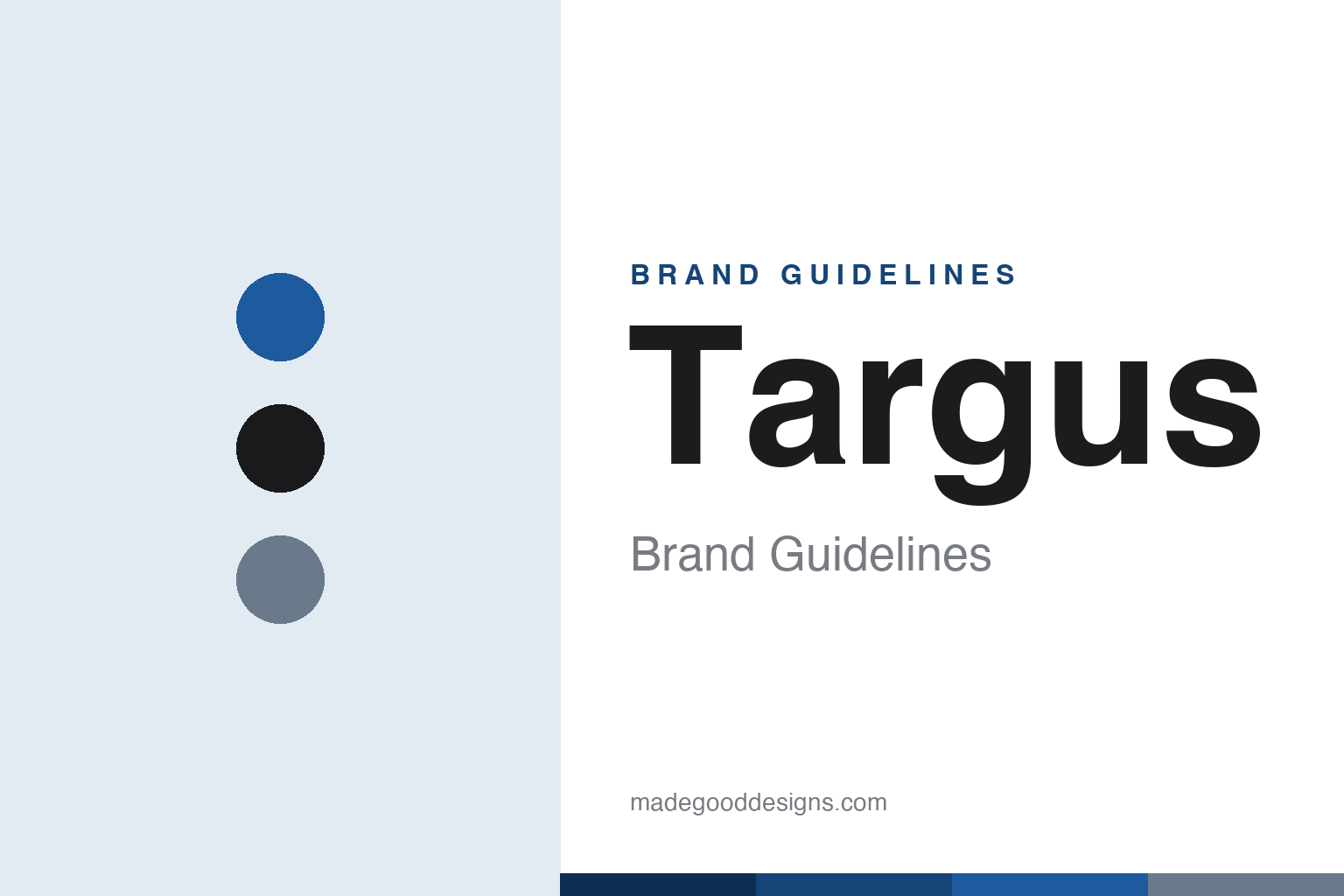
Targus Brand Guidelines
Carry. Protect. Connect. — the brand widely credited with pioneering the laptop bag, now a B2B tech-accessory staple.
Aa
Two constants: a corporate-blue-and-black palette and a technical, corporate sans. Abstract homage — not the Targus wordmark.
Carry. Protect. Connect.
Targus pioneered the laptop bag.
Targus is a lesson in defining a category and then broadening it. Targus was founded in 1983 — and, notably, in Barnes, London, UK, not the United States (it only later became a California company). (An honest note: it’s British-founded; the founder is reported as Neil Bruce-Copp but that name is best treated as unconfirmed. Two more notes: no official brand hex is published, and the wordmark typeface is undocumented.)
Targus is widely credited with pioneering the dedicated notebook/laptop carrying case. Handle the specifics carefully: a literal “1983 laptop case” is chronologically shaky (mass-market laptops barely existed then), and the brand’s landmark early case, the T3100L, launched around 1986 off a 250-unit order from Toshiba (for the Toshiba T3100). So the accurate framing is “widely credited with pioneering the dedicated notebook carrying case in the mid-to-late 1980s,” not a hard 1983 claim.
From that beachhead, Targus broadened into a full “laptop bags + PC accessories” company: bags, backpacks, briefcases and rolling cases, plus docking stations (USB-C and Thunderbolt), universal laptop chargers, wireless mice and keyboards, USB hubs, webcams, privacy screens, cooling pads, and the trademarked DEFCON line of laptop security cable locks. It’s HQ’d in Anaheim, California (not Irvine) and is strongly B2B/enterprise-focused, selling heavily through corporate IT channels. On ownership, be precise: Targus is private and has never been publicly traded (there was no SPAC listing) — B. Riley Financial acquired Targus directly and privately in October 2022 (~$250M enterprise value), after an earlier chain through the Carlyle Group and a 2016 Chapter 11. Its tagline: “Carry. Protect. Connect.”
Colour
Targus lives in a corporate-blue-and-black palette. Click a swatch to copy the hex.
Targus’ identity leans on a corporate, tech-professional palette — a corporate blue, black and steel greys, with white. The tones read as dependable, professional and enterprise-ready — the look of a B2B technology brand that sells to corporate IT departments rather than a fashion label — while blue signals trust and technology. It’s a straightforward, professional palette that matches a company built on protecting and connecting business hardware. The honest caveat: Targus publishes no official brand hex, so the corporate blue, black and steel here are an original, unofficial interpretation, not first-party values.
The lesson is a corporate palette signals B2B trust and technology. Targus’ blue-and-black world reads as dependable and enterprise-ready. For designers, it’s a reminder that a restrained corporate palette can convey trust and professionalism for a B2B brand. The takeaways: use corporate blue and black for enterprise trust; keep it professional and straightforward; and treat specific hexes as unofficial when there’s no published spec.
Typography
The wordmark is a technical corporate sans — dependable and professional.
Targus’ identity carries a technical, corporate, dependable spirit — the all-caps “TARGUS” wordmark whose even, engineered letterforms read as professional, trustworthy and tech-focused. The technical type matches a brand built on protecting and connecting business hardware and selling into enterprise IT, and it keeps the personality dependable and straightforward rather than fashion-led. Set against a corporate-blue-and-black palette, the type feels technical and professional — exactly the “carry, protect, connect,” B2B personality Targus cultivates. It’s technical and corporate rather than decorative, mirroring the practical accessories. Because the exact wordmark face isn’t publicly documented, the honest description is “a technical corporate sans spirit,” not a named font. The type behaves like the brand: technical, corporate and dependable.
Aa
A technical corporate sans spirit — dependable and professional. (Specimen set in Rajdhani, a technical corporate sans in the spirit of the Targus identity; the real face is undocumented.)
Category creation as the legacy
Targus made the laptop bag a thing.
Targus is a lesson in creating a category and then owning the ecosystem around it. Targus’ enduring claim is that it helped invent a product category — the dedicated notebook carrying case — at the very dawn of portable computing, then spent four decades expanding from that beachhead into the whole ecosystem of things that carry, protect and connect a laptop: bags, docking stations, chargers, locks, privacy screens, peripherals. That’s a powerful long-game strategy: define a need before anyone else, become the default answer, then grow with the platform (the PC) as it evolves, moving deep into the B2B/enterprise channel where IT departments buy accessories at scale. The tagline captures the arc exactly — “Carry. Protect. Connect.” The lesson is that pioneering a category gives a brand a durable identity, but longevity comes from broadening with the platform rather than clinging to the original product. Be precise about the history (British-founded in 1983; the notebook case pioneered in the mid-to-late 1980s; private, never publicly traded), and the real story is impressive enough without embellishment. Create the category, then own its ecosystem.
For designers and brand-builders, Targus offers a clear takeaway: pioneering a category and then broadening with the platform builds a durable brand. The lessons: define a need early (the dedicated notebook case); expand into the whole ecosystem (bags, docks, chargers, locks, peripherals); and go where your buyers are (the enterprise IT channel). It’s also a reminder to keep the facts precise — Targus was founded in 1983 in London, is widely credited with pioneering the notebook carrying case (its early T3100L case shipping around 1986 for Toshiba), makes the DEFCON security locks, is HQ’d in Anaheim, and is privately held under B. Riley (never publicly traded). Targus made the laptop bag a thing — proof that category creation can be a lasting legacy.
Explore & save
Keep Targus’s identity on hand — save it to a board in the Made Good inspiration library.
Targus identity set
Pin the corporate palette and the technical-sans spirit to your own board.