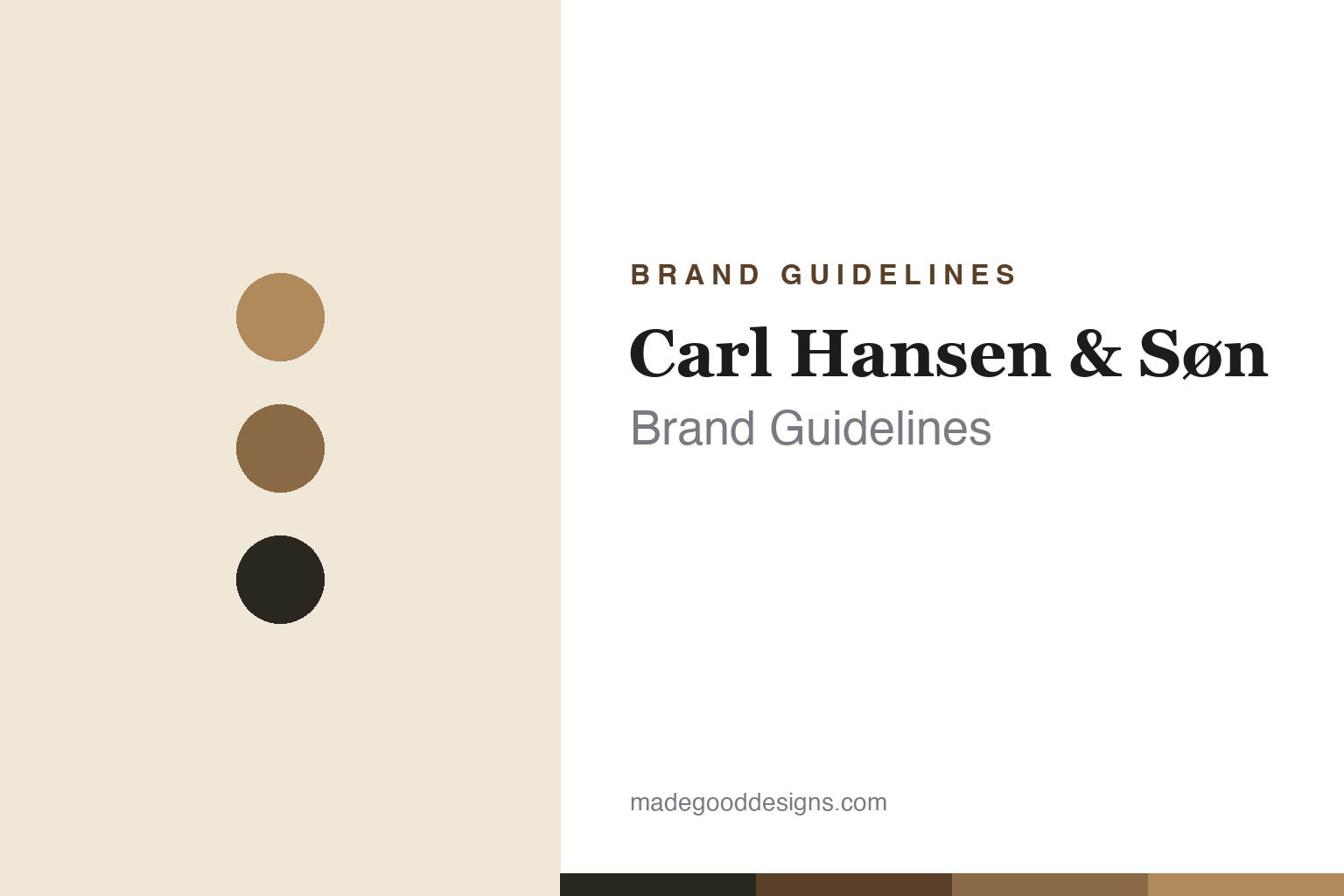
Carl Hansen & Søn Brand Guidelines
Danish craft since 1908 — Hans Wegner’s Wishbone Chair, hand-woven in paper cord, made the same way for 75 years.
Aa
Two constants: a warm oak-and-walnut wood palette and a refined heritage serif. Abstract homage — not the Carl Hansen wordmark.
Danish craft since 1908
Carl Hansen wove a masterpiece.
Carl Hansen & Søn is a lesson in craftsmanship and one great partnership. It was founded in 1908 by master cabinetmaker Carl Hansen in Odense, Denmark (its headquarters is now elsewhere on the island of Funen). It remains independent and family-owned into its fourth generation, led by CEO Knud Erik Hansen — the founder’s grandson. (Two honest notes: no official brand hex is published, and the wordmark typeface is undocumented.)
The brand’s defining chapter is its partnership with designer Hans J. Wegner. In 1949, Wegner designed the CH24 “Wishbone Chair” (also called the “Y-Chair,” for its Y-shaped back splat) as part of his first commission for the firm; it went into production in 1950 and has been made continuously ever since. Each chair takes more than 100 steps, largely by hand, and its seat is hand-woven from around 120 metres of paper cord — roughly an hour of weaving per seat. (Two honest notes on dates: it was designed in 1949 and went into production in 1950; keep those distinct.)
Beyond the Wishbone, Carl Hansen produces other Wegner classics — the CH25 lounge chair and the CH07 Shell Chair (1963, a flop that was triumphantly relaunched in 1998) — and the work of other Danish masters (Kaare Klint, Ole Wanscher, Børge Mogensen, Poul Kjærholm), plus contemporary designers like Tadao Ando. It calls itself “the world’s largest manufacturer of Hans J. Wegner furniture.” (An honest, important caveat: Carl Hansen & Søn is a separate company from Fritz Hansen — a very common mix-up; Carl Hansen makes select Jacobsen architectural pieces but not the Egg, Swan or Series 7, which are Arne Jacobsen for Fritz Hansen.) A lovely detail: its current logo is based on a wordmark Wegner himself drew in 1950, revived in 2014 for his centenary. Danish craft since 1908.
Colour
Carl Hansen lives in warm oak and walnut. Click a swatch to copy the hex.
Carl Hansen & Søn’s identity leans on a warm, natural wood palette — oak, beech, ash and walnut tones, the pale cream of paper cord, and a near-black wordmark. The tones read as crafted, natural and timeless — the colours of fine Danish cabinetmaking rather than fashion — matching a brand built on wood, hand-craft and the honest beauty of materials. It’s a warm, understated palette that signals quality, craft and heritage. The honest caveat: Carl Hansen publishes no official brand hex, so the oak, walnut and warm wood here are an original, unofficial interpretation of its materials, not first-party values.
The lesson is a warm wood palette signals craft and timelessness. Carl Hansen’s oak-and-walnut world reads as crafted and natural. For designers, it’s a reminder that natural material tones can convey quality and heritage. The takeaways: use warm wood tones for craft heritage; let the material’s honesty lead; and treat specific hexes as unofficial when the palette is wood-based.
Typography
The wordmark is a refined heritage serif — crafted and timeless.
Carl Hansen & Søn’s identity carries a crafted, refined, heritage spirit — a wordmark based on Wegner’s own 1950 drawing, whose classic, understated letterforms read as timeless, considered and craft-led. A refined heritage serif captures the mood: it feels like Danish cabinetmaking and mid-century craft, matching a brand built on hand-woven chairs and 115-plus years of woodworking. Set against a warm oak-and-walnut palette, the type feels crafted and timeless — exactly the Danish-craft, Wegner personality Carl Hansen cultivates. It’s refined and classic rather than modern or loud, mirroring the honest, handmade furniture. Because the exact wordmark face isn’t publicly documented, the honest description is “a refined heritage serif spirit,” not a named font. The type behaves like the brand: crafted, refined and timeless.
Aa
A refined heritage serif spirit — crafted and timeless. (Specimen set in Newsreader, a refined serif in the spirit of the Carl Hansen identity; the real face is undocumented, though the brand’s wordmark is based on Wegner’s own 1950 drawing.)
Craft as the difference
Carl Hansen kept making it by hand.
Carl Hansen & Søn is a lesson in uncompromising craft as a differentiator. The Wishbone Chair has been made essentially the same way since 1950 — more than 100 steps, a seat hand-woven from ~120 metres of paper cord — and that refusal to cheapen or fully automate the process is the whole brand. In an age of flat-pack and mass production, Carl Hansen’s differentiator is that it still does the hard, patient, skilled work, producing furniture meant to last generations rather than seasons. That craft, paired with a genuine design partnership (Wegner) and steady family ownership across four generations, gives the brand deep authenticity: a Wishbone Chair is credible as an heirloom because it genuinely is one. The lesson is that in a mass-manufactured category, preserved, honest craft — real hand-work, real materials, real continuity — can be the most durable differentiator of all, and it’s inseparable from the design it serves. Keep making it by hand, and the object earns its place across generations. Craft is the brand.
For designers and brand-builders, Carl Hansen offers a clear takeaway: preserved, honest craft can be the most durable differentiator. The lessons: keep the skilled hand-work real (100+ steps, hand-woven paper cord); build on a genuine design partnership (Wegner); and let continuity and family ownership deepen authenticity. It’s also a reminder to keep the facts precise — Carl Hansen & Søn was founded in 1908 in Odense, is family-owned into its fourth generation, makes Wegner’s Wishbone Chair (designed 1949, in production since 1950), and is a separate company from Fritz Hansen. Carl Hansen kept making it by hand — proof that craft can be the difference.
Explore & save
Keep Carl Hansen & Søn’s identity on hand — save it to a board in the Made Good inspiration library.
Carl Hansen identity set
Pin the wood palette and the heritage-serif spirit to your own board.