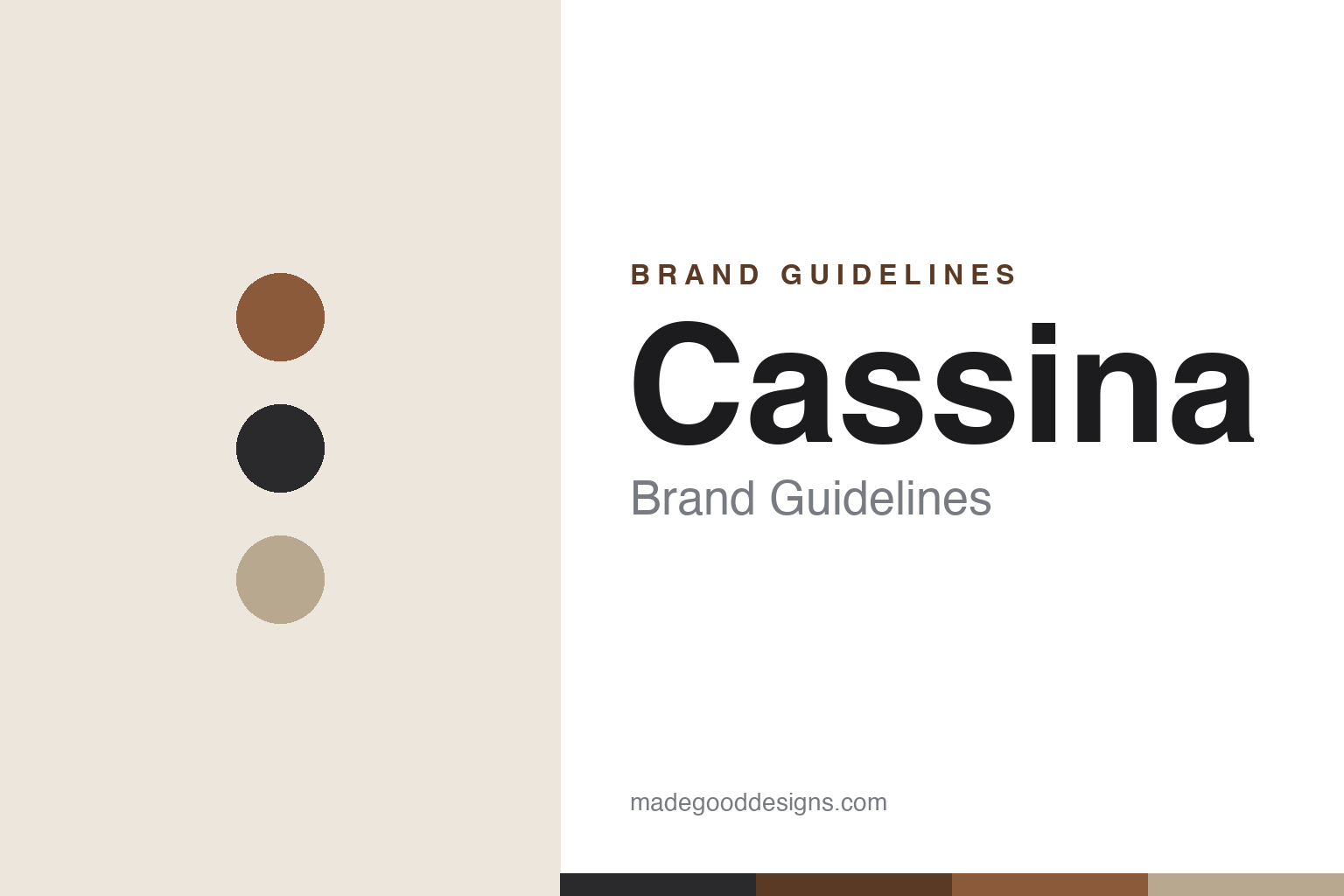
Cassina Brand Guidelines
Italian modernism, licensed and made — the authorized home of Le Corbusier, Ponti and the i Maestri.
Aa
Two constants: a warm cognac-and-charcoal palette and a clean, modern sans. Abstract homage — not the Cassina wordmark.
Modernism, licensed and made
Cassina industrialised the icon.
Cassina is a lesson in industrialising high design. It was founded in 1927 in Meda, in Italy’s Brianza furniture district, by brothers Cesare and Umberto Cassina. It became a pioneering high-design Italian manufacturer, central to turning modern furniture from craft into industry — and it helped stage design history itself, co-sponsoring MoMA’s landmark 1972 exhibition “Italy: The New Domestic Landscape.” (Two honest notes: no official brand hex is published, and the wordmark typeface is undocumented.)
Cassina’s most famous role is as a custodian of modernist icons. In 1964 it founded the “i Maestri” (“the Masters”) collection and became the exclusive worldwide licensee of Le Corbusier’s furniture (designed with Pierre Jeanneret and Charlotte Perriand) — the LC2/LC3 armchairs and the LC4 chaise longue — later adding the reissue rights to Gerrit Rietveld and Charles Rennie Mackintosh. (An honest note: Cassina produces authorized reissues of these historical designs — it didn’t originate them.) It also produced original modern classics, most famously Gio Ponti’s Superleggera (1957, model 699) — a chair so light (about 1.7 kg) it could be “lifted by a child with one finger,” refined from the traditional Ligurian Chiavari chair.
Cassina’s designer roster spans the greats — Vico Magistretti, Mario Bellini, Gaetano Pesce (whose Cassina work includes “I Feltri,” 1987), and, as art director since 2015, Patricia Urquiola. (An honest correction to a common myth: Pesce’s famous “UP” series was made by B&B Italia, not Cassina.) On ownership: Cassina was bought by the Poltrona Frau Group in 2005, and since 2014 it has been owned by the American company Haworth (through that Italian holding, later “Lifestyle Design”), alongside Poltrona Frau and Cappellini. It remains an Italian house — American-owned, not American. Modernism, licensed and made.
Colour
Cassina lives in warm cognac and charcoal. Click a swatch to copy the hex.
Cassina’s identity leans on a warm, modernist palette — cognac and tan leathers, deep charcoal and black, warm neutrals and the rich material tones of fine Italian furniture. The palette reads as refined, architectural and timeless — the colours of leather, wood and modernist upholstery rather than fashion brights — matching a brand that produces both Le Corbusier’s leather-and-chrome icons and Ponti’s elegant chairs. It’s a grown-up, material-led palette that signals craft and design heritage. The honest caveat: Cassina publishes no official brand hex, so the cognac, charcoal and warm neutral here are an original, unofficial interpretation, not first-party values.
The lesson is a warm, material-led palette signals modernist craft. Cassina’s cognac-and-charcoal world reads as refined and architectural. For designers, it’s a reminder that rich material tones can convey design heritage and quality. The takeaways: use warm, material-led tones for modernist craft; let leather and wood lead; and treat specific hexes as unofficial when the palette is material-based.
Typography
The wordmark is a clean modern sans — refined and architectural.
Cassina’s identity carries a refined, modern, architectural spirit — a lowercase “cassina” wordmark whose even, clean letterforms read as modernist, considered and design-led. The clean type matches a brand built on industrialised high design and modernist icons, and it keeps the identity refined so the furniture — Le Corbusier’s chrome-and-leather, Ponti’s elegant chairs — takes the spotlight. Set against a warm cognac-and-charcoal palette, the type feels refined and architectural — exactly the modernist, i Maestri personality Cassina cultivates. It’s clean and modern rather than decorative, mirroring the pared-back modernist designs. Because the exact wordmark face isn’t publicly documented, the honest description is “a clean modern sans spirit,” not a named font. The type behaves like the brand: refined, modern and architectural.
Aa
A clean modern sans spirit — refined and architectural. (Specimen set in Be Vietnam Pro, a clean modern sans in the spirit of the Cassina identity; the real face is undocumented.)
Custodianship as the difference
Cassina keeps the masters in production.
Cassina is a lesson in authorized custodianship of design history. Cassina’s genius was to recognise that modernist masterpieces — Le Corbusier’s furniture, Rietveld, Mackintosh — deserved to be produced authentically, at quality, in perpetuity, and to secure the exclusive licenses to do it. That i Maestri model turned a manufacturer into a custodian of the canon: when you buy an authorized LC4 chaise, you’re buying Cassina’s stewardship of Le Corbusier’s intent. It’s a powerful, durable position — the designs are historically important and the license is exclusive, so competitors can’t authentically copy them, and the brand’s credibility rides on faithful reproduction rather than novelty. Paired with its own original classics (Ponti’s Superleggera) and a living roster of great designers, Cassina bridges heritage and now. The lesson is that becoming the authentic, authorized home of important designs — and honouring them faithfully — can be a differentiator as strong as invention itself. Keep the masters in production, and you keep the canon alive. Be the faithful custodian.
For designers and brand-builders, Cassina offers a clear takeaway: authentic, authorized custodianship of design history can be a durable differentiator. The lessons: secure and honour the rights to important designs (the i Maestri Le Corbusier license); reproduce them faithfully at quality; and balance heritage with living design (Ponti, Urquiola). It’s also a reminder to keep the facts precise — Cassina was founded in 1927 in Meda, licenses Le Corbusier through i Maestri (est. 1964), produces Ponti’s Superleggera, and has been Haworth-owned since 2014. Cassina keeps the masters in production — proof that custodianship can be the difference.
Explore & save
Keep Cassina’s identity on hand — save it to a board in the Made Good inspiration library.
Cassina identity set
Pin the modernist palette and the modern-sans spirit to your own board.
Source & notes
Frequently Asked Questions
What font can I use to match the Cassina look?
This guide describes Cassina’s type as “A clean modern sans spirit — refined and architectural”. Its type specimen is set in Be Vietnam Pro from Google Fonts as a stand-in; Be Vietnam Pro is not Cassina’s own lettering.
What colours are in the Cassina palette?
This guide’s Cassina palette is Cognac #8A5A3A, Charcoal #2A2A2C, Warm Neutral #B8A890, Espresso #4A3424 and Cream #EDE6DC. The tones are the guide’s own unofficial interpretation, not official Cassina hex codes.
When was Cassina founded?
Cassina was founded in 1927, in Meda. Its best-known design, per this guide: i Maestri.
Who owns Cassina?
Cassina is owned by Haworth. Its best-known design, per this guide: i Maestri.