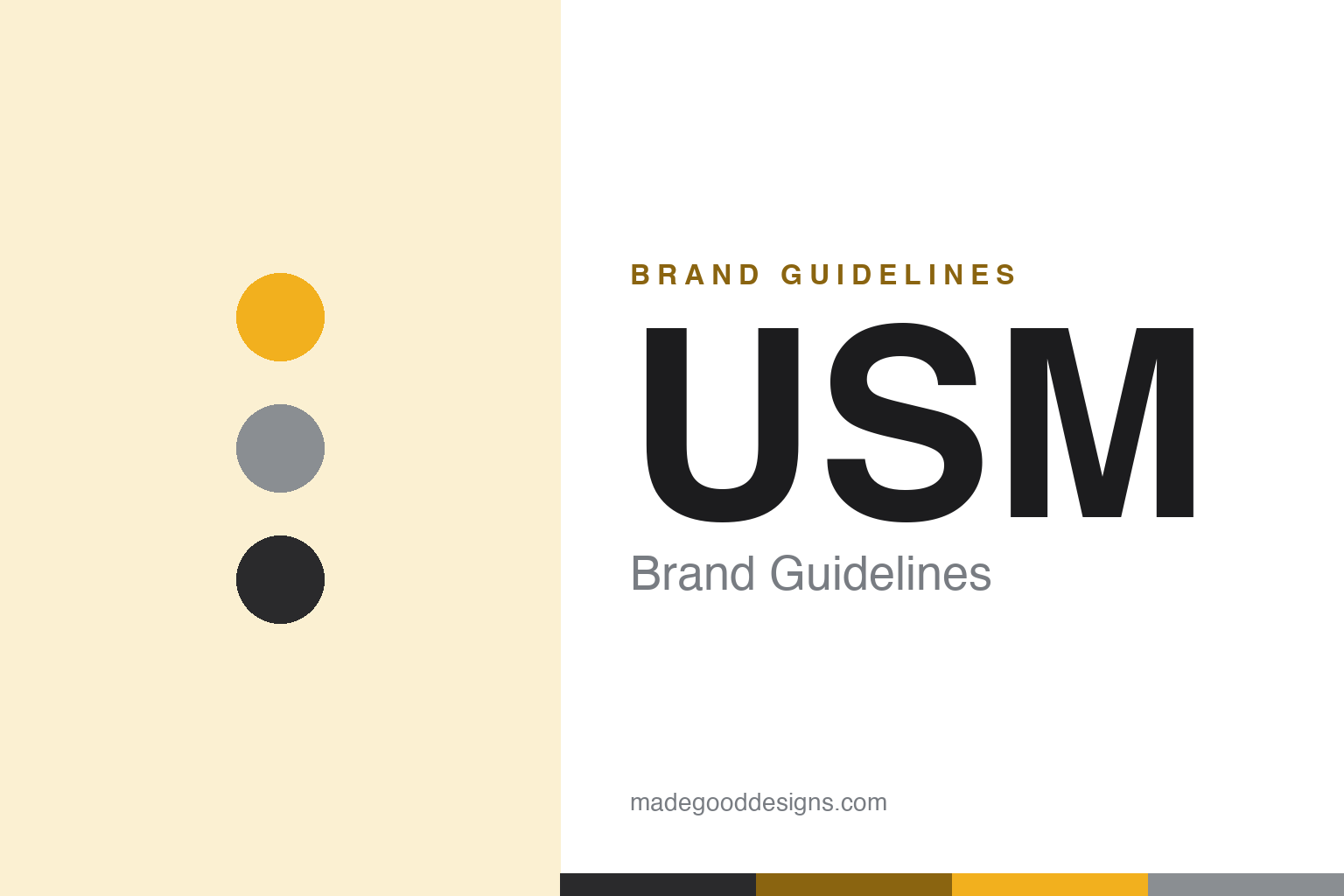
USM Brand Guidelines
Ball, tube, panel — a Swiss modular system, endlessly reconfigurable, with an iconic Golden Yellow.
Aa
Two constants: an iconic golden-yellow-and-chrome palette and a geometric, modular sans. Abstract homage — not the USM wordmark.
Ball, tube, panel
USM systematised furniture.
USM is a lesson in modular design as a system. The company was founded in 1885 in Münsingen, Switzerland by Ulrich Schärer as a locksmith and metalworking shop; today it’s USM U. Schärer Söhne AG. (An honest note on the acronym: the brand mark USM stands for Ulrich Schärer Münsingen — the founder’s initials plus the town — while the legal company name is “U. Schärer Söhne”; don’t say the letters stand for “Söhne.” Two more notes: no official brand hex is published, and the wordmark typeface is undocumented.)
USM’s icon is the USM Haller modular furniture system, developed by the Swiss architect Fritz Haller with Paul Schärer (the founder’s grandson). The dates matter: it was developed in 1963, the signature ball connector was patented in 1965, and mass production began in 1969. The system is built from three elements — a chrome-plated steel ball connector, chromed steel tubes, and powder-coated steel (or glass) panels — and the shiny ball, which lets tubes extend in up to six directions, is the visual and structural signature. A wonderful origin detail: it was created to furnish the Schärer company’s own new headquarters (Paul Schärer had commissioned Haller to design the building), and only later became a product.
USM Haller is genuinely museum-grade — held in the permanent collections of MoMA (New York), Cooper Hewitt and Munich’s Die Neue Sammlung — and infinitely reconfigurable, which is why the same system serves as shelving, sideboards and storage across decades. Its colour is part of its identity: panels come in a defined palette of 14 colours, and the iconic hero is USM Golden Yellow (alongside Pure White, Anthracite, Steel Blue, Ruby Red and more). (An honest note: USM markets these by proprietary name, not published hex/RAL codes.) It remains an independent, family-owned Swiss company, into its fourth generation (Alexander Schärer, CEO since 2000). Ball, tube, panel.
Colour
USM lives in Golden Yellow and chrome. Click a swatch to copy the hex.
USM’s identity is unusually defined for a furniture brand: its panels come in a fixed palette of 14 colours, anchored by the iconic USM Golden Yellow, with chrome/steel, pure white, anthracite and a set of clear, confident hues. The palette reads as precise, systematic and Bauhaus-descended — the colours of a modular system rather than fashion — and the golden yellow against gleaming chrome is instantly recognisable as USM. It’s a disciplined, engineered palette that matches a brand built on a rigorous modular system. The honest caveat: USM markets its colours by proprietary name, not published hex, so the golden yellow, steel and chrome here are an original, unofficial interpretation, not first-party values.
The lesson is a defined palette can be part of a system’s identity. USM’s Golden-Yellow-and-chrome world reads as precise and systematic. For designers, it’s a reminder that a disciplined, named colour set (with one iconic hero) can be a brand asset in its own right. The takeaways: define a clear, limited palette with an iconic hero (Golden Yellow); tie colour to the system’s logic; and treat specific hexes as unofficial when the brand uses proprietary names.
Typography
The wordmark is a geometric modular sans — precise and systematic.
USM’s identity carries a precise, systematic, engineered spirit — the “USM” lettermark whose clean, geometric letterforms read as modular, rigorous and Swiss. A geometric modular sans captures the mood: it feels like a system, a grid, a set of interlocking parts, matching a brand built on the ball-tube-panel logic of the Haller system. Set against a Golden-Yellow-and-chrome palette, the type feels precise and systematic — exactly the modular, engineered personality USM cultivates. It’s geometric and disciplined rather than decorative, mirroring the modular furniture. Because the exact wordmark face isn’t publicly documented, the honest description is “a geometric modular sans spirit,” not a named font. The type behaves like the brand: precise, systematic and engineered.
Aa
A geometric modular sans spirit — precise and systematic. (Specimen set in Sarpanch, a geometric sans in the spirit of the USM identity; the real face is undocumented.)
The system as the difference
USM built one idea to last.
USM is a lesson in a single, perfect system as an enduring brand. USM didn’t build a catalogue of trend-driven products; it perfected one modular system — the ball, the tube, the panel — and let its infinite reconfigurability carry the brand for over half a century. That’s the whole idea: because the system is genuinely modular, a single USM Haller unit can be shelving today and a sideboard tomorrow, extended, reconfigured and added to for decades, so it never really goes out of date. The chrome ball connector — patented, structural, and beautiful — is both the engineering key and the instantly recognisable icon, and the defined colour palette (led by Golden Yellow) makes it unmistakable. Backed by museum-grade credibility (MoMA) and steady family ownership, the system reads as timeless rather than fashionable. The lesson is that perfecting one genuinely modular, adaptable system — rather than chasing new products — can build a brand that lasts generations, because the product literally adapts instead of expiring. Build one great system, and let it endure. Modularity is the message.
For designers and brand-builders, USM offers a clear takeaway: a single, genuinely modular system can outlast trends. The lessons: perfect one adaptable system rather than a churning catalogue (ball, tube, panel); make its key element iconic (the chrome ball); and give it a defined, recognisable palette (Golden Yellow). It’s also a reminder to keep the facts precise — USM was founded in 1885 in Münsingen, the mark stands for Ulrich Schärer Münsingen, the Haller system was developed in 1963 (patented 1965, produced 1969), and it remains an independent Swiss family company. USM built one idea to last — proof that a system can be the difference.
Explore & save
Keep USM’s identity on hand — save it to a board in the Made Good inspiration library.
USM identity set
Pin the Golden-Yellow palette and the modular-sans spirit to your own board.