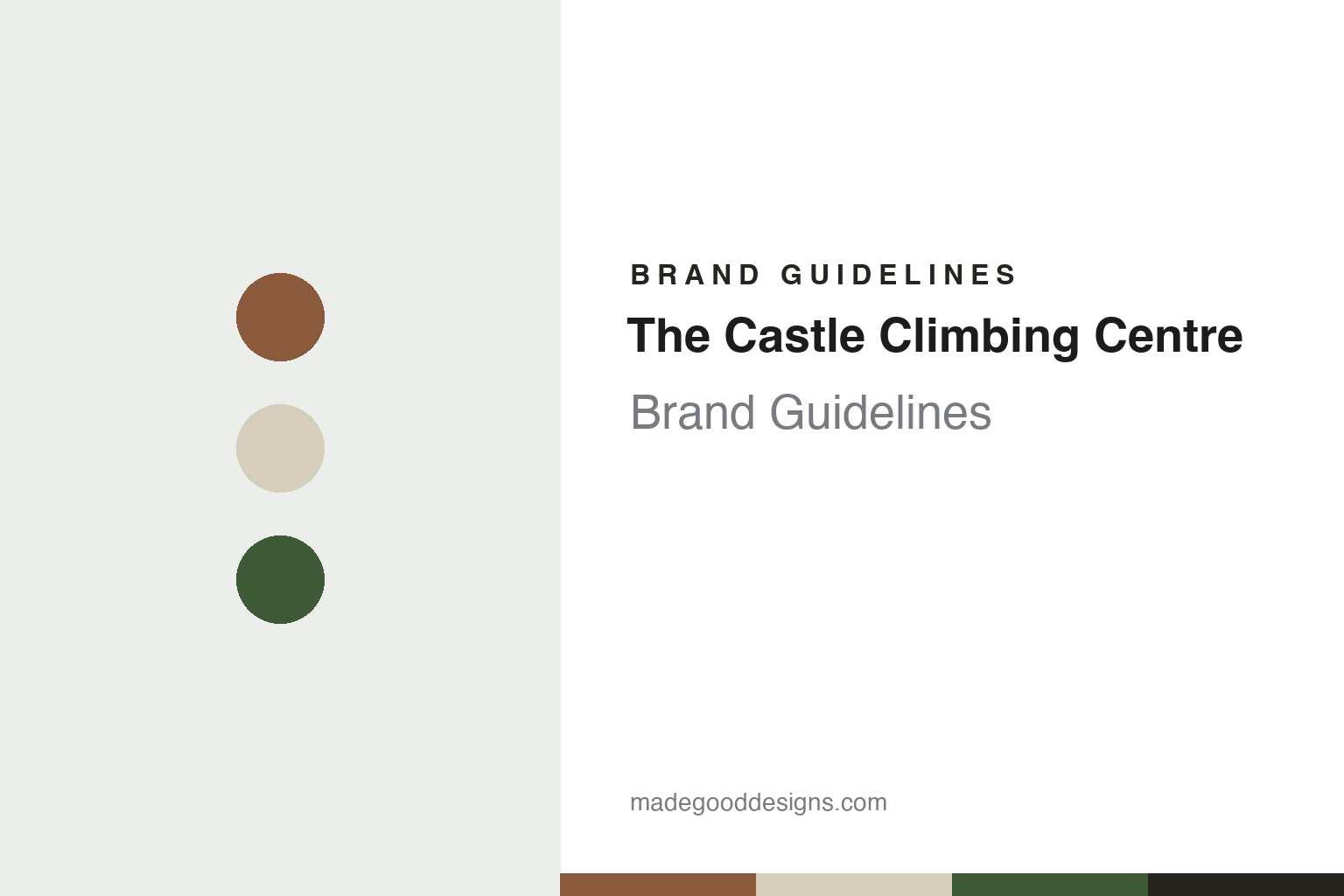
The Castle Climbing Centre Brand Guidelines
A climbing centre inside a Victorian pumping station built to look like a castle.
Aa
Two constants: a brick, stone and garden green palette and a Victorian serif register. Abstract homage — not a Castle Climbing Centre asset; no building photograph, logo or sign is reproduced.
The pumping station
A Victorian waterworks in Stoke Newington.
The Castle Climbing Centre sits inside a Victorian water pumping station in Stoke Newington, in the London Borough of Hackney. English Wikipedia calls the building Stoke Newington Pumping Station, also known as the New River Pumping Station, and says it is more commonly known locally as “The Castle.” The climbing centre opened on 20 October 1995, according to English Wikipedia.
The building came out of the Metropolis Water Act 1852, which required London’s water companies to filter their water and stopped them taking drinking water from the Thames below Teddington Lock, the centre’s own history page says. The New River Company already had two reservoirs in Stoke Newington, built in the 1830s, and added filter beds and a pumping station beside them. The centre and the London history blog The London Phile, writing in February 2013, date the construction to 1852–1856; English Wikipedia gives 1854–56. The engineer was William Chadwell Mylne, surveyor to the New River Company, and English Wikipedia and The London Phile name the architect as Robert William Billings.
The machinery changed over time. In 1936 the steam engines and boilers were replaced with diesel engines and electric pumps, the centre says, and The London Phile reported that the station had stopped operating by 1942. In 1971 the Metropolitan Water Board, which had taken over the New River Company, applied to demolish the building and redevelop the site; local residents and historical associations objected, the centre says. English Wikipedia and the centre describe the building as Grade II* listed; Wikipedia dates the listing to May 1972, while The London Phile gave Grade II and 1974. The site was under threat again in the late 1980s, according to the centre; The London Phile linked that to the coming privatisation of the water industry.
Colour
Battlements, towers and a garden.
The building’s look is the brand’s strongest asset. English Wikipedia describes it as Scottish Baronial, set on a man-made mound to suggest a motte-and-bailey castle, in stock brick laid in English bond with stone quoins, battlements and stepped buttresses. The design may have drawn on Stirling Castle, according to both English Wikipedia and The London Phile, which noted that Mylne was Scottish and Billings a specialist in historic Scottish buildings; both also mention Holloway Prison as a possible model.
The towers were not only decoration. The London Phile wrote that each had a job — one held a chimney shaft, another a water tank, and the turret with the conical roof a spiral staircase to the roof — and that the front buttresses held part of the engines’ flywheels. English Wikipedia says the buttresses on the southwest front are hollow for that reason, and that the engine room takes the form of a keep. Mylne’s name and the year 1855 appear in metal lettering on the buttresses, picked out in gold paint, Wikipedia says.
Inside, the climbing areas carry their own names. The centre’s website lists areas including the Engine House, the Quarry, the Tower and the Loft, alongside its outdoor boulders. English Wikipedia counts about 450 boulder problems on 14 indoor and three outdoor boulders, and more than 100 roped lines carrying about 350 routes in 13 areas. The London Phile described brightly coloured walls behind the castle front.
The garden is the other half of the identity. The centre says it began with four no-dig vegetable beds in early 2009 and now covers about 1.5 acres (English Wikipedia gives 1.4), with three outdoor boulders carrying more than 130 problems, open from spring to autumn. Old climbing ropes are woven into chairs and windbreaks, pallets become planters and benches, and climbing holds become stools, the centre says; volunteers grow vegetables, fruit and herbs for its café.
Typography
Climbing gyms and their buildings.
Climbing-gym and bouldering-gym chains present themselves less through a single product than through places. Each gym has a name, and chains handle those names in different ways: some put every site under one company name, while others let each gym keep a name of its own, often taken from its neighbourhood or from the building it occupies. In Climbing Business Journal’s accounts, the American company Movement moved its Earth Treks and Planet Granite gyms under one name in 2021, while Touchstone Climbing in California runs gyms called Mission Cliffs, Pacific Pipe and The Post.
Inside the gyms, the visual language is set largely by the walls. Holds and volumes come in many colours, and routes are usually marked by colour and labelled with grades on small signs or tags at the foot of the wall. Wall builders and hold makers supply much of what climbers see, and a few chains make some of their own holds; Touchstone says it shapes and pours holds at its Sacramento gym.
Buildings carry much of the character. Chains have taken over converted warehouses, factories, former big-box stores, cinemas and a post office, and their own history pages often describe what each building was before. Membership cards, day passes, gear shops and merchandise carry the gym or chain name, and many sites also offer yoga and fitness classes alongside climbing.
Ownership has changed quickly in this sector. Gym groups have merged, been backed by private equity and bought smaller regional chains, and a gym’s name on the door can outlast several owners. The guides in this series set out what can be checked about each chain — who founded it, who owns it, when its gyms opened — and mark clearly what rests only on the company’s own word.
Aa
A Victorian serif for a building with battlements. (Specimen set in Playfair Display, a serif STAND-IN; NOT The Castle Climbing Centre logo.)
The Castle Climbing Centre
From waterworks to climbing walls.
The climbing centre itself began in the early 1990s. English Wikipedia says the company that runs it was incorporated in July 1993 as Turnchain Projects Limited and renamed High Performance Sports Limited that December. Thames Water, which had inherited the station, had no use for it and passed it to Steve Taylor and two other founders, who set out to build what Wikipedia calls the fourth climbing centre in London at the time.
Planning permission came in May 1994, with approval from English Heritage on condition that the outside of the building kept its appearance and that any internal elements removed were conserved, according to Wikipedia; The London Phile reported the same condition, that removed items be stored for future use. Wikipedia credits the design scheme to the architects Nicholas Grimshaw and Partners. The centre first opened only in the engine room, expanded into the boiler house in 2000, and added three outdoor boulders in 2013, which were refurbished in 2019, Wikipedia says. It is a member of the Association of British Climbing Walls, according to the same article.
The centre leans on the local nickname. Across its website it calls itself simply “The Castle,” with pages headed “About The Castle” and “Map of The Castle,” so the building’s popular name and the business name have become one. The brick front and towers do the rest of the identity work, with no separate mascot or emblem needed to tell visitors where they are.
For a design guide, The Castle Climbing Centre shows how a listed industrial building can carry a whole identity: the battlements, the brick and the gilded 1855 lettering are what visitors remember. Compare Depot Climbing, a chain named after the bus depot where it began, and Boulderwelt. For this guide we use brick red, stone, garden green and iron black with a serif, an unofficial interpretation; no product or logo is reproduced.
Explore & save
Keep The Castle Climbing Centre’s identity on hand — save it to a board in the Made Good inspiration library.
The Castle Climbing Centre identity set
Pin the brick, stone and garden green palette and the Victorian serif register to your own board.
Source & notes
Frequently Asked Questions
What font can I use to match the The Castle Climbing Centre look?
This guide describes The Castle Climbing Centre’s type as “A Victorian serif for a building with battlements”. Its type specimen is set in Playfair Display from Google Fonts as a stand-in; Playfair Display is not The Castle Climbing Centre’s own lettering.
What colours are in the The Castle Climbing Centre palette?
This guide’s The Castle Climbing Centre palette is Stock brick #8B5A3D, Quoin stone #D6CDBB, Garden green #3E5A37, Engine iron #26241F and Paper #F6F3EC. The tones are the guide’s own unofficial interpretation, not official The Castle Climbing Centre hex codes.
When did The Castle Climbing Centre open?
The Castle Climbing Centre opened on 20 October 1995, in Stoke Newington, London.