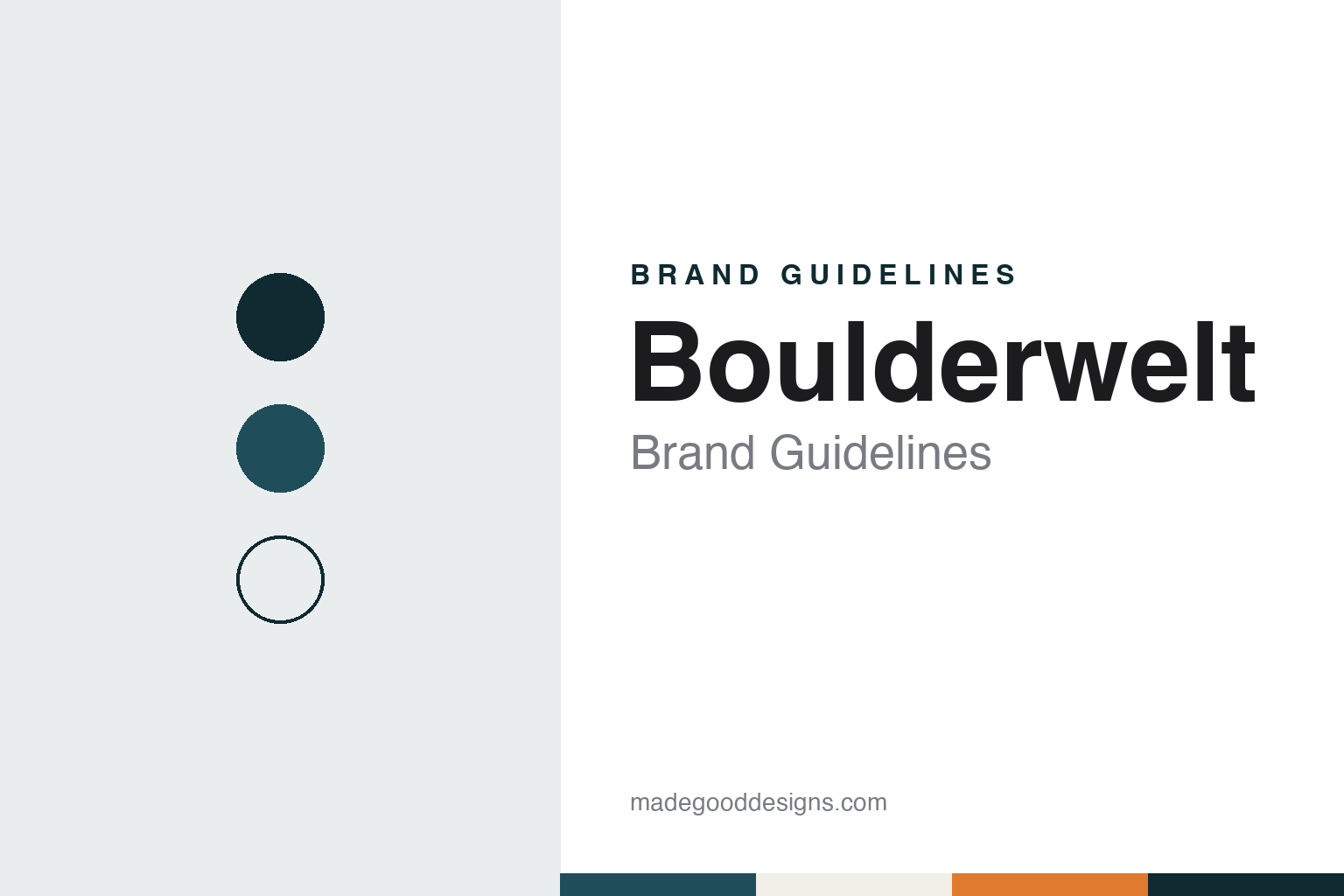
Boulderwelt Brand Guidelines
The Munich bouldering chain that grew to eight halls.
Aa
Two constants: a petrol, chalk and orange palette and a condensed sans register. Abstract homage — not a Boulderwelt asset or mark; no logo, wall or hall is reproduced.
Munich, 2010
Three friends, an idea in 2009 and a hall by the Ostbahnhof.
Boulderwelt began in Munich in 2010. Climbing Business Journal, in an April 2025 report on the chain, says the friends Dave Cato, Markus Grünebach and Thomas Peter came up with the idea in 2009, at a time when bouldering in Germany was mostly done in training caves inside lead-climbing gyms, many of them run by the German Alpine Club, the Deutscher Alpenverein. The operating company, Boulderwelt GmbH, dates its founding to 2010, and its websites carry the line “Bouldering since 2010.”
The original hall opened in July 2010 near Munich’s East station, the Ostbahnhof. A news post on the hall’s own website, dated 13 July 2010, describes an opening weekend that began on 10 July with a contest called the “Day of the Boulder,” with about 150 entrants and 100 boulders, followed by an open day with live music and an outdoor slackline park. Climbing Business Journal gives the size of that original building as roughly 21,500 square feet.
That hall is now called Boulderwelt München Ost. In 2019 it moved into a new building in the Plaza quarter of the iCampus development, in the Werksviertel district, German Wikipedia’s article on the Werksviertel says. The company’s website describes the new hall as having a rooftop and a view over the city.
The operating company is now registered in Brunnthal, south-east of Munich, next to its München Süd hall. Its legal notice names Markus Grünebach, Sebastian Oppelt and Thomas Peter as managing directors, and Climbing Business Journal lists Grünebach, Oppelt, Peter and Cato as the owners. The company describes itself as owner-managed rather than investor-owned.
Colour
Eight halls in fourteen years.
Growth came in stages. In 2012 the team opened two more halls, in Frankfurt am Main and Regensburg, and Sebastian Oppelt joined the ownership group that year, Climbing Business Journal reported; it describes him as chief executive today. The Regensburg website calls that hall the chain’s third at the time it opened. München West followed in 2014, in a listed brick building in Neuaubing, spread over two levels, according to the company.
The next phase began in 2019. The climbing news site Lacrux reported in April 2019 that Boulderwelt Dortmund was opening on the weekend of 13 and 14 April in the city’s Indupark, with 3,250 square metres of floor space and a children’s area of more than 300 square metres, which brought the chain to five halls. In a report published a week before the event, Lacrux gave 31 October 2020 as the opening date of the sixth hall, München Süd, a new building of 2,500 square metres in the Brunnthal Nord business park; the same report named Grünebach and Cato as the owners who opened the original Munich hall in 2010.
Karlsruhe followed in 2022, in the city centre at the Europaplatz, and Hamburg in December 2024. Climbing Business Journal reported that the Hamburg hall, the eighth, occupies the ground floor of a 26-storey tower that had stood empty for more than 15 years, and that the team finished building and setting it on 21 December 2024. The report gives 17,250 square feet of bouldering surface, a training area with Moon and Kilter boards and a spray wall, and credits the walls to Citywall. It adds that the company had nearly opened in Hamburg in 2018 but turned down the building on offer at the time.
The group website now lists eight halls: three in and around Munich, plus Frankfurt, Regensburg, Dortmund, Karlsruhe and Hamburg, the last of them at the Berliner Tor.
Typography
Gyms, walls and identities.
Climbing-gym and bouldering-gym chains present themselves less through a single product than through places. Each gym has a name, and chains handle those names in different ways: some put every site under one company name, while others let each gym keep a name of its own, often taken from its neighbourhood or from the building it occupies. In Climbing Business Journal’s accounts, the American company Movement moved its Earth Treks and Planet Granite gyms under one name in 2021, while Touchstone Climbing in California runs gyms called Mission Cliffs, Pacific Pipe and The Post.
Inside the gyms, the visual language is set largely by the walls. Holds and volumes come in many colours, and routes are usually marked by colour and labelled with grades on small signs or tags at the foot of the wall. Wall builders and hold makers supply much of what climbers see, and a few chains make some of their own holds; Touchstone says it shapes and pours holds at its Sacramento gym.
Buildings carry much of the character. Chains have taken over converted warehouses, factories, former big-box stores, cinemas and a post office, and their own history pages often describe what each building was before. Membership cards, day passes, gear shops and merchandise carry the gym or chain name, and many sites also offer yoga and fitness classes alongside climbing.
Ownership has changed quickly in this sector. Gym groups have merged, been backed by private equity and bought smaller regional chains, and a gym’s name on the door can outlast several owners. The guides in this series set out what can be checked about each chain — who founded it, who owns it, when its gyms opened — and mark clearly what rests only on the company’s own word.
Aa
A condensed sans for hall names and grade signs. (Specimen set in Barlow Condensed, a sans STAND-IN; NOT the Boulderwelt logo.)
Boulderwelt
One name, a city after it, one site per hall.
The identity is built on a single name repeated at every site. Each hall carries the Boulderwelt name followed by its city or district, and each has its own website on a domain of the same pattern, while the group site at boulderwelt.de gathers them on one page with a map of Germany. A customer account, Boulderwelt Plus, sits across the halls for online tickets. The favicon is a round badge, and a mascot called Yaffi was part of the München Süd opening programme, Lacrux reported in 2020.
The brand was reworked once the chain had four halls. Climbing Business Journal quoted the company’s head of marketing as saying the years before 2019 were used to grow the team and rethink its processes, brand values and corporate design, and that Dortmund opened in 2019 with that new concept. The same report says Boulderwelt grades its boulders on a nine-level scale similar to the Fontainebleau scale and resets sectors three days a week. Every hall uses that same scale.
The hall websites follow one template. Each opens with the same short history, starting with the 2010 opening in Munich, and then sets out the café, the children’s and family area, courses for newcomers and news from the hall. What changes from site to site is the building: a listed brick hall in Munich West, a new build in Brunnthal, an industrial-style café in Dortmund, a city-centre hall in Karlsruhe with a view over the town, and a tower ground floor in Hamburg.
For a design guide, Boulderwelt shows how a chain can turn one place name into a network: a city suffix, one web template and a founding year repeated on every page. Compare Kilter, whose boards are installed in the Hamburg hall, and Moon Climbing, whose boards stand beside them. For this guide we use a deep petrol blue, chalk white and a warm orange with a condensed sans, an unofficial interpretation; no product or logo is reproduced.
Explore & save
Keep Boulderwelt’s identity on hand — save it to a board in the Made Good inspiration library.
Boulderwelt identity set
Pin the Boulderwelt petrol, chalk and orange palette and the condensed sans register to your own board.
Source & notes
Frequently Asked Questions
What font can I use to match the Boulderwelt look?
This guide describes Boulderwelt’s type as “A condensed sans for hall names and grade signs”. Its type specimen is set in Barlow Condensed from Google Fonts as a stand-in; Barlow Condensed is not Boulderwelt’s own lettering.
What colours are in the Boulderwelt palette?
This guide’s Boulderwelt palette is Petrol #1F4E5A, Deep petrol #0F2A31, Chalk #F2EFE8, Hold orange #E07A2E and Mat grey #D9D6CF. The tones are the guide’s own unofficial interpretation, not official Boulderwelt hex codes.
When was Boulderwelt founded?
Boulderwelt was founded in 2010, in Munich, Germany.
Who founded Boulderwelt?
Boulderwelt was founded by Dave Cato, Markus Grünebach and Thomas Peter in 2010.