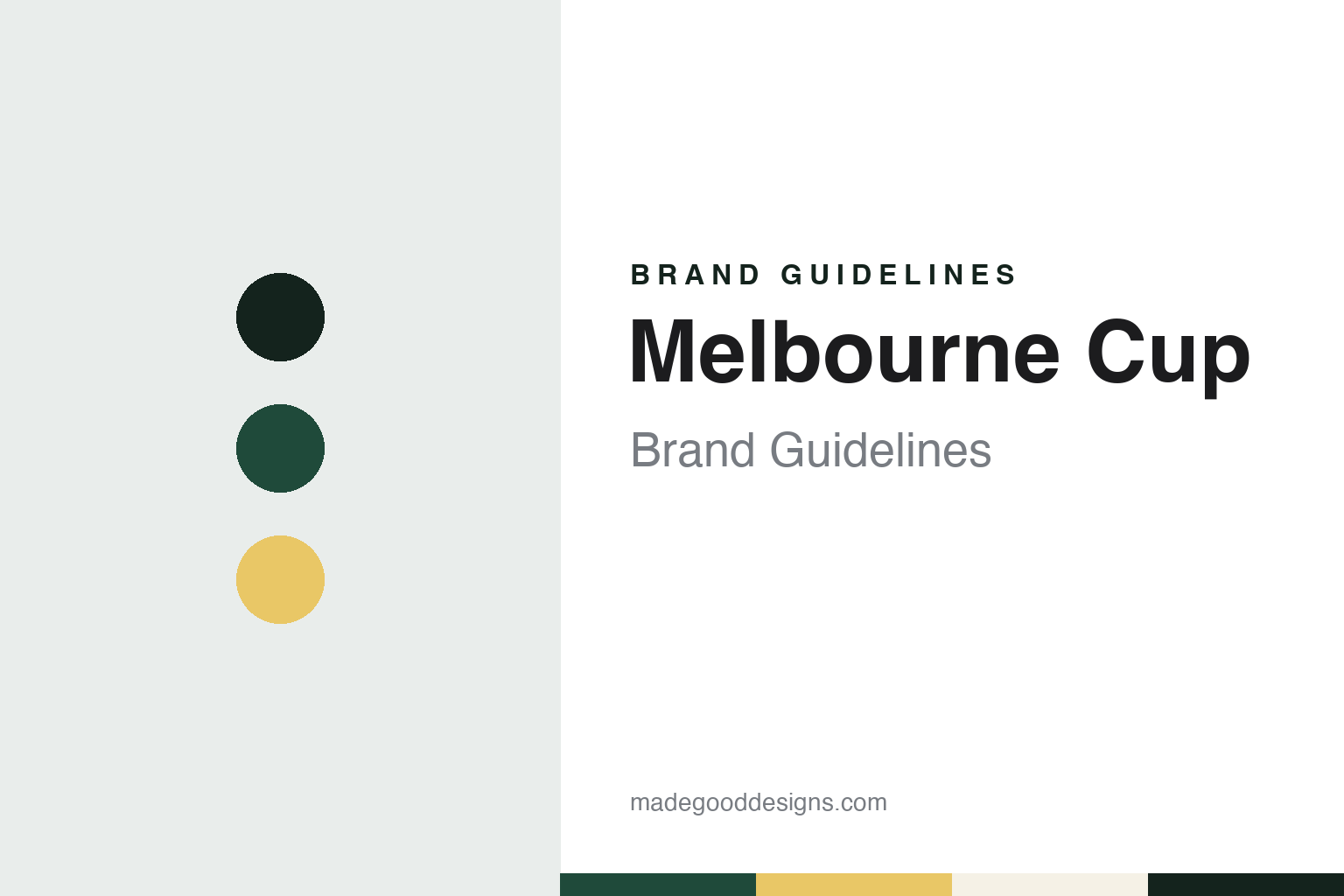
Melbourne Cup Brand Guidelines
Flemington’s 3,200-metre handicap, run every year since 1861.
Aa
Two constants: a green, yellow-rose and gold palette and a racecard serif register. Abstract homage — not a Melbourne Cup or Victoria Racing Club mark; no trophy, logo or poster is reproduced.
Flemington, 1861
A race on the river flats beside the Maribyrnong.
The Melbourne Cup is a Group 1 handicap for thoroughbreds aged three and older, run at Flemington Racecourse in Melbourne. English Wikipedia gives its distance as 3,200 metres and says it starts at 3pm on the first Tuesday of November, as the centrepiece of the Melbourne Spring Racing Carnival. The Victoria Racing Club, which conducts it, dates the first Cup to Thursday 7 November 1861; Wikipedia says seventeen horses started that day and that the race has been run every year since. ABC News called the edition of 3 November 2026 the 166th running.
The ground is older than the race. The VRC says the first meeting at Flemington was held on 3 March 1840, on rough flats beside the Maribyrnong River, when Melbourne was barely five years old. Wikipedia says the course was leased to the Victoria Turf Club in 1848, and that the first Cup was a legacy that club passed on when it merged with the Victoria Jockey Club to form the Victoria Racing Club in 1864. The Victoria Racing Club Act of 1871 gave the new club control of Flemington, and the VRC says it also took authority over race meetings across the state, registering horses and owners’ colours and licensing jockeys and trainers. Wikipedia says that statewide role passed to Racing Victoria in 2001; the club still runs Flemington and the Cup.
The calendar settled early. Wikipedia’s timeline says the race was first run on a Tuesday in 1875, and the VRC says that year it was timed to coincide with the Prince of Wales’s birthday holiday. Cup Day has been a public holiday in metropolitan Melbourne since the 1870s, according to Wikipedia. During the Second World War, Wikipedia says, the Cup was run on Saturdays from 1942 to 1944. The original distance was two miles; when Australia adopted the metric system in 1972 it became 3,200 metres, about 18.7 metres shorter.
Fields have changed too. Wikipedia records a field of 39 in 1890 and notes that the final field is now limited to 24 starters. The course itself is pear-shaped, with a six-furlong straight known as the Straight Six, and Flemington was added to the Australian National Heritage List on 7 November 2006, an event both Wikipedia and the VRC date to that year’s Cup.
Colour
A gold cup, yellow roses and a dress code.
Much of the Cup’s visual identity sits off the track. The most recognisable object is the trophy. Wikipedia’s history of the prize runs from a gold watch in 1861, through English-made silver cups in the 1860s, to the first Australian-made trophy in 1876. The first gold trophy came in 1916, and the three-handled loving cup design was first awarded in 1919, after the VRC commissioned the Melbourne silversmith James Steeth to design a trophy in keeping with the race. A new cup is struck each year and becomes the property of the winning owner. Wikipedia says it is hand spun from about 1.65 kilograms of 18-carat gold and that W. J. Sanders, part of the Pallion group, has made it since 2016.
Flowers are the second constant. Wikipedia says Flemington holds around 12,000 roses and that each of the carnival’s main days has an official flower: the yellow rose belongs to Cup Day, while Derby Day, Oaks Day and Stakes Day have the cornflower, the pink rose and the red rose. ABC News described a spectator at the 2026 Cup in a dress painted with the trophy and yellow roses.
The third is fashion. Wikipedia dates Fashions on the Field to the 1962 carnival, and the VRC still lists the competition among its carnival pages. Hats, fascinators and formal race-day dress are part of how the event is photographed and broadcast. Wikipedia says the VRC hosts four race meetings at Flemington during the carnival, with the Victoria Derby on the Saturday before the Cup, the Oaks on the Thursday after and Stakes Day on the following Saturday.
Broadcast has shaped the identity as well. Wikipedia says the Cup was first filmed in 1896, first broadcast on radio in 1925, shown live to Sydney in 1960 and live in Victoria only from 1978. In February 2024 the Nine Network agreed a five-year broadcast deal with the VRC. Since 2003 the club has also sent the trophy on an annual tour of communities in Australia and New Zealand, which its 2026 pages call the Lexus Melbourne Cup Tour.
Typography
Design and documentation.
Horse races, race meetings and racecourses present themselves through a small set of lasting things: a race name, a place and a date in the calendar. Many of the oldest names come from people or places. English Wikipedia says the Derby at Epsom took its name from the 12th Earl of Derby in 1780, and that the name was later borrowed by races in Ireland, France, Germany, Italy, the United States and Japan. Other names record a sponsor, a patron or a change of venue, and renamings and moves are part of each event’s history.
The racecourse is the main stage. Grandstands are often named, rebuilt and renamed over the decades: at Cheltenham the Princess Royal Stand opened in 2015, and at Epsom the main stand was renamed the Queen Elizabeth II Stand in 2022, according to English Wikipedia. The ground matters too, from Cheltenham’s amphitheatre under the Cotswold escarpment to the open downs at Epsom, where part of the crowd has always watched for free.
Objects carry the rest of the identity, and a trophy can become an emblem of a race: The Jockey Club says the original 1924 Cheltenham Gold Cup returned to the course in 2018 and is now presented as a perpetual trophy. Racecards, posters and paintings add a printed and painted record, as William Powell Frith’s The Derby Day of 1858 shows.
Behind each event stands an organiser or owner. In Britain, The Jockey Club owns and operates both Cheltenham and Epsom Downs. This guide describes each race or racecourse through dated facts: when it was first run, who organises it, where it has been held and how its name and buildings have changed.
Aa
A racecard serif for a nineteenth-century race. (Specimen set in Playfair Display, a serif STAND-IN; NOT the Melbourne Cup logo.)
Melbourne Cup
A club race that became a public holiday.
The race carries a title sponsor’s name: the VRC’s 2026 pages call the race day the Lexus Melbourne Cup Day. Inside the course, the club has rebuilt in stages: Wikipedia records a new grandstand opened in 2000, and the VRC says its Club Stand, a five-level members’ building with a rooftop garden, opened in 2018. The Hill Stand of 1977 houses a seven-panel mural by Harold Freedman tracing the history of racing, according to Wikipedia.
The race also draws an international field. Wikipedia notes that Vintage Crop, trained in Ireland, won in 1993, and that horses from Japan and France have since won. On 3 November 2026, ABC News reported, Point of Law, trained by Ciaron Maher, won the 166th Cup, and the VRC said 97,000 racegoers attended, the biggest crowd in a decade. The VRC’s chief executive, Kylie Rogers, told the broadcaster that 60 per cent of general admission ticket holders across the carnival were under 35. Wikipedia says the race is commonly billed as “the race that stops a nation,” and a 1986 poem by Vivienne McCredie took that phrase as its title.
For a design guide, the Melbourne Cup shows how a single race can carry a whole visual system through objects rather than a mark: a gold three-handled cup, a named rose and a fixed afternoon in November. Compare Lexus, the car maker whose name the VRC places on Cup Day, and Kentucky Derby, another race in this series of guides. For this guide we use a deep Flemington green, a soft yellow and an old gold with a serif, an unofficial interpretation; no product or logo is reproduced.
Explore & save
Keep Melbourne Cup’s identity on hand — save it to a board in the Made Good inspiration library.
Melbourne Cup identity set
Pin the Melbourne Cup green, yellow-rose and gold palette and the racecard serif register to your own board.
Source & notes
Frequently Asked Questions
What font can I use to match the Melbourne Cup look?
This guide describes Melbourne Cup’s type as “A racecard serif for a nineteenth-century race”. Its type specimen is set in Playfair Display from Google Fonts as a stand-in; Playfair Display is not Melbourne Cup’s own lettering.
What colours are in the Melbourne Cup palette?
This guide’s Melbourne Cup palette is Flemington green #1F4A3A, Course ink #14231D, Yellow rose #E9C766, Trophy gold #B8892E and Members’ cream #F5F1E6. The tones are the guide’s own unofficial interpretation, not official Melbourne Cup hex codes.