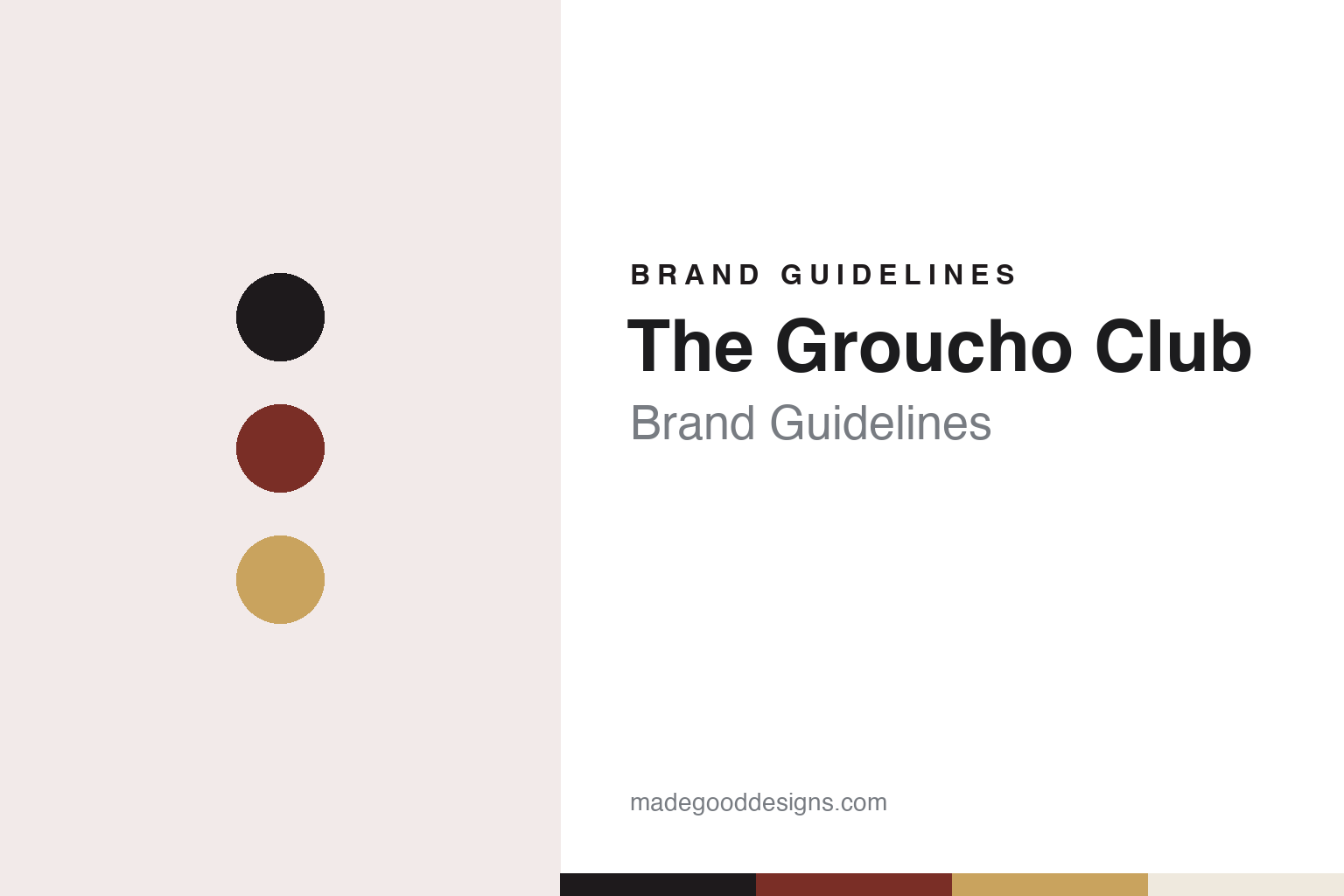
The Groucho Club Brand Guidelines
The Soho club publishers started in 1985.
Aa
Two constants: a night, oxblood and brass palette and a bookish display serif register. Abstract homage — not a Groucho Club asset; no logo, sign or artwork is reproduced.
A club for publishers
An answer to the gentlemen’s clubs of St James’s.
The Groucho Club opened in Soho on 5 May 1985, in a building on Dean Street. It was dreamt up by a group of London publishers and literary agents who wanted somewhere to meet and relax that was not one of the older gentlemen’s clubs. The Guardian wrote in March 2024 that it was founded “by a group of publishers and agents including Carmen Callil and Liz Calder”; Art de Vivre names Ed Victor and Michael Sissons alongside them. The club’s own thirtieth-anniversary book, Groucho 30th Anniversary, edited by Alice Patten and published by Preface in June 2015, calls Liz Calder “Groucho’s inventor.”
The publishers took the idea to Tony Mackintosh, who already ran a members’ bar in Covent Garden, The Zanzibar, and Restaurant 192, the publisher’s description of the book says; he and his partners turned the plan into a club. A photograph of the founding committee published by Art Basel also lists Louis Baum, John Armit, Liam Carson, Tchaik Chassay and Matthew Evans. From the start the club admitted women as members, which both ARTnews and The Guardian note set it apart from many London clubs of the period, and its membership was drawn from publishing, the arts, film, music and advertising.
The name is a joke that the club still tells about itself. It refers to the line attributed to Groucho Marx, that he did not want to belong to any club that would have him as a member, ARTnews explained in 2022. The club’s current tour page closes on the same quip, inviting prospective members to “come and see whether he had a point.” That self-mocking tone, set against a room full of serious publishing and art-world business, is the core of how the club speaks.
Colour
Three townhouses, two refits and a wall of art.
The building is not one house but several. Wallpaper* wrote in a travel entry (updated October 2022) that the club “has grown rather haphazardly across three period townhouses,” and described a refurbishment by the architects Michaelis Boyd, working with the club’s creative director Alice Anthony and its director of art Nicky Carter, to give those rooms a single theme and an easier route through the building. Original features were restored, including an antique stained-glass window and the timber panelling of the main staircase and bars. The first-floor Soho Bar was given lacquered walls and timber floors salvaged from the BBC’s former Bush House, and walls elsewhere were lined with linen to soften the acoustics.
A second stage followed with the London practice Transit Studio, led by Ben Masterton-Smith. The Spaces reported in July 2021 and Wallpaper* in July 2022 that the work combined three bedrooms into a large event room named The Carter Room, after Nicky Carter, whom Wallpaper* describes as the club’s director of art for thirty years. The adjoining Gennaro Room was given a bar wrapped in waterjet-cut stainless steel and topped with a blue-purple marble, with arched shelving behind; the furniture designer Matthew Elton made coffee tables that convert into dining tables; and the Mackintosh Room became a more private lounge with sliding, art-lined walls. A new front desk was built with Studio Wilson-Copp. Wallpaper* notes that these upper rooms are brighter and more colourful than the darker, moodier look of the rest of the club.
The walls are as much a part of the identity as the joinery. ARTnews counted a collection of 150 artworks in 2022, by artists including Damien Hirst, Michael Craig-Martin, Tracey Emin, Peter Blake, Yinka Shonibare and Banksy, and Art de Vivre lists works acquired over the years, such as Alessandro Raho’s painting Louise, bought in 2010 and hung in the Gennaro Room, and Johanna Melvin’s Seascape, acquired in 2012. The publisher of the anniversary book says the collection grew largely through donations from members.
Typography
How members’ clubs present themselves.
Private members’ clubs present themselves through a small set of signals. The name often carries the story: The Groucho Club borrows a line attributed to Groucho Marx, ARTnews explained in 2022, while Annabel’s takes its name from Lady Annabel Vane-Tempest-Stewart, The Guardian reported in 2018. Wordmarks, crests and monograms tend to appear quietly, on a website header, an application page or, as Vogue noted at Annabel’s, on china stamped with the club’s crest.
Buildings and interiors do much of the work that advertising does elsewhere. Many London clubs occupy period townhouses, and their refits are credited to named architects and designers in the design press: Wallpaper* has credited Michaelis Boyd and Transit Studio with successive changes at the Groucho Club, and Martin Brudnizki with the rooms Annabel’s moved into at 46 Berkeley Square in 2018. Art collections, murals and wallpaper are often described as part of a club’s character, and this guide names them only where a dated source does.
Printed and practical matter carries the rest of the voice: menus, event brochures, dress codes, signage, membership cards and keys, and the pages that explain how to apply, how to book a tour or how to hire a room. The tone ranges from the dry wit of a Soho club to the formal language of a Mayfair house, and this guide quotes it only from the clubs’ own published pages or from dated reporting.
Owners and groups matter to the identity as well. Clubs are bought, sold and grouped, and they move, close or rename; the Groucho Club passed from private-equity owners to Artfarm in 2022, and Annabel’s is one of The Birley Clubs. The guides in this category state ownership, sites and closures plainly with dates, leave out fees and prices, and never name members or guests.
Aa
A bookish display serif for a club started by publishers. (Specimen set in DM Serif Display, a serif STAND-IN; NOT the Groucho Club logo.)
The Groucho Club
From private equity to an art-world hospitality group.
The club has changed hands several times. Wikipedia records that it was owned by the private equity firm Graphite Capital from 2006 to 2015. In June 2015 a management buyout was announced, backed by Alcuin Capital Partners, Isfield Investments and other individual investors, while Graphite Enterprise Trust kept a holding, Legal Monitor reported on 18 June 2015. In August 2022 the club was bought by Artfarm, the hospitality company of the gallerists Manuela and Iwan Wirth, founders of Hauser & Wirth, ARTnews and Harden’s reported; Harden’s noted that Artfarm began as a museum café at the gallery’s site in Bruton, Somerset, and that the company is run by Ewan Venters. Artfarm’s website now lists the club among its 14 properties, describing it as created “by a group of predominantly women publishers as an antidote to traditional gentlemen’s clubs.”
Membership was put at about 5,000 by ARTnews in 2022 and by The Guardian in 2024; the anniversary book’s publisher gave “four thousand or so” in 2015. Wikipedia says applicants are proposed by two existing members, and the club’s website now sells itself through three doors: an application, a guided tour and private hire. The events page says rooms can be hired by non-members, who are given temporary membership for the occasion, and that events can run until 2am. The tour page describes a programme called Spark for young artists, writers and makers.
The club’s printed and online voice is dry and conversational rather than grand: short sentences, a wink at Groucho Marx, and the art collection used as backdrop rather than as a boast. Its interiors pair period panelling and stained glass with lacquer, brass, linen and, upstairs, polished steel and coloured marble.
For a design guide, The Groucho Club shows how a members’ club can build an identity from a joke, a street and a collection: a name borrowed from a comedian’s line, three Soho townhouses knitted into one, and walls hung with a collection built up over four decades. Compare Soho House, another London members’ club group, and The Hospital Club, another London club for the creative industries. For this guide we use a night tone, an oxblood and a brass with a serif, an unofficial interpretation; no product or logo is reproduced.
Explore & save
Keep The Groucho Club’s identity on hand — save it to a board in the Made Good inspiration library.
The Groucho Club identity set
Pin The Groucho Club night, oxblood and brass palette and the bookish display serif register to your own board.
Source & notes
Frequently Asked Questions
What font can I use to match the The Groucho Club look?
This guide describes The Groucho Club’s type as “A bookish display serif for a club started by publishers”. Its type specimen is set in DM Serif Display from Google Fonts as a stand-in; DM Serif Display is not The Groucho Club’s own lettering.
What colours are in the The Groucho Club palette?
This guide’s The Groucho Club palette is Dean Street night #1E1A1C, Lacquer oxblood #7A2E26, Bar brass #C9A35E, Linen wall #EFE9DE and Bush House oak #6B5440. The tones are the guide’s own unofficial interpretation, not official The Groucho Club hex codes.
When did The Groucho Club open?
The Groucho Club opened on 5 May 1985, in Soho, London.
Who founded The Groucho Club?
The Groucho Club was founded on 5 May 1985 by Publishers and agents incl. Liz Calder, Carmen Callil; Tony Mackintosh.
Who owns The Groucho Club?
The Groucho Club is owned by Graphite Capital 2006–2015; investor buyout 2015; Artfarm from 2022.