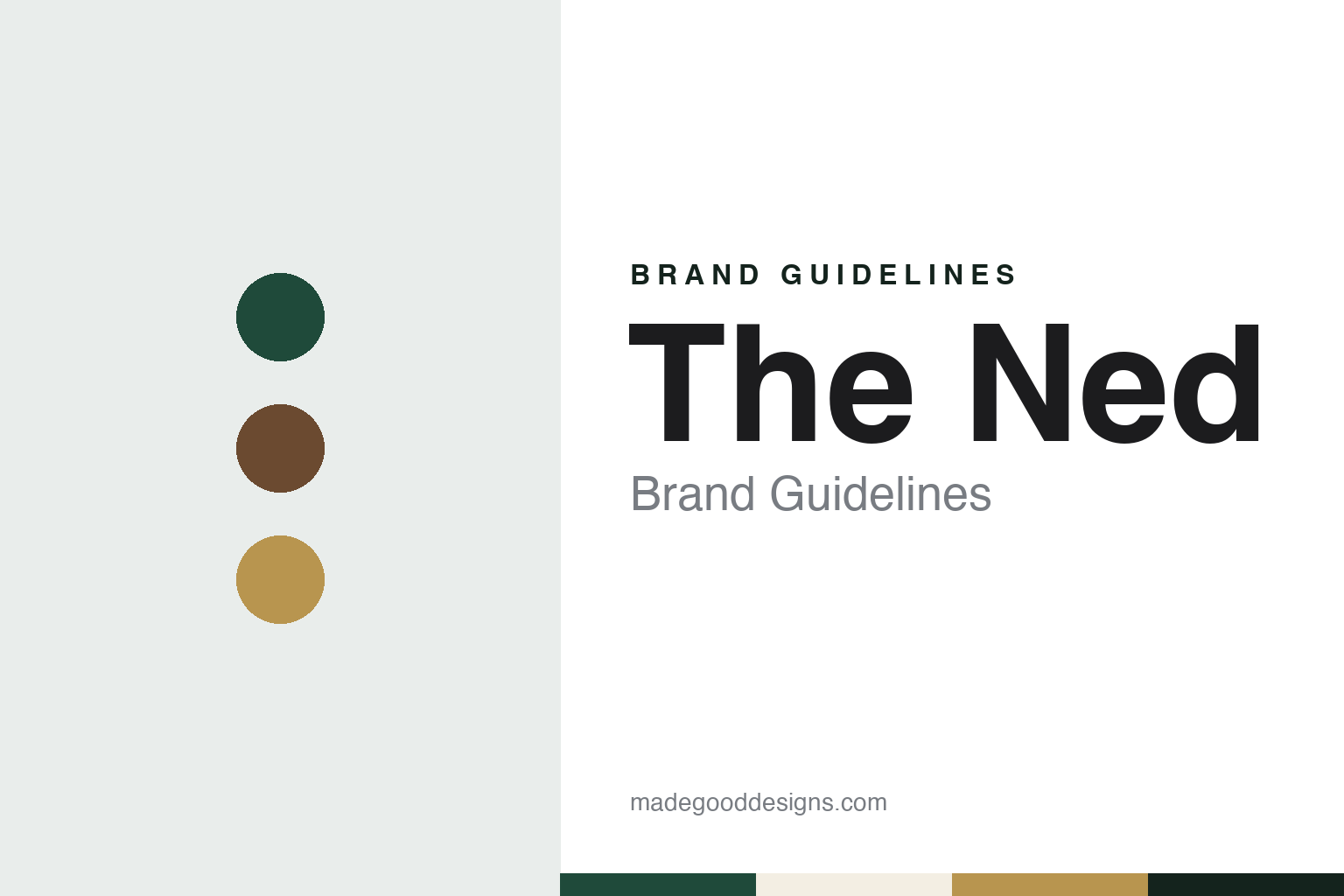
The Ned Brand Guidelines
Lutyens’s Midland Bank, turned into a hotel and members’ club.
Aa
Two constants: a verdite green, walnut and brass palette and a classic serif register. Abstract homage — not a mark of The Ned; no logo, sign or interior is reproduced.
A bank on Poultry
Lutyens’s Midland Bank headquarters, 1924–1937.
The Ned occupies the former headquarters of the Midland Bank on Poultry, in the City of London. English Wikipedia says the bank, which had taken the name Midland Bank in 1923, commissioned the building in 1924, and that it was built between 1924 and 1929 to designs by Sir Edwin Lutyens. Lutyens’s link to the bank ran through its chairman from 1919, Reginald McKenna, for whom he had already designed a London townhouse; Lutyens returned to carry out a major extension between 1935 and 1937. The building is listed at Grade I, and Wikipedia notes that Historic England describes it as one of Lutyens’s “finest urban buildings.”
The Midland was absorbed into HSBC in 1992, and the Poultry building stayed in banking use until 2007, according to Wikipedia; it was later vacated and sold. The hotel takes its name from the architect: “Ned” was Lutyens’s nickname, The Caterer reported in April 2017, and Hot Dinners described the venture in January 2017 as named for Sir Edwin “Ned” Lutyens.
How the bank became a hotel is told in The Caterer’s April 2017 report by Janet Harmer. Nick Jones, who founded Soho House & Co in London in 1995, said he was tipped off about the empty building by the landlord of one of his group’s clubs, and that he was struck by the banking floor and by the roof, with its views over St Paul’s. The opening came five years after that visit. Jones brought in a partner for a project of this size: Sydell Group, the US hotel company founded and run by Andrew Zobler, a lawyer turned hotel developer whose earlier projects included the NoMad in New York. Sydell’s main financial backer, the report said, was the American investor Ron Burkle, who had taken a majority stake in Soho House & Co in 2012.
Colour
A banking hall turned into eight restaurants.
Hot Dinners described The Ned in January 2017 as a joint venture between Soho House and Sydell Group, combining a hotel, public restaurants and a members’ club in more than 320,000 square feet. It opened on 2 May 2017 with 252 bedrooms, nine restaurants, a rooftop and a basement swimming pool, a gym and a spa, according to Hot Dinners and The Caterer. Membership of its club, Hot Dinners noted, was separate from Soho House membership.
The design came from Soho House’s own team. The Caterer credited the in-house designers Adam Geco, Alice Lund and Rebecca King, who took as their reference the faded glamour of a 1930s transatlantic ocean liner, the decade in which Lutyens’s building was completed. Bedrooms were designed to echo the hierarchy of a 1930s bank, from small rooms with floral wallpaper to larger rooms with four-poster beds and enclosed mahogany baths, with the Lutyens Suite on the seventh floor at the top. Hot Dinners summed up the look as “1930s Transatlantic liner meets the Orient Express.”
The ground-floor banking hall is the centre of the plan. The Caterer counted 92 green verdite marble columns and said the tellers’ original walnut-panelled counters had been kept and reused as bar counters and as dividers between restaurants; because the ground floor and the fourth and fifth floors are Grade I listed, little could be altered. Eight restaurants share the hall, among them Cecconi’s, Millie’s Lounge, Cafe Sou, The Grill Room and Zobler’s, a New York-style deli, as Hot Dinners listed them.
The club spaces divide upstairs and downstairs. Ned’s Club took over the old vault in the basement, where more than 3,000 engraved stainless-steel deposit boxes and a vault door two metres wide were kept, The Caterer reported. On the roof, Hot Dinners described the Canopy Bar with a retractable roof and two terraces named for the building’s domes, the Poultry Dome and the Princes Street Dome. Elsewhere it noted a Tapestry Room with a 1920s wraparound tapestry and original walnut panelling, and a saloon lit by a chandelier that once hung in Devonshire House.
Typography
Clubs, houses and the printed word.
Private members’ clubs present themselves through a small set of signals. The name often carries the story: The Groucho Club borrows a line attributed to Groucho Marx, ARTnews explained in 2022, while Annabel’s takes its name from Lady Annabel Vane-Tempest-Stewart, The Guardian reported in 2018. Wordmarks, crests and monograms tend to appear quietly, on a website header, an application page or, as Vogue noted at Annabel’s, on china stamped with the club’s crest.
Buildings and interiors do much of the work that advertising does elsewhere. Many London clubs occupy period townhouses, and their refits are credited to named architects and designers in the design press: Wallpaper* has credited Michaelis Boyd and Transit Studio with successive changes at the Groucho Club, and Martin Brudnizki with the rooms Annabel’s moved into at 46 Berkeley Square in 2018. Art collections, murals and wallpaper are often described as part of a club’s character, and this guide names them only where a dated source does.
Printed and practical matter carries the rest of the voice: menus, event brochures, dress codes, signage, membership cards and keys, and the pages that explain how to apply, how to book a tour or how to hire a room. The tone ranges from the dry wit of a Soho club to the formal language of a Mayfair house, and this guide quotes it only from the clubs’ own published pages or from dated reporting.
Owners and groups matter to the identity as well. Clubs are bought, sold and grouped, and they move, close or rename; the Groucho Club passed from private-equity owners to Artfarm in 2022, and Annabel’s is one of The Birley Clubs. The guides in this category state ownership, sites and closures plainly with dates, leave out fees and prices, and never name members or guests.
Aa
A classic serif for a 1920s bank. (Specimen set in Cormorant Garamond, a serif STAND-IN; NOT the logo of The Ned.)
The Ned
From the City to New York and Doha.
The Ned later became a small group of sites. In November 2021 Hot Dinners reported that The Ned was taking over the NoMad hotel at 1170 Broadway in New York, days after the NoMad had announced its permanent closure, to create The Ned NoMad: 167 bedrooms, a public bar and restaurant, and a Ned’s Club with a rooftop bar, a terrace restaurant and a mezzanine bar, reworked by a Soho House design team. The opening was then set for summer 2022.
A third Ned followed in Qatar. In October 2022 the Gulf Times reported that The Ned Doha was due to open in mid-November in a former government building on the Corniche, designed in the 1960s by the Lebanese architect William Sednaoui, with architecture by David Chipperfield Architects and interiors by Soho House Design. The paper counted 90 bedrooms and 12 suites, seven restaurants, a health club, a spa and a 30-metre outdoor pool across five floors, and described two deliberate echoes of London: a ground-floor atrium with a performance stage at its centre, surrounded by restaurants, and green Tinos marble used throughout the ground floor. Its general manager told the paper that the fourth floor was reserved for members, who could also use the members’ areas in London and New York. The Ned’s website now introduces it as “a hotel and members’ club in London, New York and Doha.”
The group that created it changed form in 2026. Soho House, the company Jones founded, completed its return to private ownership and left the New York Stock Exchange, The Caterer reported on 30 January 2026; the move had been announced in August 2025.
For a design guide, The Ned shows how a hospitality brand can take its name, materials and mood from a single building — an architect’s nickname, a green-marble banking hall, walnut counters and a vault — and carry cues such as green marble to sites in other cities. Compare Soho House, whose in-house team designed it, and EDITION, another hotel brand in this series. For this guide we use a deep verdite green, walnut brown and a brass gold on a cream ground with a serif, an unofficial interpretation; no product or logo is reproduced.
Explore & save
Keep The Ned’s identity on hand — save it to a board in the Made Good inspiration library.
The Ned identity set
Pin the verdite green, walnut and brass palette and the classic serif register to your own board.
Source & notes
Frequently Asked Questions
What font can I use to match the The Ned look?
This guide describes The Ned’s type as “A classic serif for a 1920s bank”. Its type specimen is set in Cormorant Garamond from Google Fonts as a stand-in; Cormorant Garamond is not The Ned’s own lettering.
What colours are in the The Ned palette?
This guide’s The Ned palette is Verdite green #1F4A3A, Walnut #6B4A30, Brass #B8954F, Vault ink #14231D and Ledger cream #F3EEE3. The tones are the guide’s own unofficial interpretation, not official The Ned hex codes.
When did The Ned open?
The Ned opened on 2 May 2017, in Poultry, City of London.
Who founded The Ned?
The Ned was founded by Soho House and Sydell Group (joint venture) on 2 May 2017.