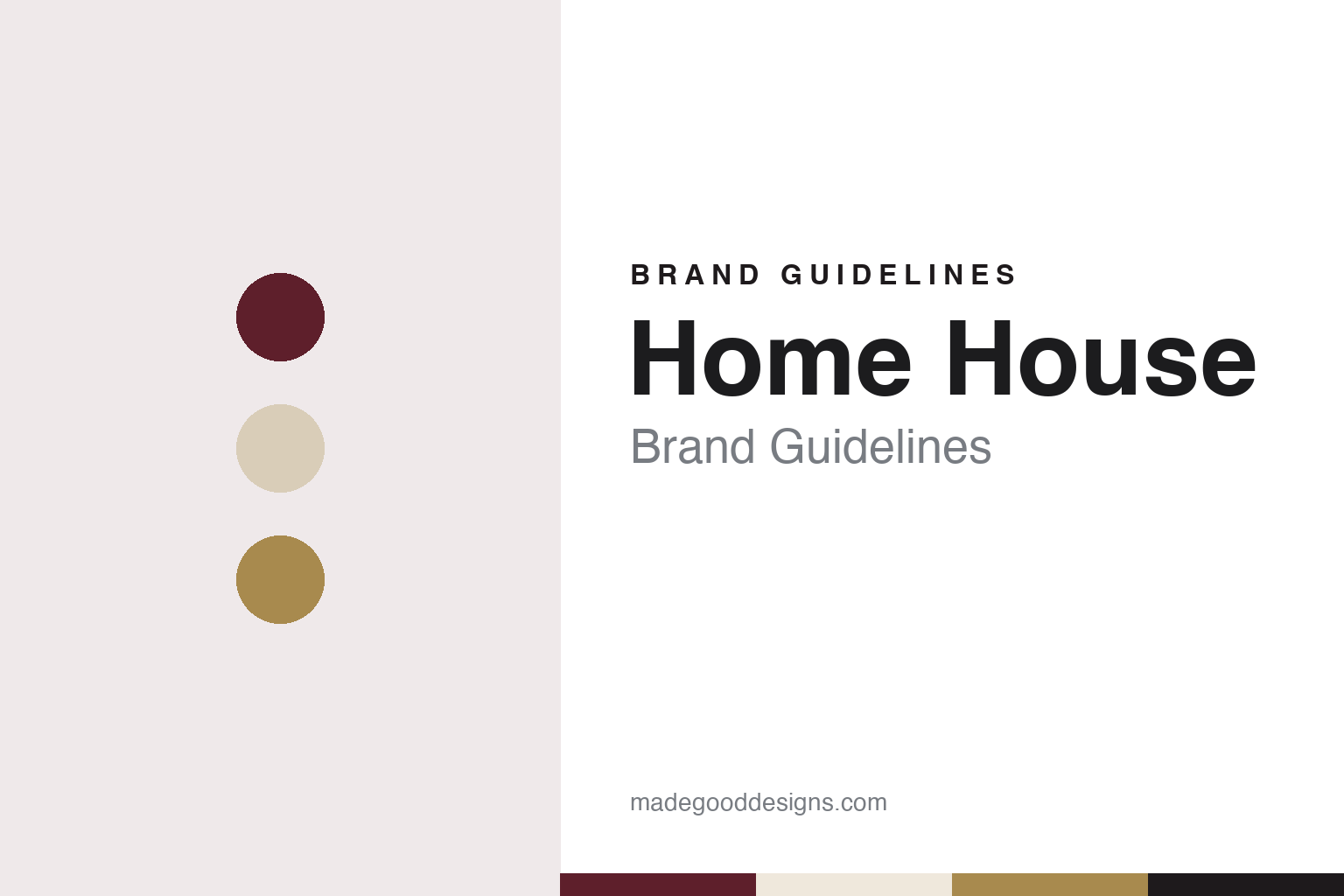
Home House Brand Guidelines
A Robert Adam townhouse, a members’ club since 1998.
Aa
Two constants: a claret, stone and gold palette and a classic serif register. Abstract homage — not a Home House mark; no logo, insignia or interior is reproduced.
Portman Square
A Georgian townhouse by Wyatt and Adam.
Home House is a private members’ club in a Georgian townhouse at 20 Portman Square in Marylebone, London. English Wikipedia says the house was commissioned by Elizabeth, Countess of Home, who in 1776 appointed James Wyatt, architect to George III; by 1777 Wyatt had been dismissed and replaced by Robert Adam, whose design for the main staircase Wikipedia illustrates. The architects Feilden+Mawson date Wyatt’s design to 1775, and Country & Town House dated the commission to 1773 in a 2023 feature, so the sources differ by a few years on the start.
The house passed through a long line of occupants. Wikipedia lists the Marquis de la Luzerne, during his time as French ambassador from 1788 to 1791; the 4th Duke of Atholl; the 4th Duke of Newcastle; Sir Francis Henry Goldsmid; and, from 1919 to 1926, Lord and Lady Islington. In 1926 the industrialist Samuel Courtauld leased it to house his growing art collection, and in the early 1930s he gave the house and the collection to the young Courtauld Institute of Art, which he had helped to found, as temporary premises. No permanent home followed for decades: the Institute stayed until 1989, when it moved to Somerset House. The house had been listed at Grade I in 1954, Wikipedia says.
After the Institute left, the house stood empty. Wikipedia says it remained vacant for seven years until it was acquired by Berkeley Adam Ltd. Feilden+Mawson, the architects who name Berkeley Adam Ltd as their client on the project, say the buildings had been placed on the Buildings at Risk Register after lying unoccupied since the late 1980s.
Colour
A members’ club since 1998.
Home House opened as a members’ club in 1998, according to Wikipedia and to Country & Town House, which marked the club’s 25th anniversary in November 2023. The restoration was led by Feilden+Mawson, which describes two phases on its project page. One restored the fine rooms and fitted a health spa, new bedrooms and commercial kitchens around the historic fabric, with repairs such as dry-rot treatment and re-roofing. The other transformed No. 21 Portman Square, where the architects introduced more contemporary interiors for a gym and spa, reception rooms and suites, meant to sit alongside the club’s Georgian rooms.
The club now spans three interconnected Georgian townhouses, Nos. 19, 20 and 21, with No. 21 added in 2010, Wikipedia says. It lists twenty-three bedrooms, two restaurants, five bars, a cigar lounge, a basement nightclub, a courtyard garden, a gym and a health spa. Wikipedia also records a cocktail bar by Zaha Hadid, which stood in the house until a refurbishment in 2020, citing T Magazine of The New York Times from 2008.
The club uses the house itself as its subject. Country & Town House wrote in 2023 that the Countess of Home had the house built as a palace for entertaining London society in the eighteenth century, and the club’s own story page today says that “since the 18th century, Home House has stood for the idea that a house can be more than four walls.” Its website pairs that history with short, plain-spoken lines, among them “We take fun deadly serious” and “Assume nothing. Stay curious.”, and calls the two buildings it runs its “Homes.” The name itself comes from the Countess, and the website plays on it: “This isn’t just a club. It’s a home.”
Typography
Clubs, houses and the printed word.
Private members’ clubs present themselves through a small set of signals. The name often carries the story: The Groucho Club borrows a line attributed to Groucho Marx, ARTnews explained in 2022, while Annabel’s takes its name from Lady Annabel Vane-Tempest-Stewart, The Guardian reported in 2018. Wordmarks, crests and monograms tend to appear quietly, on a website header, an application page or, as Vogue noted at Annabel’s, on china stamped with the club’s crest.
Buildings and interiors do much of the work that advertising does elsewhere. Many London clubs occupy period townhouses, and their refits are credited to named architects and designers in the design press: Wallpaper* has credited Michaelis Boyd and Transit Studio with successive changes at the Groucho Club, and Martin Brudnizki with the rooms Annabel’s moved into at 46 Berkeley Square in 2018. Art collections, murals and wallpaper are often described as part of a club’s character, and this guide names them only where a dated source does.
Printed and practical matter carries the rest of the voice: menus, event brochures, dress codes, signage, membership cards and keys, and the pages that explain how to apply, how to book a tour or how to hire a room. The tone ranges from the dry wit of a Soho club to the formal language of a Mayfair house, and this guide quotes it only from the clubs’ own published pages or from dated reporting.
Owners and groups matter to the identity as well. Clubs are bought, sold and grouped, and they move, close or rename; the Groucho Club passed from private-equity owners to Artfarm in 2022, and Annabel’s is one of The Birley Clubs. The guides in this category state ownership, sites and closures plainly with dates, leave out fees and prices, and never name members or guests.
Aa
A classic serif for a Georgian house. (Specimen set in Bodoni Moda, a serif STAND-IN; NOT the Home House logo.)
Home House
One house, then two.
The club added a second, business-led address in 2019. Lux magazine reported on 8 April 2019 that Home Grown, a sister club to Home House aimed at entrepreneurs and investors, had opened that month in Marylebone, spread across five Georgian townhouses with 35 bedrooms, a brasserie-style restaurant, a study café and several bars. Lux interviewed Andrew Richardson, then managing director of the Home House Collection, about the opening; he described Home Grown as a hybrid of a members’ club and a business community.
In July 2026 the group renamed it. Tempus reported on 17 July 2026 that Home Grown had been rebranded as Home House Studio, a co-working club with flexible lounges, private phone booths, meeting rooms and 35 bedrooms, set alongside Home House as the address for social and cultural life. The rebrand followed two years of research developed with members, with the strategic insight led by Truth Consulting, Tempus said, and Richardson, by then chief executive, described it as bringing Home House and Home House Studio “together more clearly under one brand.” Member programmes at the studio include business talks and workshops alongside a rotating art programme, the magazine added.
The Home House website now lists the two clubs side by side: Home House on Portman Square and Home House Studio on Great Cumberland Place, which it calls “a co-working club for people who see business their own way.” The house name, once a countess’s title, now covers both buildings.
For a design guide, Home House shows how a club can draw its identity from one listed house — Adam’s rooms, a countess’s name and two centuries of occupants — and then extend that name to a second building. Compare Annabel’s and The Groucho Club, two other London members’ clubs. For this guide we use a deep claret, a Portland stone and a muted gold on ink with a serif, an unofficial interpretation; no product or logo is reproduced.
Explore & save
Keep Home House’s identity on hand — save it to a board in the Made Good inspiration library.
Home House identity set
Pin the claret, stone and gold palette and the classic serif register to your own board.
Source & notes
Frequently Asked Questions
What font can I use to match the Home House look?
This guide describes Home House’s type as “A classic serif for a Georgian house”. Its type specimen is set in Bodoni Moda from Google Fonts as a stand-in; Bodoni Moda is not Home House’s own lettering.
What colours are in the Home House palette?
This guide’s Home House palette is Claret #5E1F2B, Portland stone #D9CDB8, Muted gold #A88A4E, Ink #1E1A1C and Plaster #EFE8DC. The tones are the guide’s own unofficial interpretation, not official Home House hex codes.